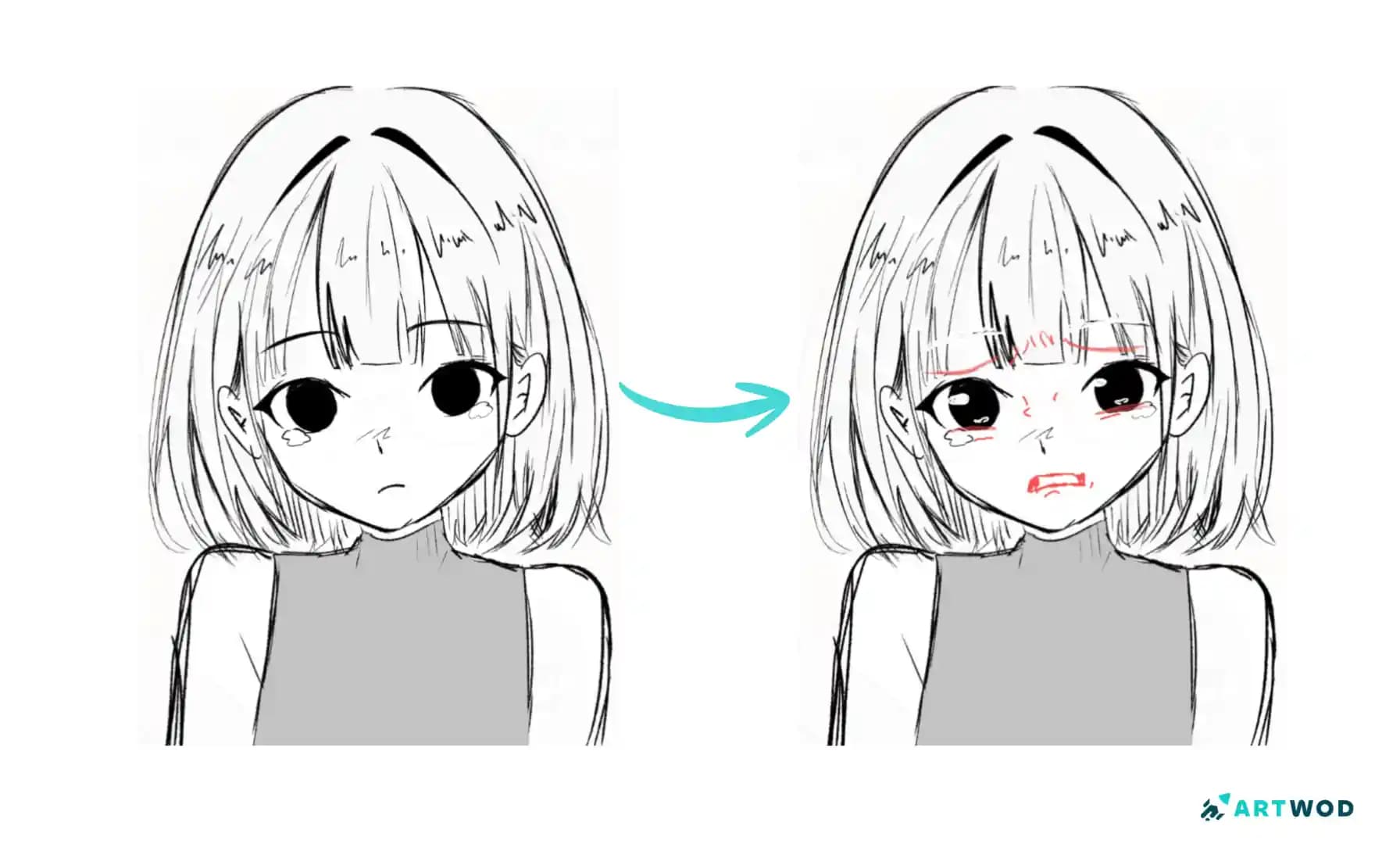
Simple Sad Anime Expression Drawing: Make Emotions Clearer
Simple Sad Anime Expression Drawing: Refine the Eyes and Mouth
Artist @kezia shared a simple anime character sketch on the Artwod Community while practicing a sad expression. The artist felt the emotion looked flat and specifically struggled with getting the eyes and mouth to work together. The feedback offers a useful way to approach sad anime expressions by treating the face as a connected set of shapes rather than changing one feature at a time.
Insights shared in this blog post are by: @gabrielle34427. You can also request feedback on your artwork in Artwod’s Art Community.
The Feedback Request: Why Does the Sad Expression Feel Flat?
In the Artwod submission, @kezia explained:
"I’ve been trying to draw a sad anime character, but the expression still feels flat. The eyes and mouth don’t seem to work together, and I’m not sure what I should change. I think my facial anatomy and shape language need some work. Using Procreate, any idea why?"
That gives us a very specific problem.
The original drawing already has several elements that could support a sad expression: large eyes, small tear-like marks beneath the eyes, and a restrained mouth. But the overall face remains relatively neutral.
The important lesson is that a sad expression is not created by simply adding sad-looking details. The eyes, eyebrows, mouth, and facial shapes need to reinforce the same emotion.
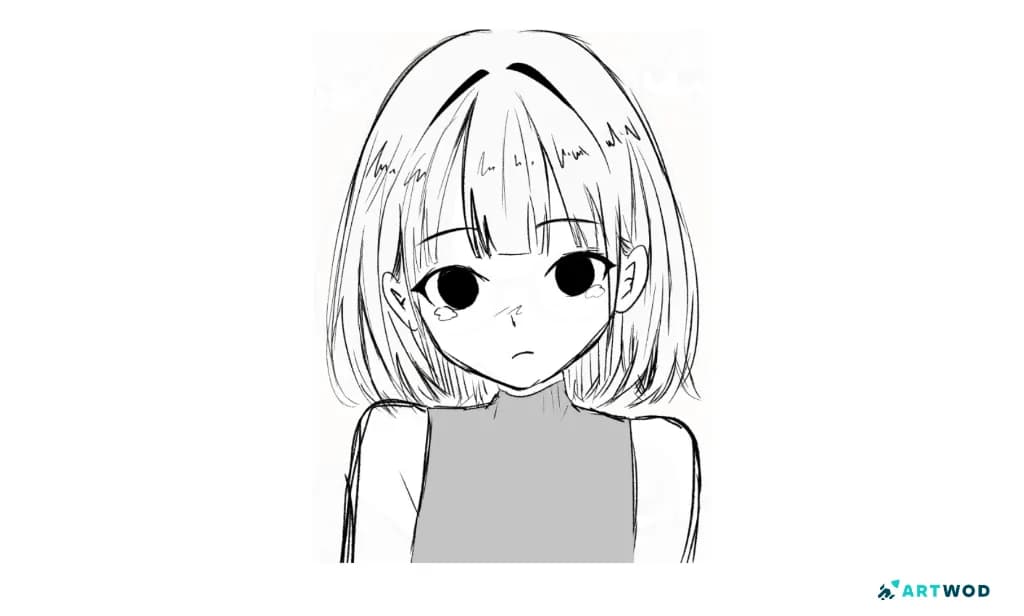
Anime character drawing with large dark eyes, short bobbed hair, straight bangs, and a small neutral mouth
Start With the Relationship Between the Eyes and Mouth
The artist specifically noticed that the eyes and mouth do not seem to work together. That is a good place to start.
Think of the expression as a conversation between the major facial features.
If the eyes look neutral while the mouth looks sad, the viewer receives conflicting information. The same thing happens when the mouth is expressive but the eyebrows and eyes remain rigid.
For a simple sad anime expression, check these features together:
Eyes: Do they feel softer, heavier, or more emotionally affected?
Eyebrows: Are they supporting the sad expression rather than remaining neutral?
Mouth: Does its shape reinforce the emotional direction of the eyes?
Cheeks: Are small marks or changes supporting the expression?
Overall face: Does the combination still feel cohesive?
You do not need to exaggerate every feature. They simply need to point in the same emotional direction.
Use the Eyebrows to Push the Sad Expression
The paintover introduces clearer eyebrow and upper-eye adjustments. This is useful because eyebrows can change the emotional reading of a face without requiring a major change to the underlying anatomy.
For a sad expression, the inner portions of the eyebrows can be raised relative to the outer portions, creating a more emotionally vulnerable shape. For me personally I add a little bit of eyebrow scrunch as well.
Try comparing three versions of the same face:
Neutral eyebrows
Slightly sad eyebrows
Strongly sad eyebrows
Keep everything else identical.
This makes it much easier to see how much emotional information the eyebrows provide.
This Artwork submission, showing a person with a nervous expression shows these concepts. While not the same exact emotion it has what can make a good sad expression. The lines under the mouth that indicate it’s trembling, the diverted eyes could show fear, and linework showing distress.
It also helps with the artist's concern about shape language. Instead of thinking only about anatomical correctness, consider the shape created by the eyebrows and eyes together.
Make the Mouth Support the Eyes
The original mouth is small and relatively neutral. In the paintover, the mouth is changed into a more clearly downturned shape.
That small adjustment gives the lower half of the face more emotional weight.
When drawing a simple sad anime face, the mouth does not need to become dramatically large. A subtle downward curve can be enough if the eyes and eyebrows are already supporting the emotion. I will add that adding wrinkles can really aid in making a sad mouth. This is because when we express emotion, our faces squash and stretch with our features resulting in wrinkles. It’s important to do it in moderation when it comes to more anime styles, but don’t be afraid to add a few if that’s what you’re going for.
A useful practice is to draw the same eyes with several different mouth shapes:
neutral
slightly downturned
strongly downturned
small open mouth
Then compare how the emotional reading changes.
This helps you learn to control expression rather than relying on a single default mouth shape.
Think About Shape Language, Not Just Anatomy
@kezia also mentioned that the facial anatomy and shape language need work.
Those two concerns are related, but they are not identical.
Anatomy asks whether the facial features are structurally positioned and proportioned well. Shape language asks what visual feeling those shapes communicate.
A face can be anatomically coherent while still feeling emotionally flat.
For this drawing, consider the shapes created by:
the eyebrows
the eye openings
the pupils and highlights
the mouth
the cheeks
the jawline
If those shapes are mostly rigid or neutral, the expression can feel restrained even when the proportions are reasonable.
The goal is not to distort the face randomly. It is to make small, intentional shape changes that support sadness.
Use Eye Highlights Carefully
The paintover also introduces brighter highlights into the dark eyes.
This is a small change, but it helps the eyes feel more alive and expressive. Since the original eyes are very dark and prominent, even a small highlight can change how they read.
When drawing expressive anime eyes, try not to add highlights simply because they are aesthetically pleasing.
Ask what the highlight is doing for the character. Anime uses highlights to convey things about a character, consider this when you’re adding them to your design.
A carefully placed highlight can make the eyes feel more present and emotionally engaged. Combined with the revised eye and eyebrow shapes, it can make the expression feel less blank.
Do Not Let Tears Do All the Work
The original drawing already includes small tear-like shapes beneath the eyes.
That is a good reminder that tears alone do not automatically make a character look sad. Without other indicators, a character can read more as shell-shocked or dead inside. Depending on what you’re trying to say about your character, and how they feel it’s important to consider how the emotions read when all together.
If the eyes, eyebrows, and mouth remain neutral, adding more tears can actually make the expression feel like a collection of symbols rather than a convincing emotion.
A better workflow is:
Draw the face without tears.
Make the eyes and eyebrows communicate sadness.
Adjust the mouth to support them.
Check the overall expression.
Add tears or small cheek details afterward.
That way, the tears reinforce an expression that is already working.
Don’t feel too alone in your struggle. This user also was also struggling with sad expressions, this feedback submission featuring an anime portrait of a girl bawling mentioned in the description:
“I'm trying to quick sketch an anime girl with a crying face and show that she's extremely sad but now she just looks weird with water drops on her face.”
This submission supports that tears don’t equal an expression of looking sad. The eyes, mouth, must match the level of despair to make the reaction feel human.
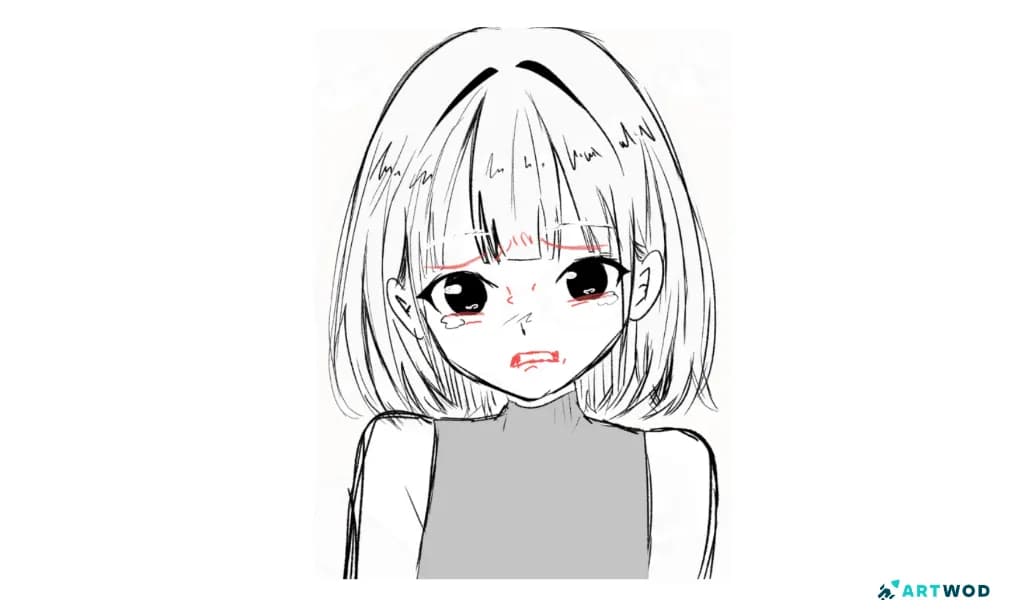
Sad anime expression paintover showing revised eyebrow and eye shapes, brighter eye highlights, and a more expressive mouth
A Simple Practice Exercise for Sad Anime Expressions
Try drawing the same character four times.
Version 1: Neutral
Keep the eyes, eyebrows, and mouth relaxed.
Version 2: Slightly sad
Change only the eyebrows and mouth.
Version 3: Clearly sad
Push the eye shape and eyebrow angle further.
Version 4: Refined sad expression
Keep the strongest changes and add small details such as eye highlights or tear marks.
Place the four versions side by side.
Then ask:
Which version reads as sad immediately?
Which feature changed the emotion the most?
Are the eyes and mouth telling the same story?
Does the expression still work without the tear marks?
This is a simple exercise, but it can teach you much more about expression than repeatedly redrawing the same face.
Common Mistakes When Drawing Sad Anime Expressions
A few habits can make a sad anime face feel flat:
Adding tears without changing the underlying expression
Keeping the eyebrows too neutral
Using a neutral mouth with emotionally expressive eyes
Making one feature exaggerated while the rest of the face stays rigid
Adding details before checking facial proportions
Focusing only on anatomy and forgetting shape language
If the expression feels wrong, step back and simplify it. Check the eyes, eyebrows, and mouth before adding anything else.
What Other Artists Can Learn From This Drawing
Expressions work as a system. The eyes and mouth should reinforce one another.
Eyebrows carry a lot of emotion. Small changes in their angle can noticeably alter the mood.
Shape language affects emotional clarity. The shapes created by the features matter as much as their individual placement.
Tears are supporting details. They work best after the underlying expression already reads as sad.
Simple expressions can still be strong. You do not need an exaggerated face to communicate sadness clearly.
These ideas can also be applied to other anime expressions, including happiness, surprise, embarrassment, and fear.
How Community Feedback Can Help With Expression Drawing
Expression problems are often difficult to diagnose when you are looking at your own drawing. You can recognize that something feels "flat" without immediately knowing whether the problem is the eyes, mouth, eyebrows, anatomy, or shape language.
That is why @kezia's feedback request is useful: the artist clearly identifies the intended emotion and the specific features that feel disconnected.
When sharing an anime expression for feedback, explaining both what emotion you want and what currently feels wrong gives fellow artists a much clearer problem to respond to.
Instead of simply asking whether the drawing looks good, you can ask whether it actually reads as sad and whether the eyes and mouth are working together.
That kind of focused feedback can make the next drawing much easier to improve. The Artwod Comminity allows artists to get feedback from other artists. The anime categories are a good place to start!
FAQs
Start by making the eyebrows, eyes, and mouth support the same emotion. Establish the expression first, then add details such as tears or eye highlights.
Why does my sad anime face look flat?The facial features may be communicating different things. Check whether the eyes, eyebrows, and mouth are all reinforcing sadness rather than leaving one or more features neutral.
How do you draw sad anime eyes?Use the eye shape, eyebrow position, pupil placement, and highlights together. Slightly softer or heavier eye shapes combined with emotionally supportive eyebrows can make sadness clearer.
How do you make an anime mouth look sad?A subtle downward curve can communicate sadness without requiring an exaggerated mouth. Make sure the mouth works with the eyes and eyebrows rather than treating it as an isolated feature.
What is shape language in anime drawing?Shape language refers to the visual feeling created by the shapes used throughout a character. The curves, angles, proportions, and repeated forms can influence how an expression feels.
Should I add tears when drawing a sad anime face?Tears are best treated as supporting details. First make the eyes, eyebrows, and mouth communicate sadness, then use tears to reinforce the emotion.
@kezia's sketch highlights an important lesson for anyone learning expressive anime drawing: a sad expression is not just a sad mouth or a pair of tears. The eyes, eyebrows, mouth, proportions, and shape language need to work together.
If your own sad anime expression feels flat, try simplifying the problem. Start with the major facial shapes, make the eyes and mouth agree emotionally, and only then add smaller details such as highlights or tears.
And if you are unsure which part is holding the expression back, sharing the sketch and explaining the emotion you are trying to communicate can make peer feedback much more specific and useful.