Anime Boy Nose Drawing: Simplify an Anime Boy Nose Without Losing Structure
Anime Nose Drawing: Simplify Structure Without Losing Form
Artist @patinooodst shared an anime boy portrait on the Artwod Community. He was trying to solve a common problem: how to draw a nose that has enough structure to read clearly without suddenly making the character look too realistic.
Insights shared in this blog post are by: @gabrielle34427. You can also request feedback on your artwork in Artwod’s Art Community.
The Feedback Request: Too Much Detail or Not Enough?
In the Artwod submission, @patinooodst explained:
“Trying to sketch an anime boy portrait and i cant figure out the nose. If i add too much it looks realistic, but if i barely add anything it just disappears. My proportions and structure probably need work. using ink here, what would you change?”
That describes a particularly common difficulty with anime facial features.
The nose sits in an awkward middle ground. Unlike the eyes or mouth, it often does not need a complete outline in a stylized anime drawing. But removing too much information can make the nose lose its position entirely.
The goal is not necessarily to draw more nose anatomy. It is to choose the smallest amount of information that communicates the form.
Why Anime Noses Can Be Difficult to Draw
A realistic nose contains many visible planes and transitions. An anime nose often represents those same forms with only a few marks.
That means every line carries more responsibility.
A small change in the position, angle, or length of a nose line can affect:
The apparent direction of the face
The character's age or stylization
The distance between the eyes and mouth
The perceived depth of the head
How realistic or simplified the portrait feels
This is why adding more lines does not automatically solve the problem.
For @patinooodst's drawing, the useful direction is to simplify the nose while making its placement and orientation clearer.
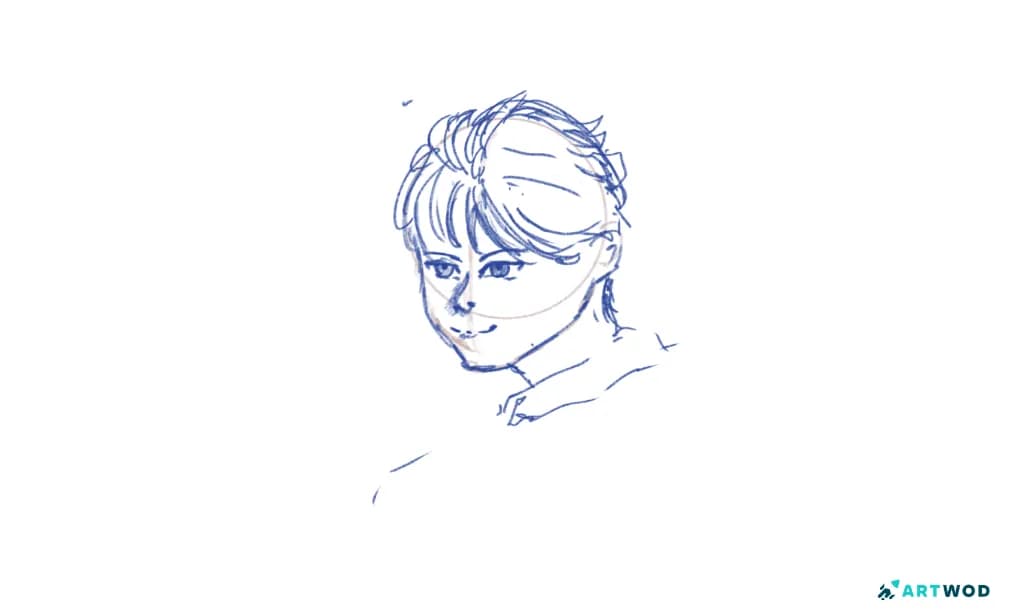
Ink sketch of an anime boy portrait with swept hair, large eyes, a defined nose, and a three-quarter head angle
Think About the Nose as a Small Form
Before drawing the visible lines, imagine the nose as a simple three-dimensional wedge projecting from the face.
You do not need to draw that wedge in the finished artwork.
It is a construction idea that helps answer three questions:
Which direction is the face pointing?
Where does the nose project from the face?
Where would the underside of the nose turn away from the viewer?
Once those relationships are established, you can reduce the construction into just a few stylized marks.
This is especially useful in a three-quarter portrait like the one in the submission.
Artwod submission “trying to draw an anime boy torso step by step” has a great example of a nose in 3D space, even with simple lines. The nose follows the center of the face and a line follows where the nose bridge would lead up to the eyebrows. The facial features all work together, the eyes following the perspective of the turn.
Use Fewer Lines, But Make Them Intentional
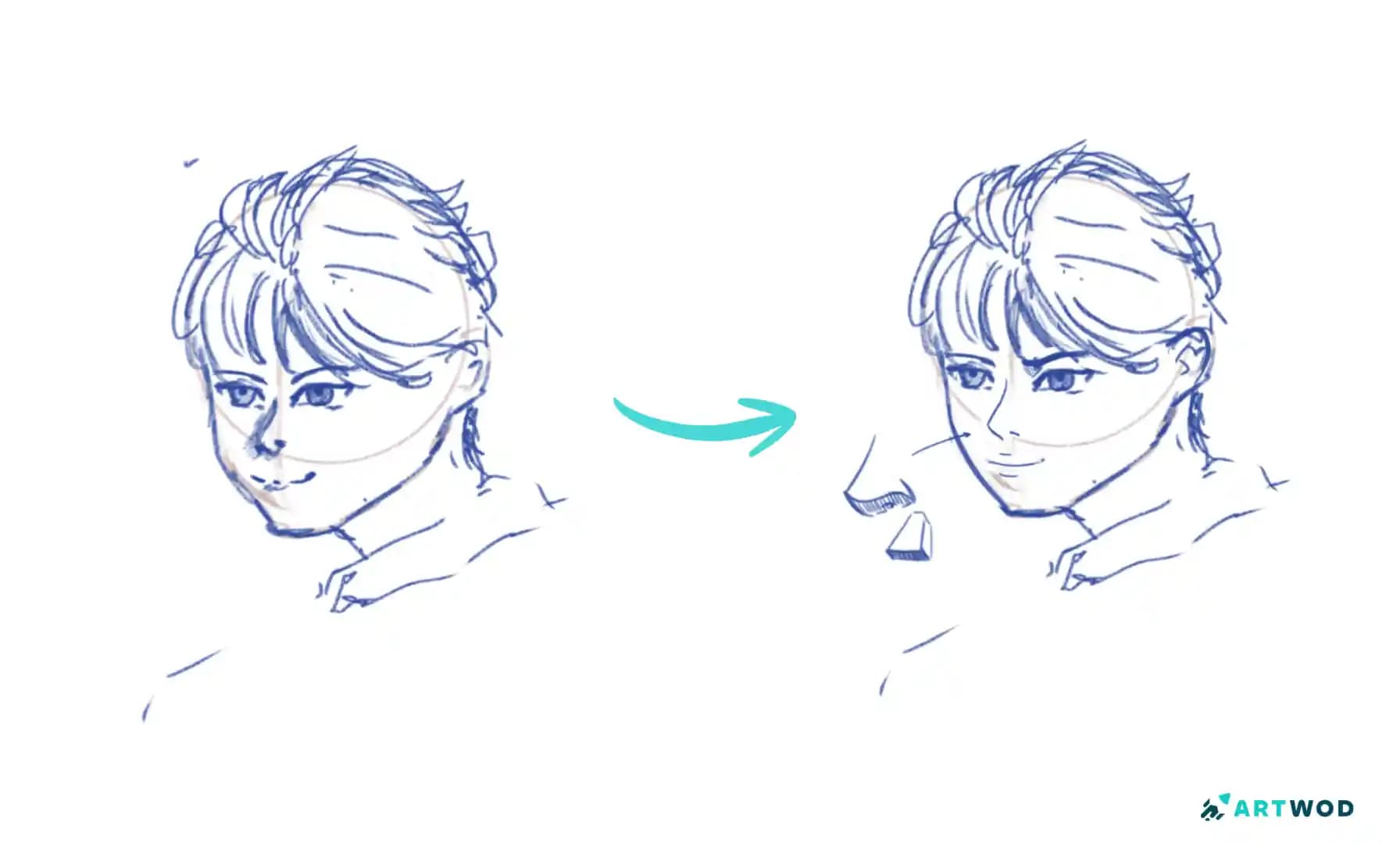
The paintover provides a useful visual example of this principle. Instead of outlining the entire nose, the feedback introduces a more economical arrangement of marks around the nose and its underside.
A simplified anime nose does not have to be completely flat. It can communicate projection, direction, and form with only a small indication of the bridge and underside.
When working with ink, this becomes even more important because every mark is permanent.
Rather than asking, “What details does a nose have?”, ask:
“Which marks are necessary for this particular angle?”
That question naturally leads to cleaner anime nose drawings. When it comes to finding references I look towards anime artists who have more semi realistic styles, such as Sataski Kon (creator of Perfect Blue, and Paprika) or Hajime Isayama (Creator of Attack on Titan). Noses are often very simplified in anime, however there are plenty of good resources out there for us to reference from.
This Artwod user also struggled with the structure of the nose and shows how you can handle simplifying the shape. The paintover shows how to use rectangles to make planes, creating simple lines over this structure to describe the form will allow structure with simplification.
Start With the Facial Structure
The nose will be much easier to place if the head structure is working first.
For an anime portrait, establish:
The centerline of the face
The eye line
The overall head shape
The jaw direction
The position of the mouth
The nose position between the eyes and mouth
In the submitted portrait, the head is turned rather than completely front-facing. That means the nose should follow the same perspective as the rest of the face. Some proportional things to keep in mind: the bottom nose tends to end around the tear ducts. They fall about a third of the way down the face.
If the facial construction is slightly off, changing the nose alone may not solve the problem.
This is why @patinooodst also mentioned that the proportions and structure might need work.
Within this Artwod submission, featuring a woman in an action pose, shows how facial structural issues can lead to a lack of depth. The user states:
“I'm struggling with perspective, form&depth, anatomy, line quality”
In the paintover we can see how the nose looks more connected to the face when the structure is adjusted by moving up the eyes, attaching the nose bridge to the eyebrows, and correcting the perspective of the eyes.
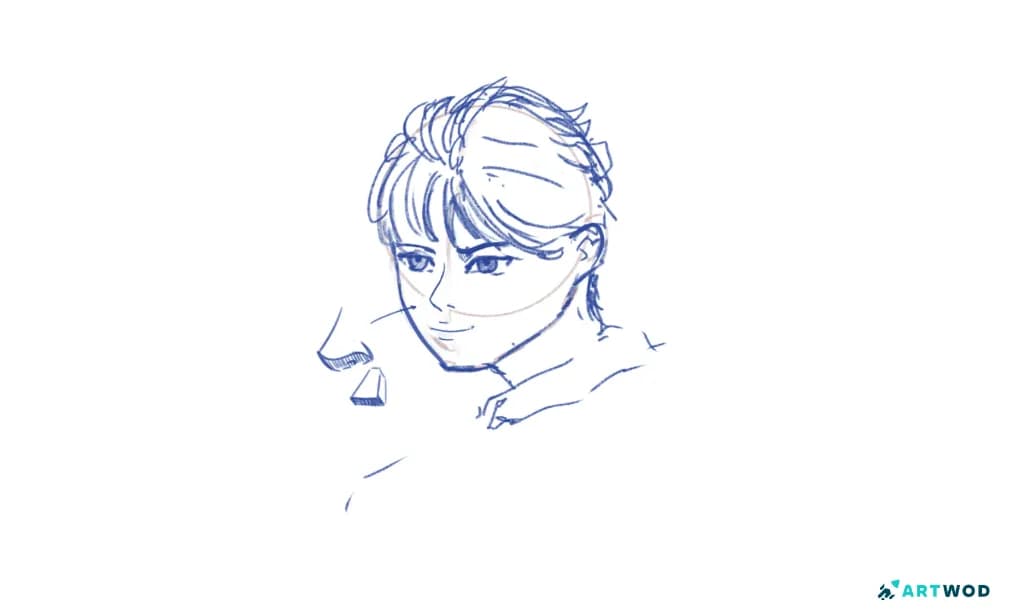
Anime boy nose paintover showing simplified nose lines, facial structure, and directional feedback for a cleaner anime style
A Simple Anime Nose Drawing Process
Try this construction exercise before committing to the final ink lines.
1. Draw the head and centerlineEstablish the overall head shape and indicate the direction the face is pointing.
2. Place the nose as a simple wedgeImagine a small form projecting outward from the face rather than immediately drawing a nose symbol.
3. Mark the tip and undersideDecide where the nose turns downward and where its underside would be visible from the chosen angle.
4. Reduce the constructionRemove everything that is unnecessary for the finished style.
You may only need a short bridge indication, a small tip or underside mark, and perhaps a subtle nostril indication.
5. Check it with the other featuresLook at the nose together with the eyes, cheeks, mouth, and jaw. It should feel like part of the same head rather than a separate symbol placed on the face.
How to Avoid Making an Anime Nose Look Too Realistic
If your anime nose suddenly looks realistic when you add detail, you may be describing too many anatomical transitions.
Try removing lines rather than making them lighter or smaller.
You can also reserve stronger marks for the parts that actually help explain the form. The rest can be suggested through placement, spacing, or surrounding facial shapes.
Stylization is not about ignoring structure. It is about compressing structure into fewer visual cues.
That is the key distinction.
How to Stop the Nose From Disappearing
The opposite problem is using so little information that the nose loses its position.
If this happens, check three things:
Is the nose positioned correctly relative to the eyes?
Does its angle agree with the head's perspective?
Is there enough indication of the tip or underside?
You can often make the nose clearer without adding a complete outline.
A single well-positioned mark can communicate more than several misplaced ones.
Practice With Three Nose Styles
A useful exercise is to draw the same anime head three times.
Version one: Use a very minimal nose with only a couple of marks.
Version two: Add slightly more information around the tip and underside.
Version three: Push the structure further and allow more anatomical information.
Then compare them.
The goal is not to decide that one style is universally correct. Instead, you are learning how much information your particular character design needs.
This is especially useful when working with ink because you can deliberately practice restraint.
Common Anime Nose Drawing Mistakes
Watch for these problems when practicing:
Drawing the nose as a complete realistic outline
Adding nostrils before establishing the nose's direction
Using too many anatomical lines
Making the nose too small to relate to the rest of the face
Ignoring the three-quarter perspective
Changing the nose without checking the underlying head construction
Using the same nose symbol regardless of head angle
If the nose looks wrong, first check the head structure and perspective. The nose is part of the face's overall construction, not an isolated feature.
What Other Artists Can Learn From This Drawing
Simplification still needs structure. A stylized nose can be minimal while still communicating three-dimensional form.
Perspective determines the marks you need. A three-quarter face does not require the same nose treatment as a front-facing portrait.
Ink rewards restraint. Fewer intentional lines can produce a cleaner result than excessive detail.
Facial proportions matter. A nose cannot be evaluated independently from the eyes, mouth, jaw, and head shape.
Stylization is selective. Anime drawing simplifies realistic anatomy rather than eliminating the underlying structure.
How Community Feedback Can Help With Anime Portraits
Small facial features can be difficult to diagnose on your own because the problem may not actually be the feature itself.
For example, @patinooodst identified the nose as the main difficulty but also suspected that proportions and structure needed work. Looking at the portrait as a whole helps reveal why those concerns are connected.
When asking for feedback on an anime portrait, it can help to identify the specific feature that feels wrong while also explaining what you are trying to achieve stylistically.
That gives other artists a clearer idea of whether to focus on anatomy, construction, proportions, line economy, or stylization.
FAQs
Start with the facial construction and treat the nose as a small three-dimensional form. Then simplify it into only the lines needed to communicate its position, direction, and underside.
Why does my anime nose look too realistic?You may be including too many anatomical transitions or outlining the nose completely. Try reducing the number of visible lines while keeping the key structural marks.
Why does my anime nose disappear when I simplify it?The nose may have been simplified beyond the point where its position or direction is readable. Add a small indication of the tip, underside, or bridge rather than drawing the entire nose.
How many lines should an anime nose have?There is no fixed number. Depending on the character and viewing angle, an anime nose may be represented by only a few marks.
How do you draw an anime nose from a three-quarter view?First establish the head's centerline and direction. Then place the nose as a projecting form and simplify the visible tip and underside according to the angle.
Should anime noses have nostrils?They can, but they do not always need them. If the nostrils make the character look too realistic, a simpler indication of the underside may work better.
@patinooodst's portrait highlights a useful lesson in anime facial drawing: simplifying a feature does not mean removing its structure.
If your anime nose looks too realistic when you add detail, reduce the number of lines. If it disappears when you simplify it, make the remaining marks more intentional. Start with the head's structure, understand the nose as a small three-dimensional form, and then choose the minimum visual information needed for the style.
With ink especially, learning where not to draw can be just as important as learning where to draw. The Artwod community is a tool that allows artists to share artwork, get feedback and helps you learn. If you want to get feedback of your own, post your art in the anime category.