Beginner Guide to Environment Drawing Fundamentals
Environment Drawing for Beginners: What to Learn First
If you’re a beginner, staring at a blank canvas trying to draw a whole environment is terrifying. Unlike drawing a character, where you have one clear subject, an environment has everything -
ground planes, trees, sky, buildings, and complex perspective. It is incredibly easy to get lost in the weeds (pun intended).But you don’t need to learn everything at once. By breaking down the fundamentals step-by-step, you can map out a clear artist improvement journey and start constructing believable worlds.
Why Beginners Struggle with Environments
Most beginners fail at environments for one simple reason: they try to draw the "stuff" instead of the space.
When you look at a landscape, your brain sees "trees, a cabin, and mountains." Naturally, you start drawing a tree, then you draw a cabin, and then you try to slap them together. Because you didn't establish the three-dimensional space first
, the ground looks flat, the cabin looks crooked, and the tree looks like it’s floating.To succeed, you have to stop drawing objects and start drawing volumes sitting in a defined space.
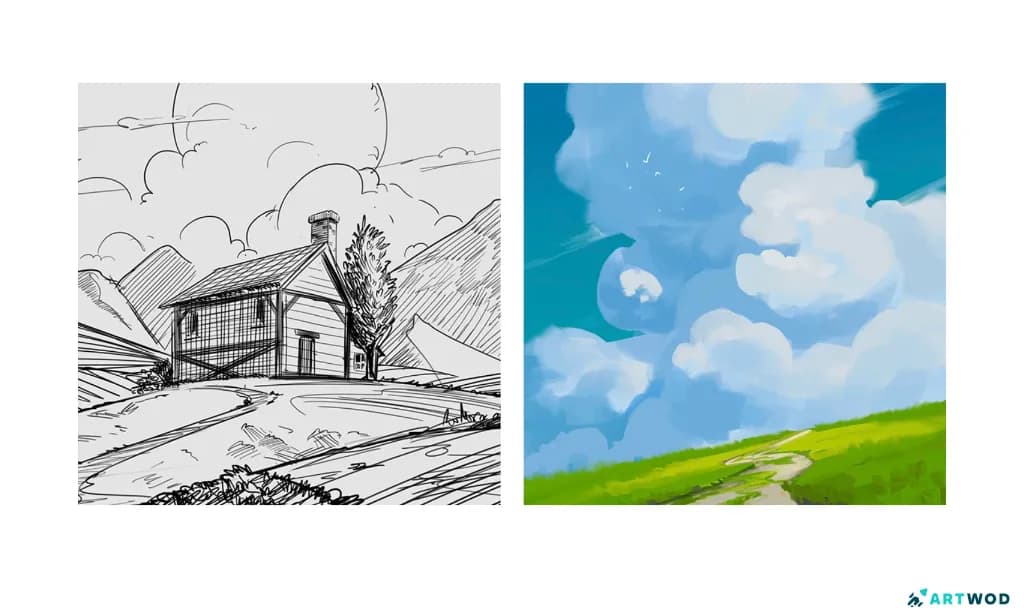
1 environment drawing and 1 environment painting. A drawing of a house on top of the hills with a road leading to it made with black pen (2d digital art). a painting of a road leading to a skyline with a massive cloud (2d digital painting).
The Best Order to Learn Environment Art
Learn how to set up a 3D grid. If you can't place a simple box in a 3D space, you cannot place a building, a rock, or a vehicle there either.
Learn how to use light, dark, and mid-tones to separate your scene into clear depth planes (foreground, midground, and background). Try doing some plein airs and you will see yourself getting into this quickly. You can find how to start plein-airing right here.
Learn how to arrange the elements in your scene to guide the viewer’s eye exactly where you want them to look.
Once the structure is locked in, use light, shadow, and details to set the mood and tell a story.
Perspective Basics for Scenes
The Horizon Line (Eye Level):
Vanishing Points: Points on the horizon line where parallel lines appear to meet in the distance.
1-Point Perspective: Used when you are looking directly flat at a wall or down a straight road.
2-Point Perspective: Used when you are looking at the corner of a building, where the sides recede to two different points on the left and right.
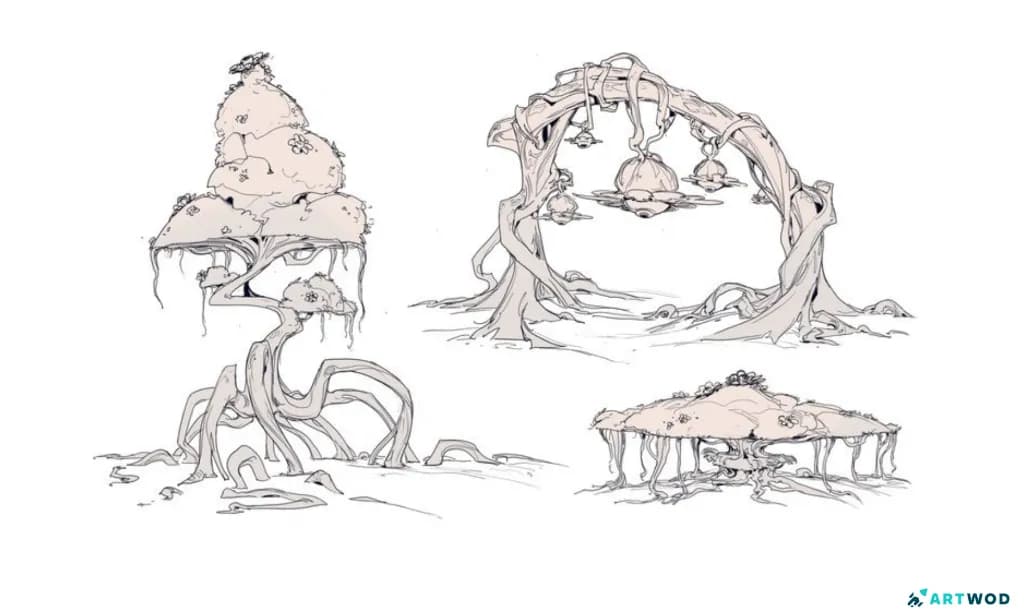
Environment asset designs. 3 whimsical trees. 2d digital art
Understanding Composition and Focal Points
Composition is how you arrange your visual elements. Without good composition, your scene will feel chaotic.
Your number one goal in composition is to create a focal point
—the main area of interest that the viewer's eye lands on first. You can guide the viewer to your focal point using:Leading Lines: Using roads, rivers, fallen trees, or rooftops to point directly toward your subject.
Framing: Placing dark trees, cave openings, or doorways in the foreground to "frame" a lighter, more detailed background.
Contrast: Placing your highest area of dark-against-light contrast right at your focal point.
Simple Environment Construction Methods
Instead of drawing complex details, build your environments using primitive shapes
.Think of a house as a box with a triangular prism on top. Think of a tree trunk as a cylinder, and the leaves as a massive sphere. By blocking out your scene with these simple shapes first, you ensure that the perspective and scale are 100% correct before you waste hours on details.
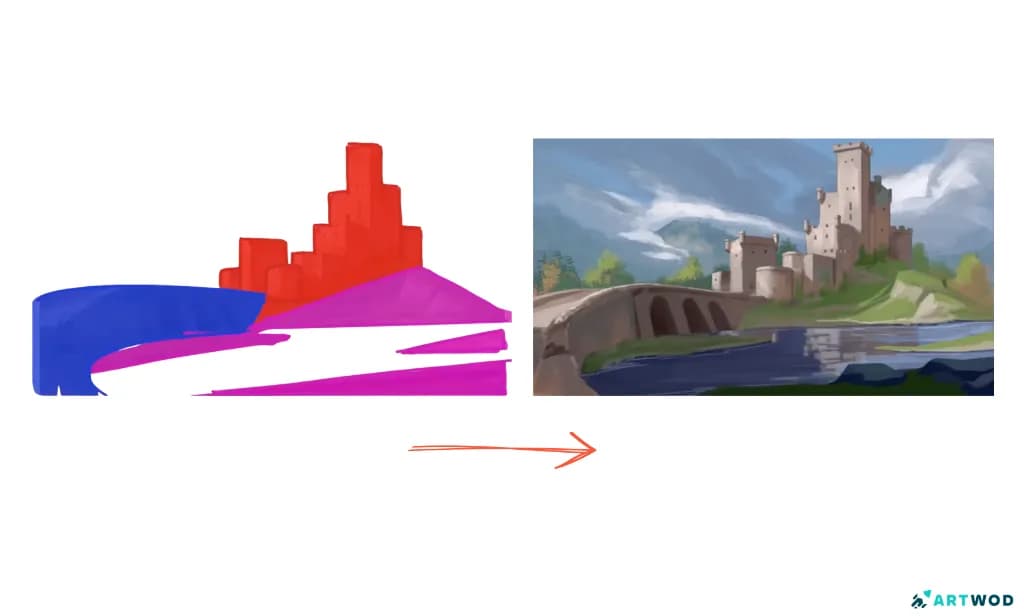
primitive shape design and final castle and bridge painting by Fosco (digital 2d painting)
Lighting Fundamentals for Environments
Lighting is what gives your 3D forms their volume. In an environment, you must always establish:
The Light Source:
Cast Shadows: The shadows thrown onto the ground by your objects. These must follow the perspective of the ground plane.
Atmospheric Perspective: The air itself has volume. As objects get further away from the camera, they lose contrast and shift toward the color of the atmosphere (usually light blue/grey). This is the secret key to creating massive scale.
Common Beginner Environment Mistakes
The "Flat Ground" Trap:
Detailing Too Early: Painting individual leaves and grass blades before the perspective grids and major values are locked in.
No Value Structure: Making the background just as dark and high-contrast as the foreground, which completely destroys the illusion of depth.
Value Studies and Depth Exercises
To master depth, practice Value Studies
.Draw a few small rectangle boxes (thumbnails). Using only three values—Dark Gray (Foreground), Medium Gray (Midground), and Light Gray (Background)—try to design a landscape. Restricting yourself to just three values forces you to rely entirely on strong shapes and atmospheric depth rather than hiding mistakes behind color and detail.
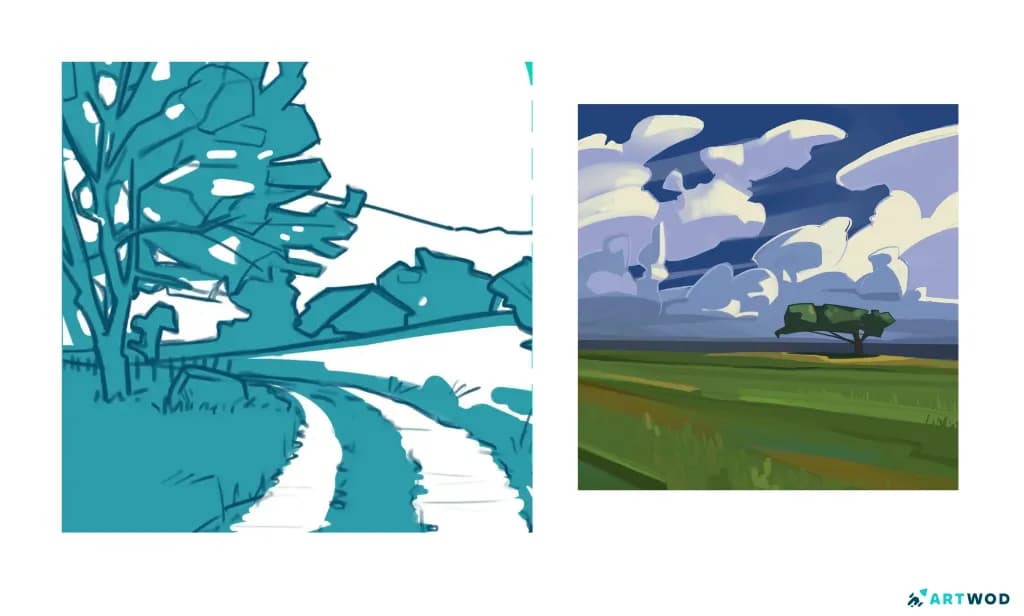
2 digital paintings, 1 simple value study (2 values) of a road, sky and trees. Second is a digital painting of a tree in the fields, clouds on the background by Dasha Martyshchuk
Scene Storytelling Fundamentals
Who lives here?
What is the weather? (Are the trees bending from strong winds, or is the water perfectly still?)
What happened right before this moment? (Is there a campfire still smoking, or a door left wide open?)
Small storytelling details turn a boring perspective exercise into a living, breathing world.
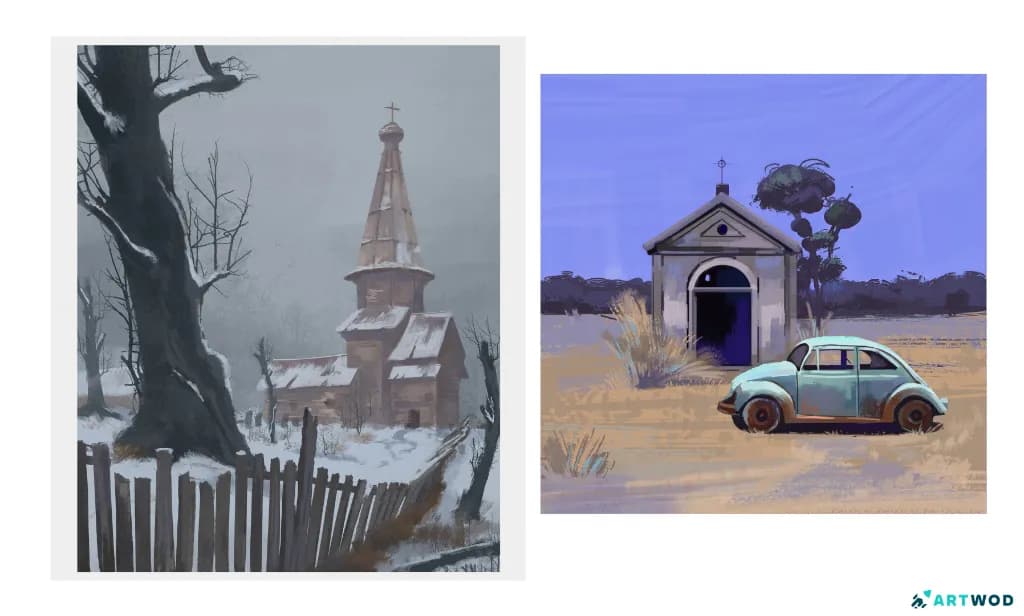
2 digital paintings by Fosco: 1. a wintery scene of a wooden church and a dead tree behind the fence, 2. a colorful car, behind which there's a crypt, trees on the background. Digital 2d painting
Related Posts