Anime Knee Drawing: Define Knee Anatomy With Simple Forms
Anime Knee Drawing: Improve Knee Anatomy and Definition
Artist @gabrielle34427 shared a pen drawing on the Artwod Feedback Tool because the knees did not feel convincing. The artist specifically wanted more definition and asked for step-by-step guidance on how to fix them. The crossed-leg pose makes this a good example of how simple knee construction can clarify an anime figure without adding unnecessary anatomical detail.
Insights shared in this blog post are by: @gabrielle34427. An you youself can request feedback on your artwork in Artwod’s Art Community.
The Feedback Request: How Do You Define Anime Knees?
In the Artwod submission, @gabrielle34427 explained:
“The knee anatomy does not look right here, and needs more definition I think. Does anyone have any step-by-step directions to fix the knee? This drawing was created with pen, would like some help thanks!”
The drawing shows a stylized anime character seated with the legs crossed. The knees are especially important because the pose creates strong bends between the thighs and lower legs.
The main challenge is not simply adding more lines around the knee.
It is understanding how the thigh, kneecap, and lower leg connect and then choosing how much of that structure should actually appear in the finished anime drawing.
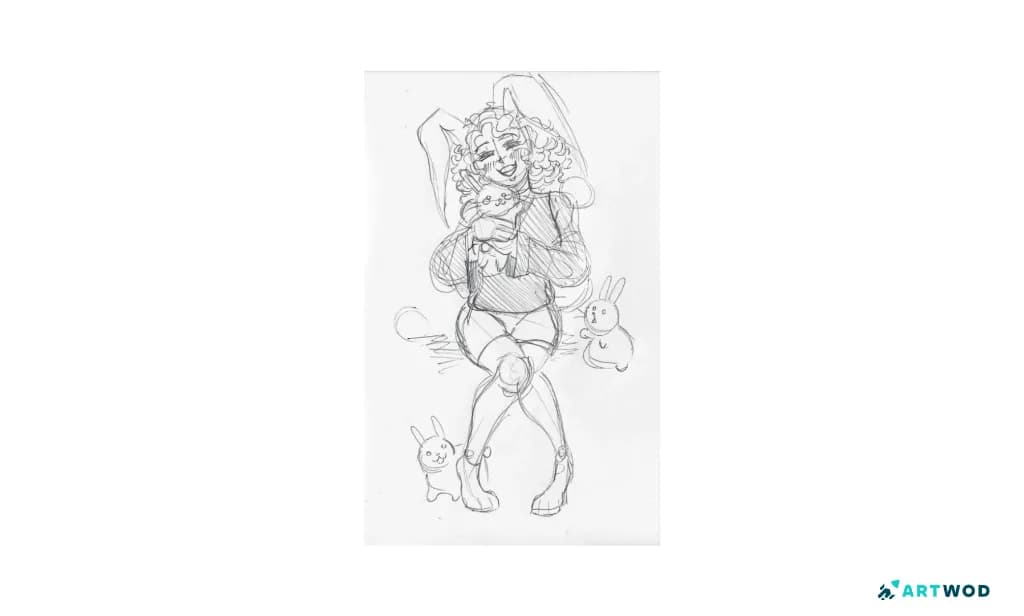
Pen anime character drawing with crossed legs, bent knees, long boots, curly hair, and two small rabbit-like characters
Think of the Knee as a Joint, Not a Circle
A common beginner approach is to indicate the knee with a circle or rounded shape.
That can be useful during construction, but a finished knee needs to communicate how the leg changes direction.
Think of the knee as the connection between two major forms: the thigh and the lower part of the leg.
The kneecap sits at the front of that joint and helps create the characteristic change in surface direction.
For an anime drawing, you do not need to render every anatomical structure. You simply need enough information to show that the leg bends through a believable joint.
Start With the Thigh and Lower Leg
Before worrying about the kneecap, construct the two larger sections of the leg. Imagine the thigh as a tapered cylinder or elongated form. Then construct the lower leg as another tapered form.
The knee sits between them.
This gives you a much stronger foundation than drawing a knee shape first and attaching the rest of the leg afterward.
For @gabrielle34427's crossed-leg pose, this is particularly important because the legs overlap and change direction.
Ask yourself:
Where is the thigh pointing?
Then:
Where is the lower leg pointing?
The knee should naturally sit at the transition between those two directions.
Another submission, “Mai Shiranui - by Isalang” which has a women standing with one leg up, shows why it is important to address the surrounding leg first. The proportional issues result in the lower legs being too short, which is corrected in the paintover. If there are anatomy issues with the legs, it’s important to address this first rather than just add on to the knees. Since the knee is based on the surrounding structure of the leg, the knee can still look incorrect if the structure is wrong. A common trick I use is generally both sides of the leg are around the same length (with the exception of certain angles), you can use lines to measure and ensure equal length.
Simplify the Kneecap
Once the two leg segments are established, indicate the kneecap as a simple front-facing form.
You can think of it as a small rounded plate sitting over the front of the knee joint.
The exact shape will change depending on the pose and viewing angle.
In a simplified anime style, the kneecap may only need:
A subtle contour
A small change in the silhouette
A short interior line
A light shadow
You do not need to draw a realistic anatomical diagram.
The construction underneath the drawing can be more detailed than the final linework.
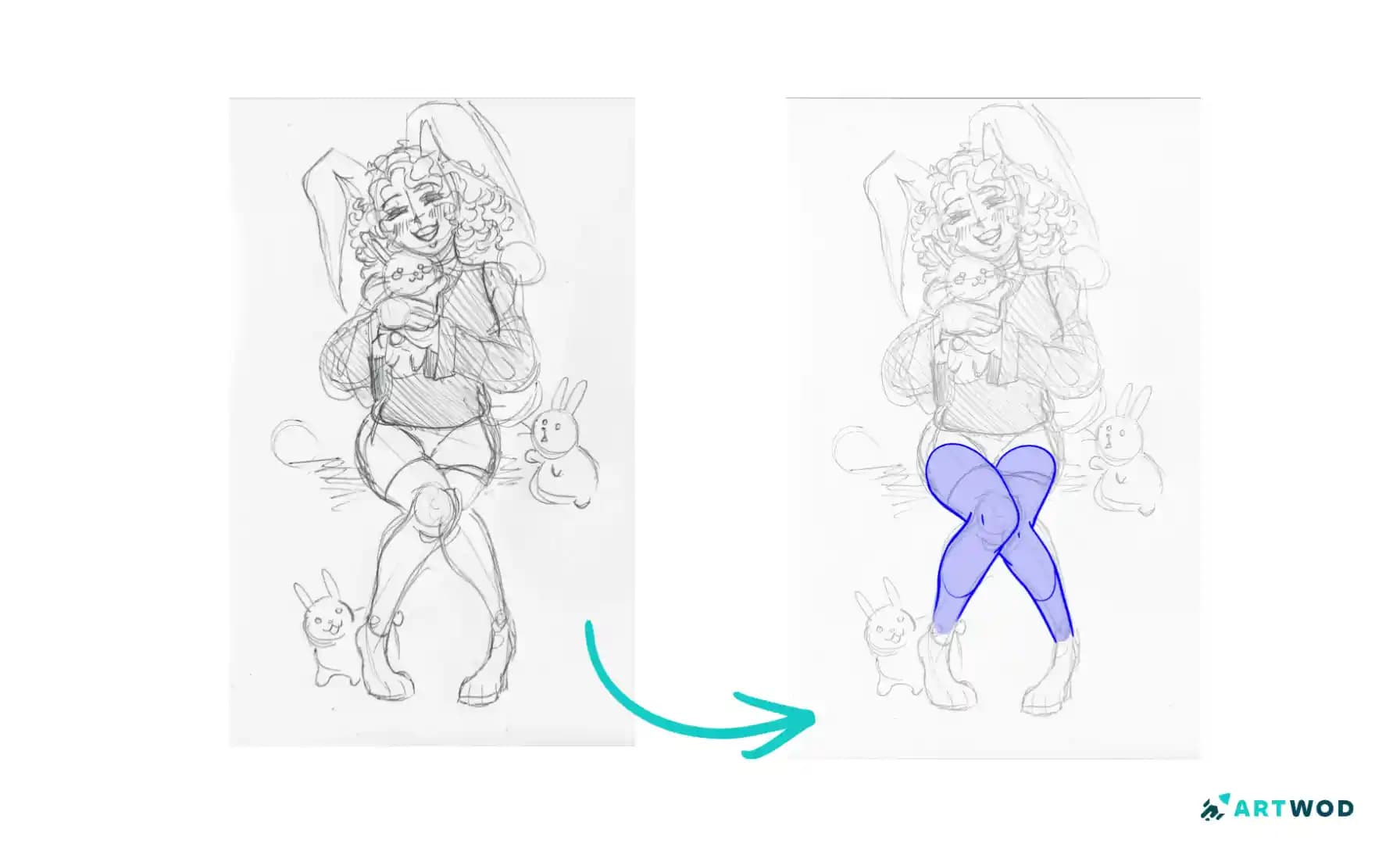
The paintover with this subject jumping into action the knees are simplified into boxes connecting the legs, based on this sketch you can then draw the contour line over it. For me, I tend to use oval like spheres for the knee. This box can mimic the structure of the knee bone and surrounding ligaments, although the actual contour is more of a curve.
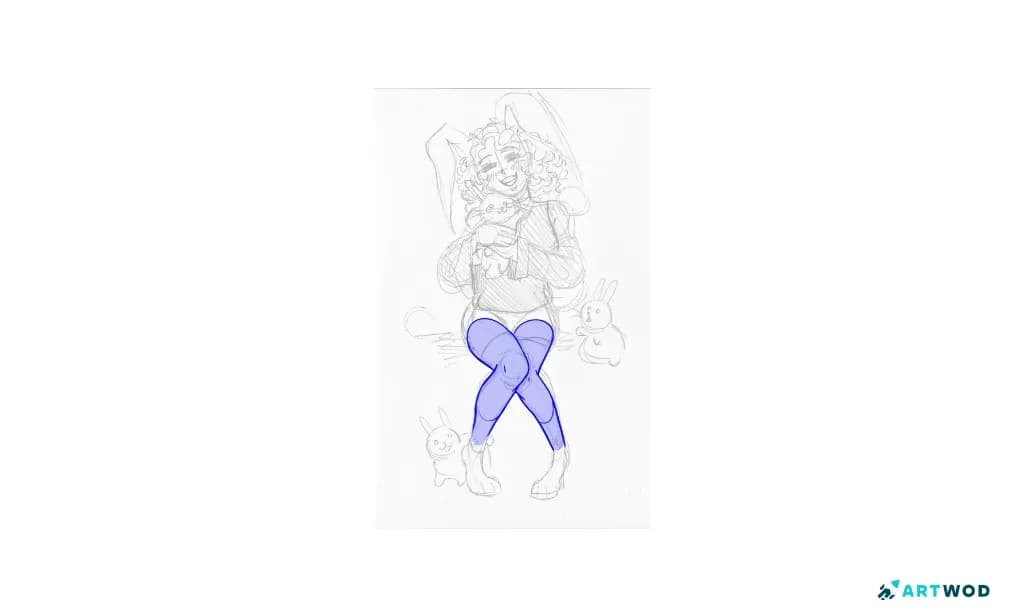
Pen anime character drawing with crossed legs, bent knees, long boots, curly hair, and two small rabbit-like characters, paintover on the knees
Pay Attention to the Bend
The knee becomes easier to draw when you think about the angle of the entire leg.
A straight leg and a sharply bent leg will expose different parts of the knee.
When the leg bends, the front of the knee becomes more prominent while the areas around the joint compress or stretch.
This matters in the submitted drawing because the character's legs are crossed rather than simply standing straight.
Instead of using the same knee symbol every time, adapt the visible structure to the pose.
Crossed Legs Need Clear Overlap
The crossed-leg pose creates another important drawing problem: which leg is in front?
When two limbs overlap, the viewer needs to understand their spatial relationship.
Establish this during construction.
Decide:
Which thigh is closer to the viewer
Which knee sits in front
Which lower leg passes behind the other
Where one contour should disappear beneath the overlapping form
Do not draw every contour continuously.
Sometimes the best way to define the knee is actually to remove a line where another limb overlaps it.
Within my art there are some perspective issues which result in confusing spatial relationships. I could remedy this in the future by thinking of the upper thigh as a cylinder in a 3D space. To adjust this now, I would define the horizon line before drawing the legs.
The artwork submission featuring a witch women shows how to apply this concept. The paintover clearly shows one leg behind the other with the foot aligning with the perspective. Despite this being a sketch, the fact it’s cleaned up around the legs help
Use the Silhouette to Define the Knee
A knee does not always need an internal anatomical line.
The outer contour can do much of the work.
Look at the silhouette around the knee and ask whether it changes direction naturally as the thigh becomes the lower leg.
A small contour change can suggest the kneecap without explicitly outlining it. When making the contour line, I find it’s important to remember that the knee has its own shape aside from just being where the leg bends. The patella bone and surrounding muscles largely what makes up its shape, and when bent they can almost look flat or boxy on top. I could adjust the leg to have a less sharp angle around the bend. Keep it simple, while also considering the underlying structure of the leg.
This is especially useful for anime drawing because the style often benefits from selective simplification.
A Step-by-Step Anime Knee Drawing Process
Try this construction process when practicing the problem from @gabrielle34427's drawing.
1. Establish the leg directionDraw a simple gesture line through the thigh and lower leg.
2. Build the thighUse a tapered cylindrical form for the upper leg.
3. Mark the knee jointPlace a simple rounded or block-like form where the two leg segments meet.
4. Construct the lower legContinue the leg with another tapered form, following the intended direction.
5. Establish the kneecapIndicate the front of the joint with a subtle plane or contour.
6. Check the overlapIf the legs cross, decide which knee and lower leg are in front.
7. Simplify the final linesRemove construction marks and keep only the contours or small indications that help the knee read clearly.
This process separates understanding the anatomy from drawing the final anime style.
Don't Add Definition Just for the Sake of Detail
Because @gabrielle34427 specifically asked for more knee definition, it may be tempting to add several anatomical lines.
But definition does not necessarily mean detail.
A knee can become clearer through:
Better proportions
A stronger silhouette
Clearer joint direction
Correct overlap
A small indication of the kneecap
Subtle value changes
If the underlying leg construction is wrong, adding more lines can actually make the knee look more confusing.
Practice Knees in Different Poses
A good way to build confidence is to draw the knee in several positions rather than repeating one front-facing example.
Try:
Straight leg
Slightly bent leg
Deeply bent leg
Side view
Three-quarter view
Crossed legs
For each one, first construct the thigh and lower leg.
Then decide what part of the knee would actually be visible.
This helps you understand the knee as a changing form rather than a fixed anime symbol.
A good supporting lesson within the is the intro to drawing roadmap including the form manipulation and introduction to organic forms. Applying these lessons to the structure of the leg in different poses will create effective study sessions.
Common Anime Knee Drawing Mistakes
Watch for these problems when practicing:
Drawing the knee as a simple circle
Making the thigh and lower leg connect without a clear joint
Using the same knee shape from every angle
Adding anatomical lines without understanding the underlying forms
Ignoring which leg is in front during a crossed pose
Drawing overlapping contours continuously
Making the knee too prominent for the intended anime style
If the knee looks wrong, simplify the leg and rebuild it from the larger forms.
What Other Artists Can Learn From This Drawing
Build the leg before defining the knee. The knee makes more sense when the thigh and lower leg are already established.
Treat the kneecap as a form. It does not need to be represented by a perfect circle or outline.
Use the silhouette. A subtle contour change can communicate the knee without excessive detail.
Respect perspective and pose. The visible knee structure changes depending on how the leg bends.
Control overlap. Crossed legs need clear foreground and background relationships.
Definition does not mean more lines. Better construction often creates more clarity with less detail.
How Community Feedback Can Help With Anime Anatomy
@gabrielle34427's question is a good example of a focused anatomy problem. The artist already knows that the knees feel wrong but is looking for a step-by-step way to understand and correct them.
That kind of specific question can make feedback much more useful.
Instead of asking generally whether the figure looks correct, an artist can point to a particular joint, pose, or anatomical transition that feels difficult. Other artists can then focus on the construction behind that specific problem.
For anime anatomy, this is especially helpful because stylization can make it difficult to tell which anatomical information should remain visible and which should be simplified.
FAQs
Start by constructing the thigh and lower leg as separate forms, then connect them through the knee joint. Add a simplified indication of the kneecap and refine the silhouette according to the pose.
Why do my anime knees look like circles?You may be treating the knee as an isolated shape rather than a joint connecting the thigh and lower leg. Use a simple circular or block form during construction, but integrate it into the larger leg volumes.
How do you draw a bent anime knee?First establish the direction of the thigh and lower leg. Then place the knee where those two forms meet and show the bend through the silhouette and simplified kneecap structure.
How do you draw crossed anime legs?Construct each leg separately and decide which one is in front. Use overlap to clarify the spatial relationship and avoid drawing every contour continuously through the crossing.
Do anime knees need anatomical details?Not necessarily. A stylized anime knee can often be communicated with a clear silhouette, a small kneecap indication, and appropriate shading or contour changes.
How can I practice drawing anime knees?Draw knees in straight, bent, side, three-quarter, and crossed-leg positions. Focus first on the thigh-to-knee-to-lower-leg construction, then simplify the final lines.
@gabrielle34427's drawing shows why knee anatomy can be difficult in a stylized figure, especially when the legs are bent and crossed. The solution is not simply to add more lines around the joint. Most importantly, the contours should follow the underlying structure, and convey perspective.
Build the thigh and lower leg first, treat the knee as a connecting form, establish which parts overlap, and then simplify the visible anatomy into the few marks your anime style needs. Clean artwork can better convey the forms, as opposed to “chickenscratching.”
If your knees still look unclear, go back to the larger leg construction. Once the thigh, knee, and lower leg read as one connected structure, the final definition becomes much easier to draw. The Artwod community helps connect you with other artists who can give you feedback on artwork you share focusing on helping you learn. If you want to get feedback of your own, post your art in the anime category.