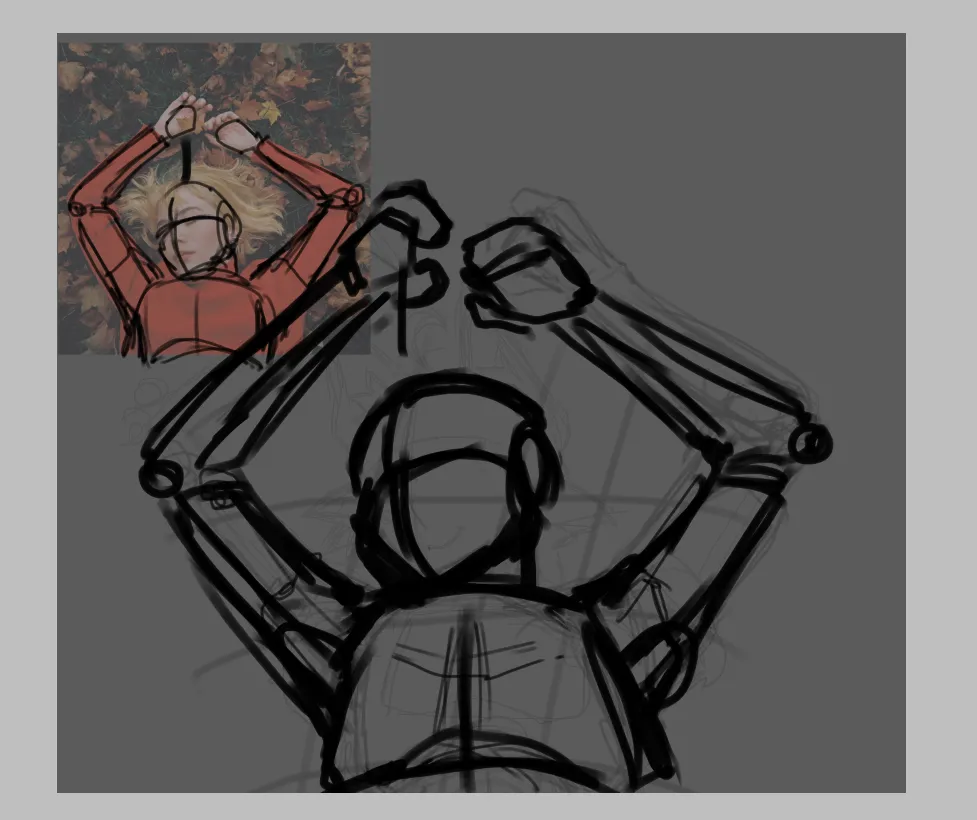
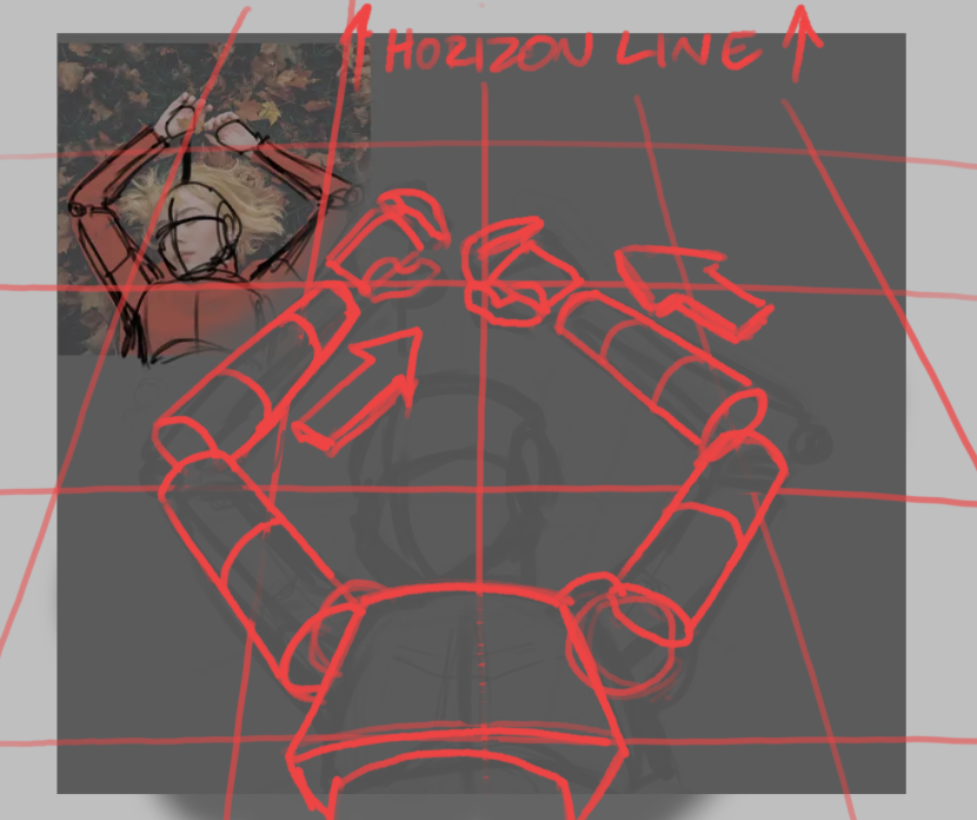
Hi, You might be overthinking things a bit. Perspective is less about a rigid set of rules and more about understanding the space and how it appears from the point of view of the observer. So for the forearm, you are correct that the wrist is smaller than the muscle at the other end near the elbow. But you would only draw the wrist larger in cases of extreme foreshortening. So if your character had there hand right up in the viewers face. Otherwise the effect of perspective won’t be that pronounced. For your reference, what you need to do first is take a moment to understand what you’re looking at. So in this case you have a person lying on the ground, but the viewer is standing over them. So effectively, we’re looking up at the person which means their arms are moving away from us. The horizon line will be way off the top end of the page. In terms of how to practice this, there’s no quick way to do it. You want to practice drawing in a way that will make perspective an intuitive part of your drawing, rather than a complicated mess of rules and formulas. Perspective really doesn’t need to be hard however, it’s just the word we use to describe drawing reality. Start with 1 point perspective. Draw a line to represent the horizon and a point for the Vanishing Point in the middle. Fill the page with squares and rectangles. Then draw in the lines going to the vanishing point to create boxes. Draw at least 20. Then do it again but this time without a VP. Try drawing your boxes with the same imaginary VP. Then repeat the exercise a third time but without a drawing in a horizon line or a VP. Once you’re confident with that, move on to a 2 point perspective. The goal is to make this intuitive so that you’re always conscious of where the horizon and vanishing points are without having to draw them. Let me know if you would like me to clarify anything.

thank you so much >.<