How to Draw Faster: A Step-by-Step Guide to Rendering for Artists
How to Draw Faster (and Smarter)
You've put in the work. You've learned the fundamentals. You're confident in what you're doing. The only problem? You're SO slow. Painfully, frustratingly slow. Every piece takes hours longer than it should, and most of those hours go into rendering details nobody is even going to look at. You think to yourself "Maybe it's just not for me."
If that sounds familiar, the good news is that drawing faster isn't about working harder or moving your hand quicker - it's more about deciding what to render and what to leave alone. Most artists waste enormous amounts of time on parts of their work that don't actually matter - and once you fix that, your speed and your finished pieces both improve.
Here's how to finish art faster without sacrificing quality.
Step 1: Decide what's important
Before you render anything, look at your piece and rank it. What's the most important element? What's the second most important? What's the least important?
The most important is almost always your focal point - the place you want the viewer's eye to land first. The second most important is whatever supports that focal point, which often comes down to whatever occupies the largest portion of the canvas. The least important is everything that exists to fill space and create context, but doesn't need to demand attention.
This sounds obvious in theory. In practice, most artists skip this step entirely and start rendering wherever feels comfortable - which is usually not where the focal point is. So they end up with beautifully detailed corners and a focal point that gets lost.
If you're not sure what the most important part of your piece is, that's actually one of the best uses for the Artwod Feedback Tool. Sometimes you're too close to your own work to see the focal point clearly. Reviewers will tell you in two seconds where their eye is naturally drawn. Saves you a lot of guessing.
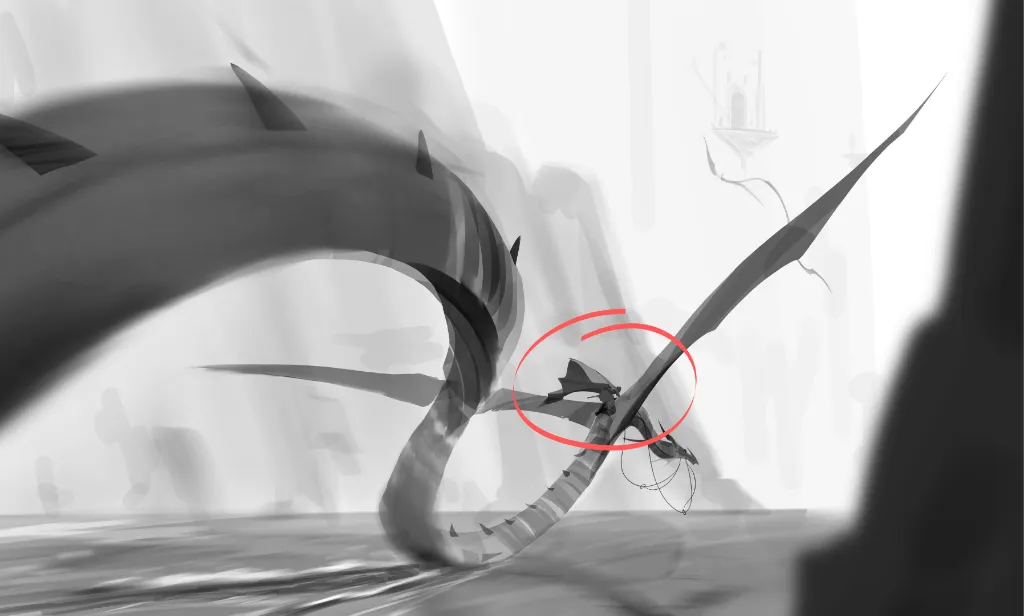
Greyscale 2d artwork, dragon rider. Focal point highlighted
Step 2: Render in order of importance
Once you know your hierarchy, start rendering at the top. Push the focal point first. Make it crisp, detailed, fully resolved. Then move to the second most important area and bring that up to a slightly lower level of finish. Then the third, even looser.
Here's the magic: by the time you've rendered the top two or three elements, your piece will already look done. Even if half the canvas is still loose. That's because human brains fill in the gaps. The viewer's eye locks onto the rendered focal point, registers the supporting elements, and assumes the rest is finished too. You're using how perception works to your advantage.
This is how professional artists draw faster than everyone else. They don't render everything - they render only what matters.
Step 3: Don't fall for the "background = basic" trap
Here's where a lot of artists mess up. They hear "you don't need to render everything" and assume that means everything in the background can stay flat or basic. But if half your canvas is just blank color fill, the piece is going to feel empty no matter how good your focal point is.
Three rules for what to render in a drawing:
- Always commit to your focal point. Detail it, make it the clearest part of the image.
- Pay attention to what occupies a lot of space. If you have a giant tree in the background or a massive sky behind your character, you can't just leave it as flat color. It needs enough rendering to feel intentional - not finished, but not empty either.
- Think for yourself. Rules are starting points, not destinations. You're the creator. You decide what matters in your piece.
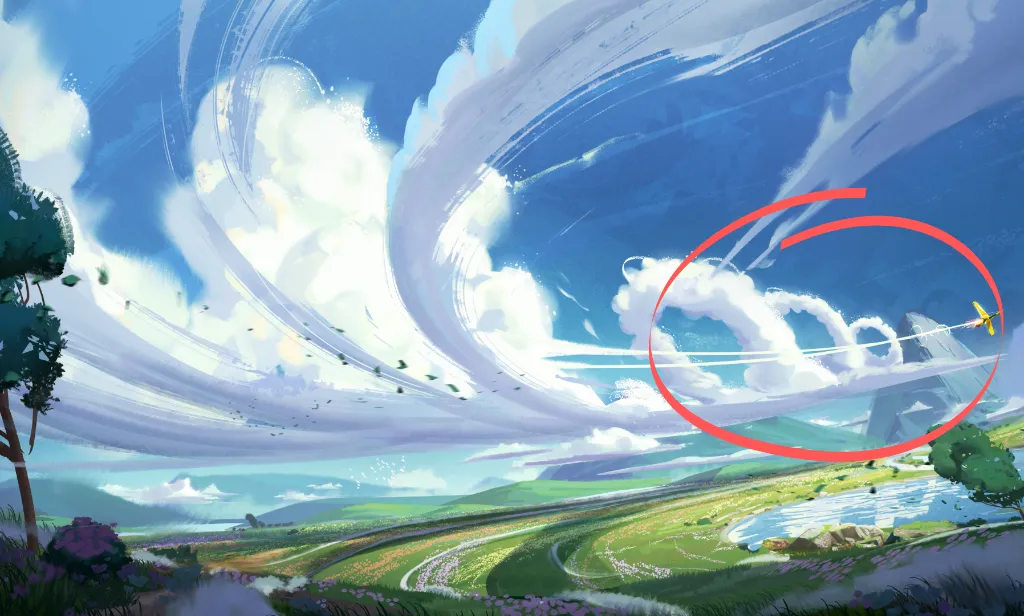
Environment 2d drawing, colorful valley with sky and clouds. Background highlighted
Step 4: Get outside eyes when you're stuck
If you've stared at your work for two hours trying to decide what to render and what to leave loose, that's a sign you need outside input. Decision fatigue is real, and it's one of the main reasons artists slow down on the back half of a piece.
The Artwod Feedback Tool is genuinely the fastest way to get unstuck. Drop your work-in-progress, ask reviewers what they think the focal point should be or where they'd push the rendering further, and let real artists help you make the call. Way faster than staring at it alone for another hour.
Drawing faster isn't a speed issue. It's a decision-making issue. The artists who finish pieces quickly aren't moving their hands faster - they're rendering less and choosing better. Rank your elements by importance, push the top ones hard, leave the rest loose, and trust the viewer's brain to do the rest of the work for you.
The hours you save are hours you can spend on the next piece - which is how artists who draw faster also tend to improve faster. It compounds.
Related Posts