How to Draw Dynamic Poses: Two Approaches That Actually Work
How to Draw Dynamic Poses: Mannequin, Movement, and the Animation Secret
Every artist has this problem eventually - their characters look like wooden human figure from IKEA (and they were not using it as a reference). No movement, no flow and no edge.
Most pose tutorials start and end with the line of action. Draw a curve, build around it, done. And while the line of action is useful, it's only half the story. If your poses still feel stiff after using it, it's because a line alone doesn't tell you what the body is actually doing.
Whether you’re a beginner or an intermediate artist, these two approaches will definitely help breathe life into your characters or figure studies.
Approach 1: Stop Drawing Lines. Start Manipulating a Structure.
The line of action gives you direction. What it doesn't give you is volume, weight, or the sense that a real body is moving through space.
That's where the mannequin comes in.
Think of your figure as a series of boxes - ribcage, pelvis, limbs - each one a three-dimensional form that can be twisted, bent, and pushed to its limits. When you manipulate those boxes instead of sketching loose lines, something changes. The pose stops being a drawing and starts being a body. Try drawing a couple of basic mannequins as a warmup. Pay attention to the masses.
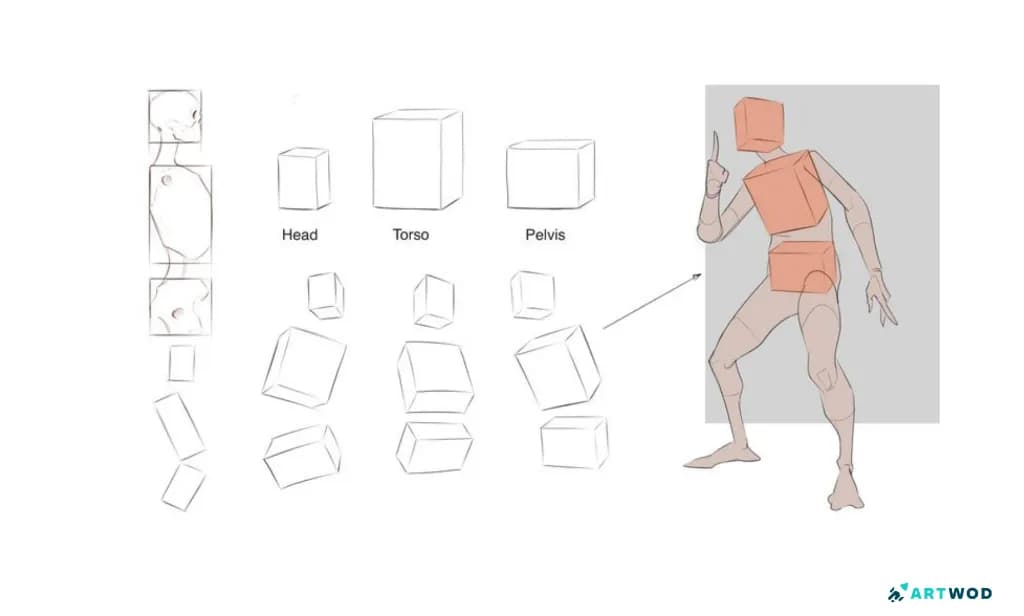
Human Mannequin Breakdown: Head Torso and Pelvis boxes with size and mass and proportions. 2d digital drawings
Now let's make things interesting! The key is exaggeration. Dynamic poses are not realistic poses. A fighter mid-swing, a dancer mid-leap, a character reacting in shock - none of these look natural. They look pushed. The ribcage twists further than it would in real life. The pelvis tilts harder. The limbs extend to their extreme.
That exaggeration is what reads as energy on the page.Now ask yourself: what is this body doing, and how far can I push each box before it breaks? Twist the ribcage against the pelvis. Tilt the whole structure. Bend the spine. The more deliberately you manipulate each form, the more dynamic the result. First, try drawing with limbs as sticks. Then give volume to the sticks by drawing them as cylinders.
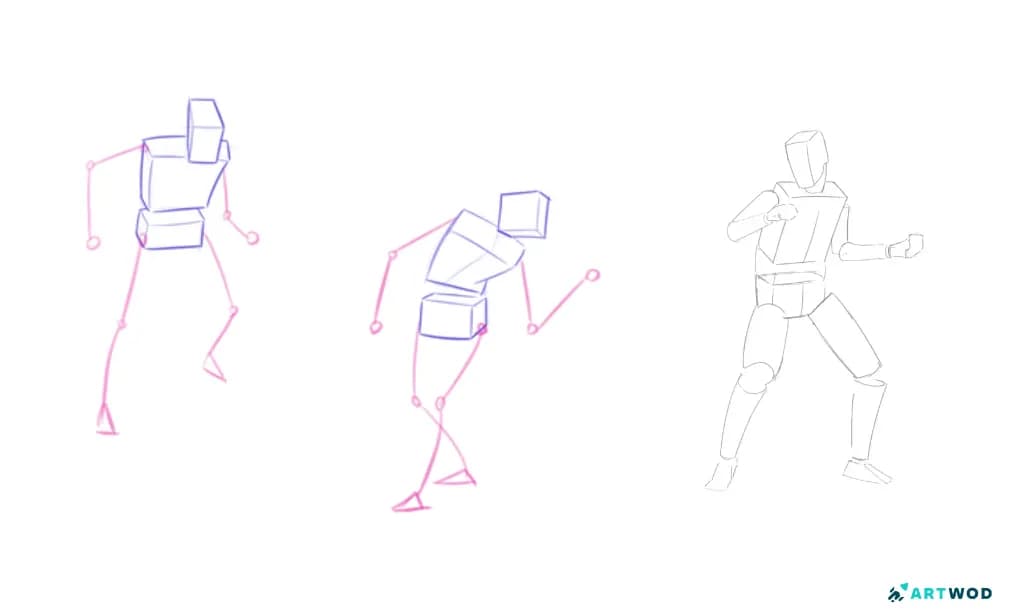
2d Digital drawing human mannequin, 3 mannequins, 2 with limbs as sticks 1 with limbs as cylinders
Approach 2: Learn From Animation - Pinch and Stretch
Animators solved the dynamic pose problem decades ago. And the principle they use is simpler than most artists expect.
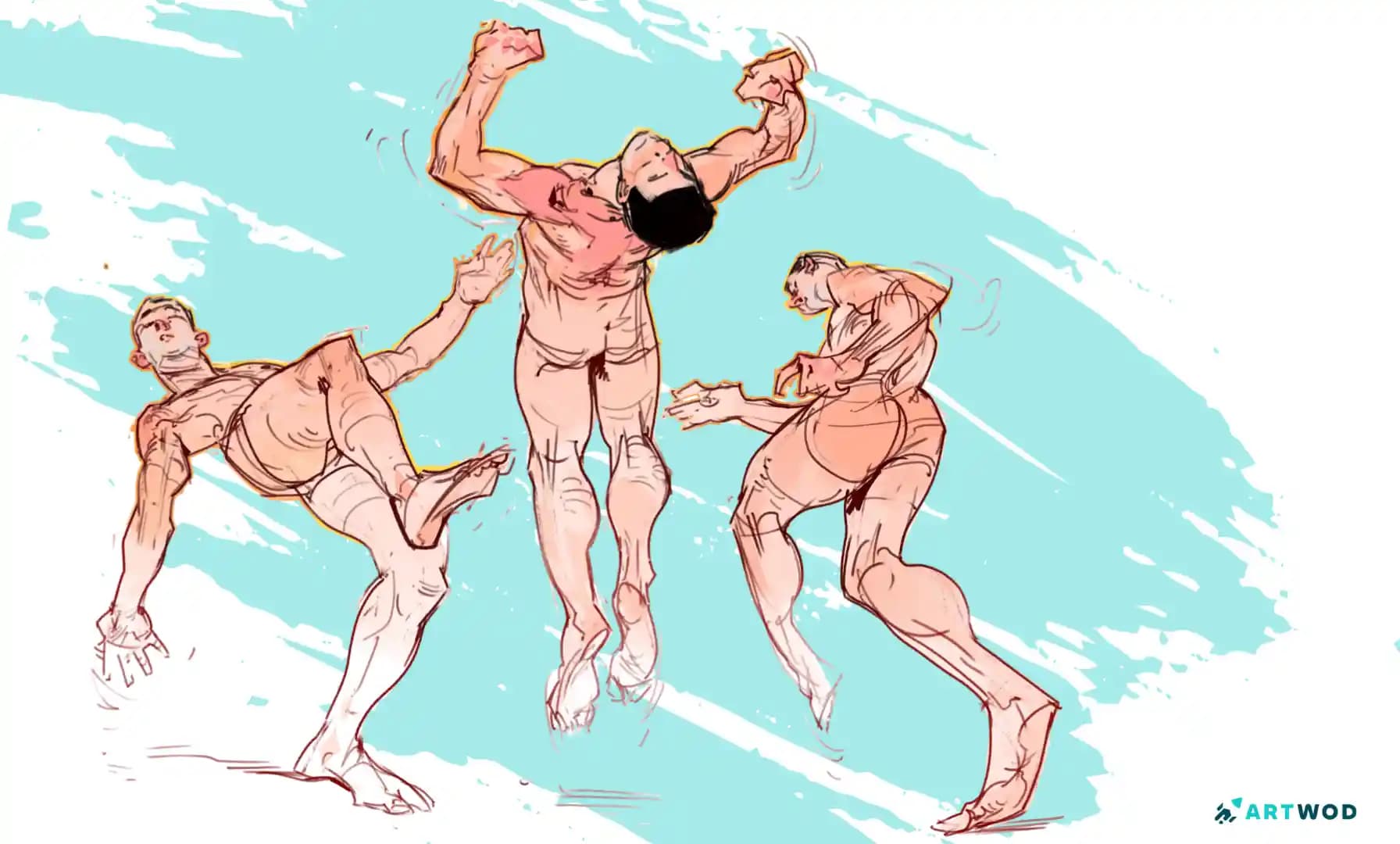
Every dynamic pose has two sides: a pinched side and a stretched side.
When a body bends, curves, or twists, one side compresses and the other elongates. A character leaning hard to the right has a compressed, pinched left side and a long, stretched right side. A fighter throwing a punch has a coiled, pinched back and an extended, stretched front.
This is the animation principle of squash and stretch applied to figure drawing - and it's one of the most powerful tools for making a pose feel like it has momentum.
The mistake most artists make is drawing both sides with equal weight and detail. That evenness is exactly what kills the energy. When you simplify one side - flatten it, compress it, reduce the detail - and let the other side breathe and extend, the pose immediately gains direction and force.
Study animated fight sequences, action scenes, even exaggerated comedy moments. Pause on a single frame and look for the pinch and the stretch. It's always there.
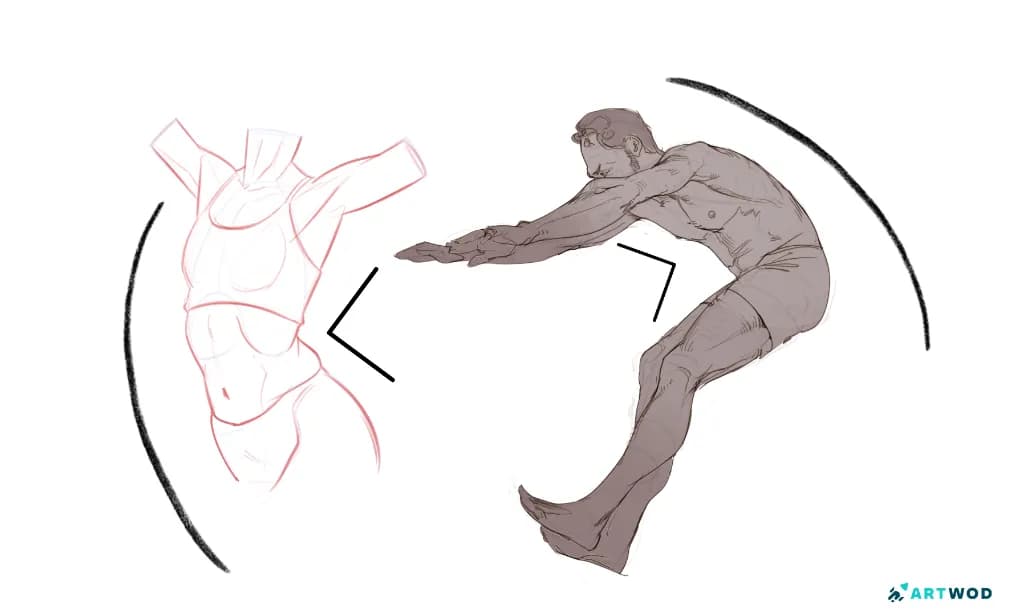
2 figure drawings, 2d, digital. Pinch versus stretch principle, one side is always a smooth curve, other one is more pinched
Not sure if your poses are reading the way you intend? Upload your WIP to the Artwod Feedback Tool and get written and visual critique from other artists. Sometimes all it takes is one draw-over to see what's missing.
The Poses That Stop People Mid-Scroll
Line of action gets you started. But structure and animation principles are what get you to poses that feel like they're actually moving.
Use the mannequin to build volume and push each form to its extreme. Use pinch and stretch to give your poses direction and momentum. Together, these two approaches cover what most tutorials skip entirely.
Related Posts