Why Your Art Is Not Improving: 5 Honest Reasons and How to Fix Them
Why Your Art Is Not Improving
You're asking the wrong questions
Most artists who feel stuck are asking the wrong question. They ask "how do I become a great artist?" or "why am I not as good as them?" And those questions are basically unanswerable. They're too big and too vague, not to mention discouraging and self-degrading.
The question that actually moves the needle is smaller and more immediate. Not "how do I become great?" but "what can I do to improve this drawing today?" Not someday. Today. This specific piece, this specific problem. Learning to draw faster and more effectively starts with this shift. When you ask a focused question, you get a focused answer. And focused answers, applied consistently, are how drawing skills improve over time. Big vague goals create paralysis. Small specific actions create progress.
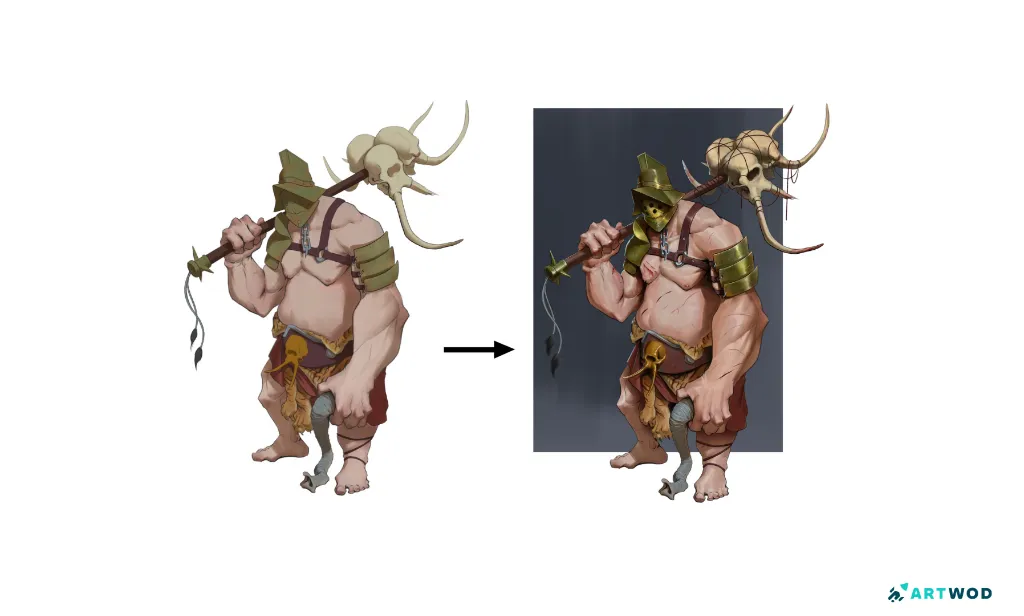
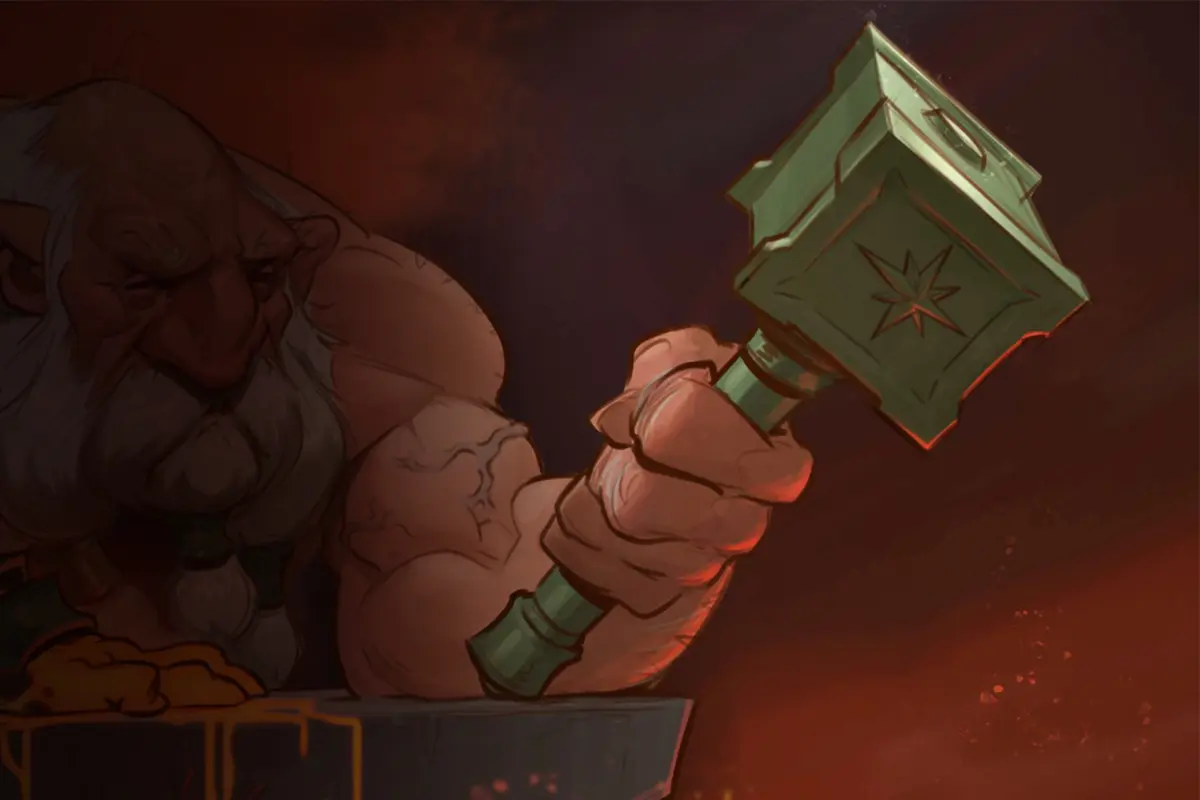
Character Design by Axel Van Nederkassel, 2 orges side by side, same design, better rendering on the right one. Digital 2d art. Left one has no highlights and occlusion, right one adds highlights, background and ambient occlusion, creating more volume and realism
You're not focused
There's a difference between drawing and deliberate drawing practice. Showing up and making marks is not the same as showing up with a specific thing you're trying to solve. If you sit down without a clear intention - a pose you're struggling with, a lighting scenario you want to understand, a construction problem you want to crack - you're basically spinning your wheels.
How to improve at drawing faster than most people comes down to one thing: deliberate practice. Every session should have a goal. It doesn't have to be big. It just has to be specific. "Today I'm going to draw ten hands from reference and then redraw three from imagination." That's a session with direction. Direction is what separates artists who plateau from artists who keep growing. Also, don't distract yourself with background noise. Try working or at least starting your practice in silence.
You're not challenging yourself
Comfort is the enemy of art progress. If every drawing session feels easy, you're not learning - you're just repeating what you already know. And repetition of what you already know is not practice. It's performance.
Getting better at drawing requires putting yourself in situations where you're genuinely unsure of the outcome. Draw subjects you've never attempted. Use a medium that feels uncomfortable. Set a timer and work faster than feels safe. Try a style completely outside your usual approach.
The discomfort is the signal. It means you're in the zone where actual drawing improvement happens. If your sessions never feel hard, you need to raise the difficulty - because your skills will only grow as far as your challenges push them.
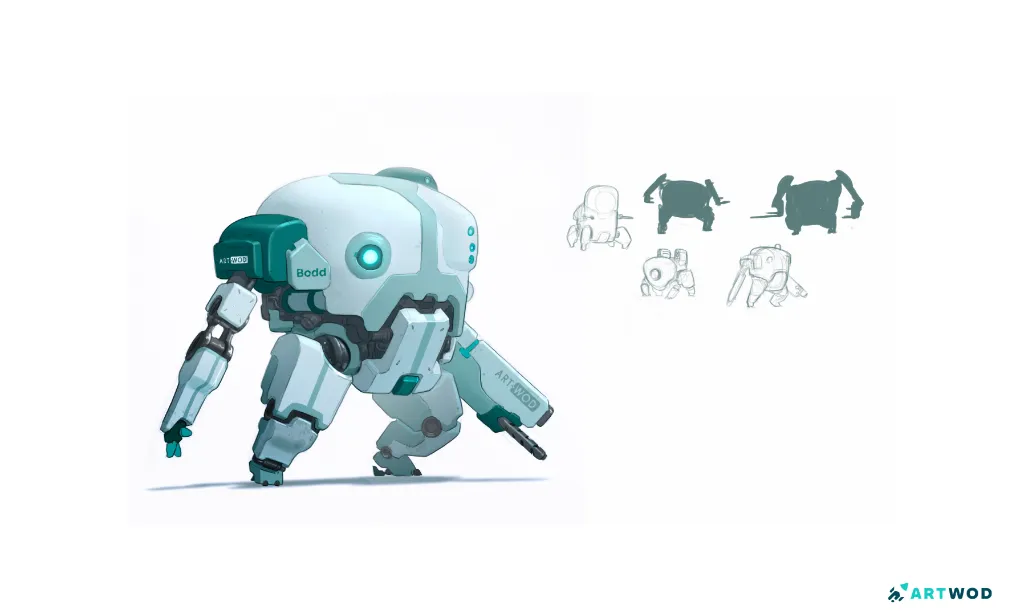
Mech design, digital 2d art. On the left 0 finished mech design, on the right - 5 sketches of silhouettes (2 with lineart and 2 with value).
You're not asking for feedback
This one is huge and massively underrated as an art improvement tip. Most artists work in isolation, judge their own work, and either hate everything they make or miss the specific problems that are holding them back. Both are equally useless.
An outside perspective from someone who knows what they're talking about can identify in five minutes what you've been unable to see after months of staring at your own work. Not vague encouragement - specific, technical, actionable feedback. "Your shoulder line and hip line are parallel, that's why the pose reads as stiff." That's the kind of note that changes how you draw forever.
If you're not getting that kind of feedback regularly, the Artwod Feedback Tool is built exactly for this. Real artists, real critique - written, visual, or both. It's one of the fastest ways to break through a drawing plateau because it tells you precisely what to fix instead of leaving you guessing.
You ditched the fundamentals and focused on rendering
This is probably the most common reason art stops improving for artists who have been drawing for a while. At some point the fundamentals feel boring - you want to render, you want to paint, you want to make finished pieces. So you skip the boring stuff and jump straight to the surface.
And then you wonder why everything still looks a little off. Why the figure feels flat even though the rendering is clean. Why the composition isn't working even though the details are nice.
Rendering on top of weak fundamentals is like painting a wall that hasn't been plastered. It looks okay from a distance but the cracks show up eventually. Figure drawing for beginners and intermediate artists always comes back to the same thing - construction, proportion, perspective, light and shadow. These are not beginner topics you graduate from. They're the foundation everything else sits on, forever.
If you've been avoiding them, go back. Artwod's roadmap covers drawing fundamentals step by step in a way that's structured and actually engaging - not just grinding boxes for months with no direction.
Related Posts