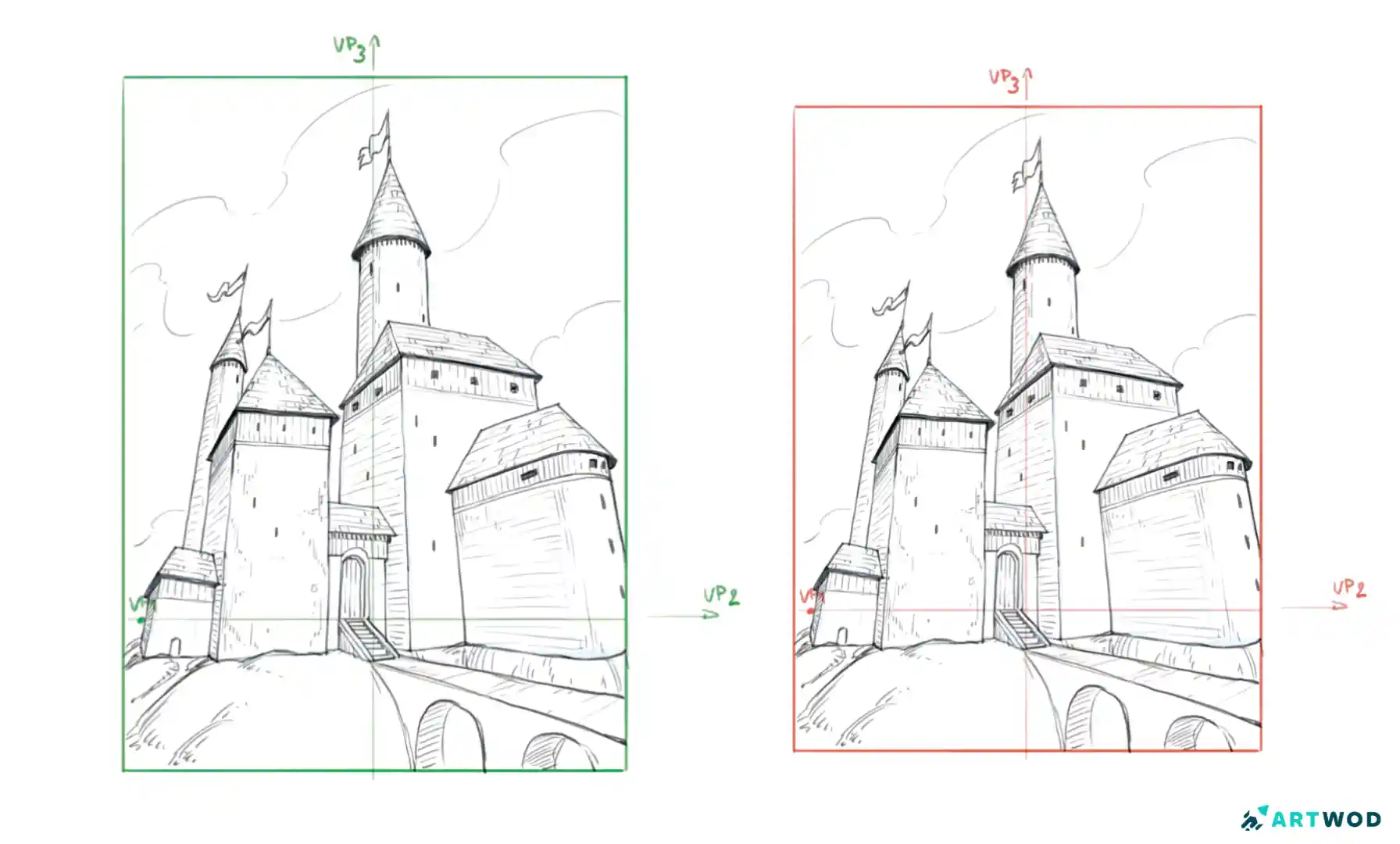
Perspective Drawing Mistakes Artists Make and How to Fix Them
Common Perspective Drawing Mistakes Artists Should Fix
Mastering perspective is one of the most definitive turning points in an artist’s journey. It is the boundary line between drawings that look flat, amateurish, or "off," and drawings that command a sense of believable three-dimensional space.
Yet, perspective remains one of the most common stumbling blocks for artists. You can spend hours meticulously rendering a character or environment, only to realize the entire piece feels fundamentally broken at step one.
In this comprehensive guide, we will break down the most common perspective drawing mistakes related to depth, form, construction, and spatial accuracy - and show you exactly how to fix them.
Why Perspective Drawings Often Feel Incorrect
Have you ever finished a drawing, looked at it, and felt an immediate sense that something was wrong, even if you couldn't quite pinpoint what?
When perspective drawings feel incorrect, it is almost always due to a conflict between what your eyes actually see
in the real world and what your brain thinks it knows. Your brain knows a table has four equal legs and a flat top, so it tries to force you to draw those legs flatly on the paper.In reality, perspective requires you to draw objects distorted by space. When you guess or rely on "gut feeling" instead of strict construction, your structural volumes twist, warp, and fight against each other. The human eye is incredibly sensitive to spatial inconsistency; the moment two objects in the same scene follow different spatial rules, the illusion of reality shatters. However, the concept of intuitive perspective exists as well, but this should be applied only after you're confident with basic perspective.
Common One-Point Perspective Mistakes
One-point perspective sounds simple because all lines converge toward a single point on the horizon. However, artists frequently trip up on the simplest rule of the system: the behavior of the non-converging lines.
The Mistake: Allowing horizontal and vertical lines to tilt or drift. In pure one-point perspective, any line that isn’t moving directly toward the vanishing point must be perfectly parallel to the horizon (horizontal) or perfectly perpendicular to it (vertical).
The Fix: If the front face of your object is tilted even slightly, you are no longer doing one-point perspective - you have accidentally introduced a second vanishing point, which distorts the entire grid.
Two-Point Perspective Construction Errors
Two-point perspective introduces a second vanishing point, allowing you to draw objects from an angle. The most frequent construction error here comes down to tracking your converging lines leading to depth and form inconsistencies.
The Mistake:
The Fix: Trace every single receding line all the way back to its designated vanishing point. Do not guess the back corners of your forms. Build your objects completely transparently - like glass boxes - so you can verify that the hidden construction lines align perfectly to the same points.
Horizon Line Misunderstandings
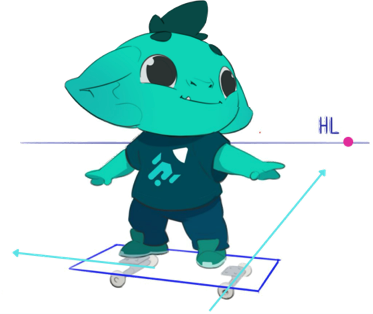
The horizon line is not just a line where the sky meets the ground; it represents the Eye Level
of the viewer or the camera. Misunderstanding this concept ruins the camera angle of your entire piece.The Mistake: Placing the horizon line arbitrarily without realizing how it impacts the scene, or shifting the horizon line halfway through a drawing. If you draw a character’s head looking down from a high eye level, but draw their feet from a straight-on eye level, the perspective is ruined.
The Fix: Establish your horizon line first and lock it in. Everything you draw above it will reveal its underside; everything below it will reveal its top surface. Treat the horizon line as a fixed camera lens that dictates how the audience interacts with the space.
Form Distortion Issues
When drawing complex subjects like vehicles, mechs, or anatomical figures, artists often struggle to maintain organic volume across a perspective grid, leading to flat or warped shapes.
The Mistake:
The Fix: Remember that as a circular form turns away from your eye level, it flattens into a perfectly smooth ellipse. The center axis of the ellipse must always align perpendicularly to the vanishing line of the form it rests on. Master drawing smooth, rounded ellipses inside perspective squares before moving on to complex organic details.
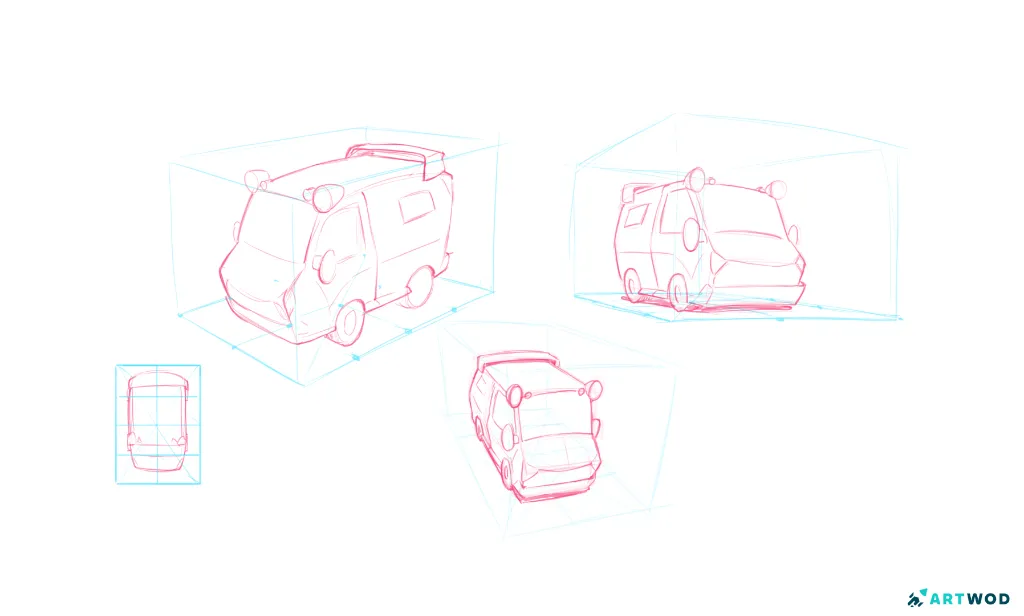
4 car drawings in different perspectives, put in boxes. digital 2d drawings in pink and blue pencils
Vanishing Point Placement Problems
This is perhaps the most widespread technical mistake in all of perspective drawing: placing your vanishing points too close together.
The Mistake:
The Fix: Place your vanishing points far outside your drawing frame. If you are drawing digitally, zoom out significantly and place your vanishing points on the outer gray workspace. If you are drawing traditionally, tape your paper to a larger desk and place your points on the desk surface. This replicates a natural camera lens rather than an extreme, distorted fish-eye lens.
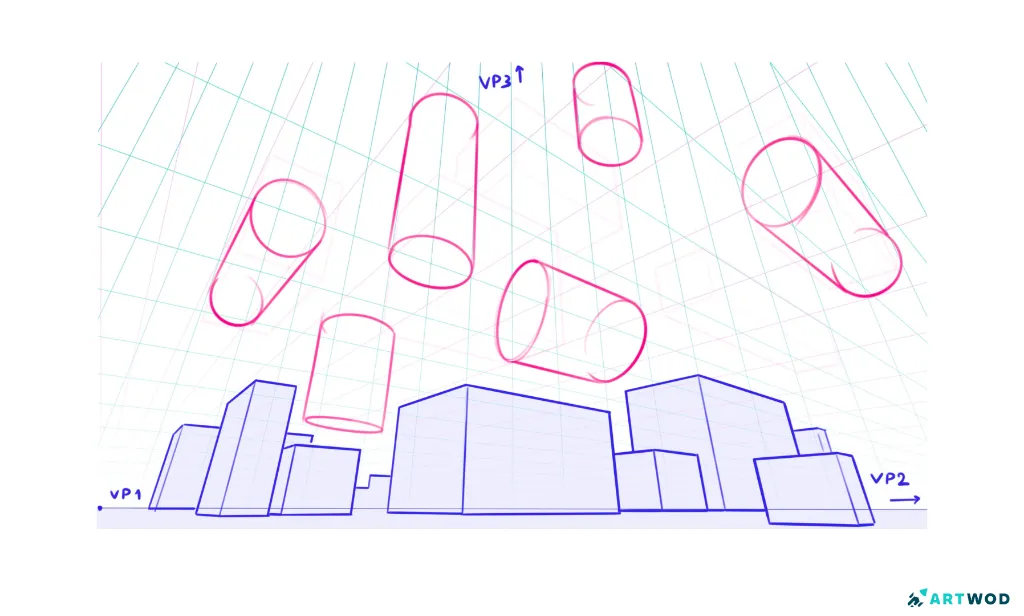
boxes and cylinders in 3 point perspective, grid. digital 2d drawings
Perspective Mistakes in Environments and Figures
A massive trap for character artists is treating figures and environments as two completely separate tasks.
The Mistake:
The Fix: Put your characters inside boxes. Treat the human body as a collection of simple 3D geometric volumes (cylinders for limbs, boxes for the torso and pelvis). Drop those basic boxes directly into your environment’s perspective grid first. If the box stands firmly on the ground plane, the character built inside it will too.
Improving Perspective Through Critique
Perspective is a highly technical skill, meaning it is incredibly easy to hide your own mistakes from yourself out of comfort or artistic ego. To break through plateaus, you need objective analysis. If you want to fast-track your learning and completely eliminate guesswork from your grid setups, getting professional eyes on your spatial grids is crucial. You can submit your work directly to our Community Hub and get perspective drawing feedback to have your vanishing points and planes systematically checked by experts.
Master Your Artistic Foundation
If you want to stop guessing, stop wasting hours on broken drawings, and finally build art that stands firmly in 3D space, you need consistent, accurate feedback.
Don't let perspective mistakes hold your artwork back. Upload your latest drawings to Artwod's centralized art feedback platform today, target your weakest construction habits, and join our structured pipeline to turn spatial anatomy from your biggest headache into your strongest artistic asset!