Inktober Edition: How to Turn a Single Word Into a Strong Drawing Idea
Inktober Edition: How to Turn a Single Word Into a Strong Drawing Idea
Inktober prompts are just words. But drawings don't speak with words, they speak with visual elements. Telling you how to train yourself to turn one into another in this post.
The first idea that shows up is the one everybody else has too. That is true for the 31 Inktober 2026 prompts, and it is just as true for a client brief, a commission request or the theme of your next art challenge. Getting past the obvious idea is a skill, and it can be trained. Here is a method you can use on Ogre, Cactus, Contraption or any other word that makes your mind go blank.
Throw away your first five ideas
Take the word and write down ten associations before you draw anything. Do not judge them, just write.
Say the prompt is Cactus. Your list will start with desert, spikes, cowboy hat, sand and tequila. Those are the ideas your brain grabbed first because they are the most common, which means they are the ideas everyone else grabbed too. Cross out the first five. The interesting stuff lives further down the list: the cactus on an office windowsill that gets watered once a year, a balloon seller walking past one, a cactus that wants a hug and gets none.
Ten associations feels like a lot until you try it. Around number seven your brain runs out of clichés and starts offering you something weird, which is exactly what you want.
Change the question
“What does this word look like?” only produces dictionary answers. Ask something else instead:
Who owns it? What happened just before? What happens one second after? What is wrong with it? How big is it really?
Ogre is a good test. An ogre looks like a big green guy with a club. An ogre doing his taxes at a tiny desk looks like a story. An ogre apologising to a bridge he just sat on looks like a joke. Same word, but now there is a situation, and a situation gives you a pose, an expression and a setting without any extra effort.
Collide it with something unrelated
When a single word gives you nothing, borrow a second one. Pair two prompts from the list, or pair the prompt with a random object from your desk.
Contraption plus Bake gives you a machine built entirely to make one cookie. Lounge plus Cactus gives you a cactus on a sun bed with sunglasses and a drink. Hero plus Flimsy gives you a superhero whose cape keeps tearing. The collision does half the thinking for you, and the results are almost always funnier and more specific than anything you would have planned. Check out this drawing for "Relic" from @Yurei, our community member.
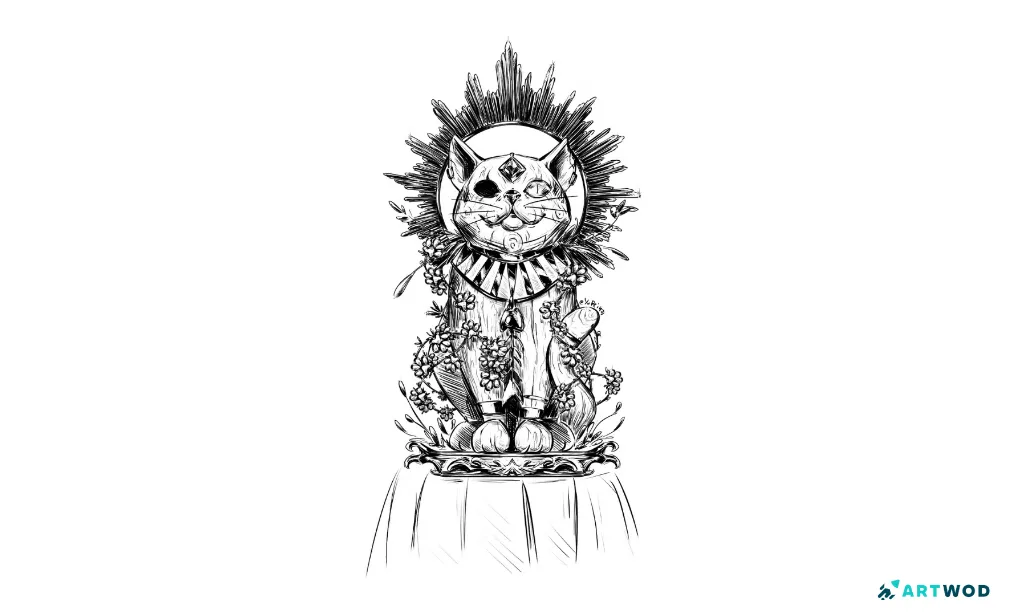
Inktober Relic by Yurei, Digital Inking
Thumbnail three versions before you commit
Once you have an idea, resist the urge to start the final drawing. Make three tiny sketches instead, two minutes each. Change the camera angle and the composition every time: one from above, one from the ground, one as a close-up.
Pick the one that reads fastest. Usually it is not the one you expected, and it is almost never the first thumbnail. Try our Practice Section for sketching. Or use it for doing some form exercises as a warm-up before doing your thumbnails.
Make the idea readable
A clever idea nobody can read is wasted. Before you ink, squint at your thumbnail. Can you tell what the subject is? Is there one clear place where the eye lands first? Is the darkest dark next to the lightest light at the spot where the joke or story happens?
If the answer is no, the fix is almost never more detail. Simplify the silhouette, push the contrast and give the focal point some space. A drawing that reads in one second will always beat a drawing that needs a caption. Check out this drawing by @Rikuh. Simple prompt - Flightless, but a unique representation with nice storytelling!
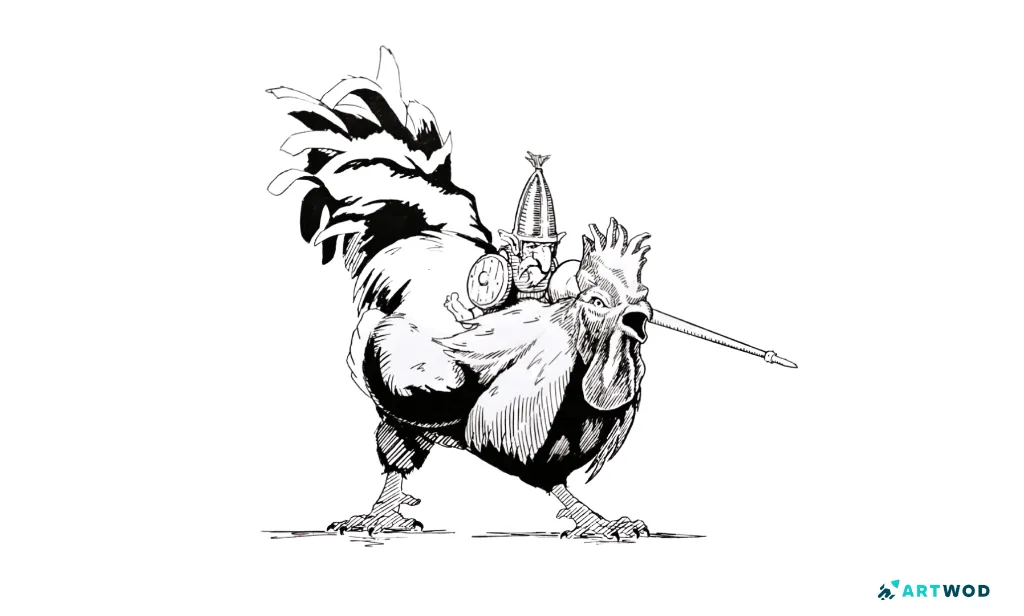
Inktober Flightless by Rikuh, traditional inking
Set a time limit and finish
The idea does not need to be precious. A finished, slightly flawed drawing teaches you more than a perfect concept that stays in your head. Give yourself a fixed window, say 45 minutes from word to finished drawing, and treat the daily prompt as a training ground for exactly that habit.
Thirty-one prompts means thirty-one chances to run this whole method, and by day ten you will notice the first two steps taking about a minute each. That is the actual prize. The prompt list ends on October 31st, but the skill sticks around.
FAQ
How do I come up with drawing ideas fast?
Write ten associations for your word and cross out the first five.
What do I do when a prompt doesn't give me any ideas?
Ask “what happened just before?” or "who does it belong to?" Post the result in the Inktober category of the Community Hub and see how other artists tackled the same word.
Do I have to follow the prompt literally?
No. Interpretations that twist the word usually get the strongest reactions. Check the same Inktober category to see how differently people read one prompt.
How do I make sure my idea reads clearly?
Test the thumbnail at small size and check the silhouette first.
How do I stay consistent for 31 days?
Keep each drawing small and give it a time limit. For a longer-term structure after October, the Artwod roadmaps give you a guided path so you always know what to practice next.
Can I use this method outside Inktober?
Yes. It works for any drawing challenge, client brief or blank-page day. Submit a WIP to the Community Hub and get feedback from real artists!
Keep practising
Explore roadmapsHelp an artist with feedback
Find work to critique