Easy Anime Boy Eye Drawing: Fixing Pupil Direction
Easy Anime Boy Eye Drawing: Refining Pupil Placement
Learning how to draw anime boy eyes from a bottom-up viewpoint becomes much harder when the pupils seem to point in different directions. In this Artwod Community submission, @valerie53 is working on a dynamic anime boy pose and suspects the problem comes from facial construction and anatomy. The paintover provides a useful lesson in building the eyes around the head rather than placing pupils independently.
Insights shared in this blog post are by: @gabrielle34427. You can also request feedback on your artwork in Artwod’s Art Community.
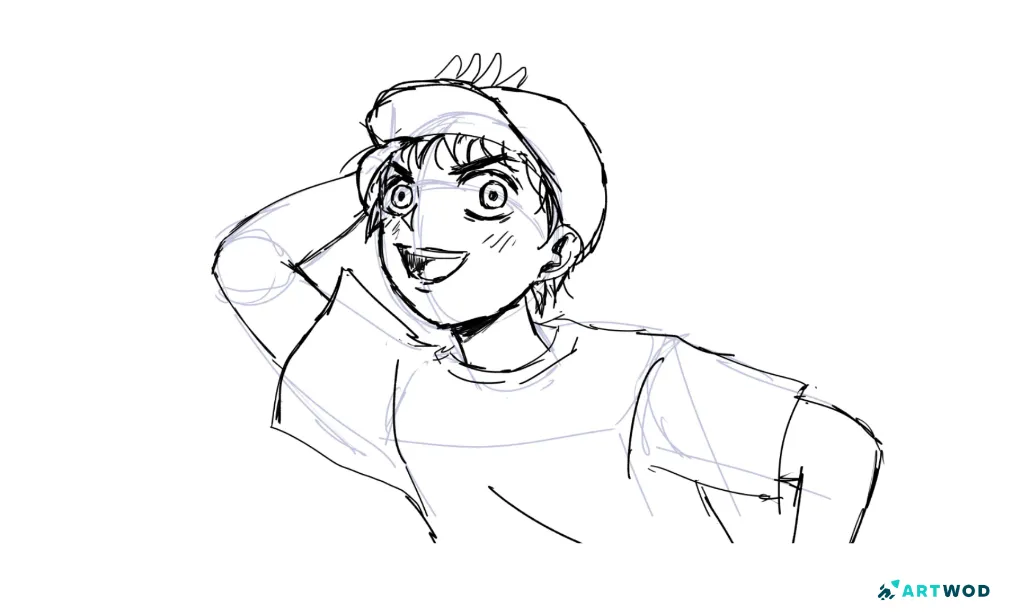
Anime boy eye drawing from a bottom-up viewpoint with pupils, face construction, and dynamic pose
The Artwork and the Problem
The submission, “Anime pupils but they don't seem right,” is an easy anime boy eye drawing study from a bottom-up viewpoint. The goal is a more dynamic pose, but the artist noticed that the pupils appear to point in different directions. They already identified an important clue: simply centering each pupil inside its iris does not seem to solve the problem.
The larger drawing shows a character looking upward from a low viewing angle, with the head tilted relative to the viewer. That means the eyes cannot be treated as two flat symbols placed independently on the page.
The important issue is construction.
When the head is viewed from below, the eyes need to follow the three-dimensional orientation of the face. If each eye is constructed separately, even small differences in angle or placement can make the pupils appear misaligned.
Why the Pupils Can Look Like They Point in Different Directions
A pupil can be perfectly centered inside its iris and still look wrong.
The reason is that the iris itself sits on the surface of the eyeball, while the eyeball is positioned within the three-dimensional structure of the head. When the face rotates or tilts, the visible shape and position of each eye change with that structure.
This becomes particularly important in a bottom-up viewpoint.
Instead of asking only:
“Is the pupil in the center of the iris?”
ask:
“Are both eyes following the same head orientation?”
That distinction can make pupil problems much easier to diagnose.
One way I have found to check to see if they are drawing arrows from the pupils to the object they’re meant to be looking at. This can be done whether they are looking at the sky, the ground, or the camera. If the pupils don’t match the direction of whatever they’re looking at, it will make the character’s eyes look off.
I used this method in my own illustration here, as you can see the pupils don’t sit exactly in the center of the eye, and instead are adjusted to look as if they’re looking to the side.
The paintover illustrates this by reducing the eye problem to simpler construction stages. The blue diagrams beside the character show progressively developed circular forms, while the red drawing demonstrates a simplified facial construction with the eyes placed within it.
The lesson is to solve the underlying structure before correcting the final pupil position.
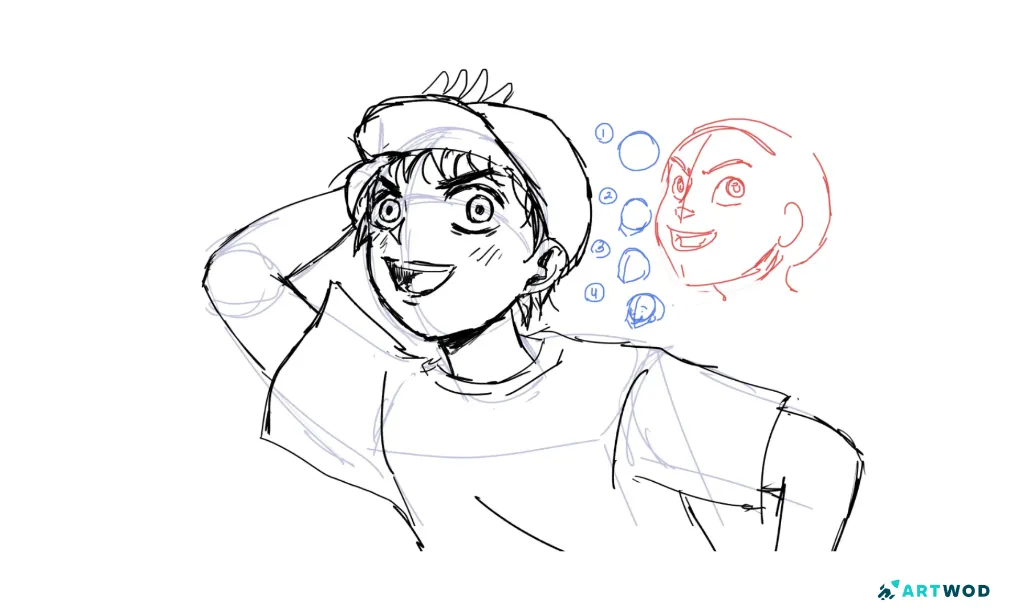
Anime boy eye paintover showing pupil placement, eye construction, facial structure, and four simplified construction stages
How to Draw Anime Eyes From a Bottom-Up View
Try building the eyes in this order:
Establish the head orientation.
Start with the overall head rather than jumping directly into the eyes. Decide how much the face is tilted upward and how the central facial axis travels across the head.Build the eye sockets or eyeball forms.
Think of the eyes as rounded forms embedded in the head. Avoid treating each eye as a flat shape.Place the iris within each eye.
The iris should follow the orientation of its corresponding eyeball and the direction of the character's gaze.Check both eyes together.
Compare their angle, height, spacing, and relationship to the facial centerline. Do not evaluate one eye in isolation.Add the pupils last.
Once the iris placement works, place the pupils according to the intended gaze.Simplify the final lines.
Only after the construction makes sense should you commit to the final anime eye shapes, lashes, eyebrows, and other details.
This workflow prevents the pupils from becoming a distraction while the underlying head construction is still unstable.
The Head Controls the Eyes
One of the most useful lessons from this sketch is that eye alignment is connected to head construction.
If the face is rotated upward, the visible portions of the eyes change. The eyelids, irises, pupils, eyebrows, nose, and mouth all need to occupy positions that make sense on the same three-dimensional head.
This is why repeatedly moving the pupils may not fix the drawing.
If the eyes still feel disconnected after several adjustments, temporarily remove the details and redraw the head using simple construction forms. Re-establish the facial centerline and eye placement, then rebuild the eyes from that structure.
There are many different ways to simplify forms in the head, but the method I use is starting with a circle and determining the center lines (horizontal and vertical) is a good place to start. From there you cut that top circle’s sides off and you can draw out the jaw as a curved line for the side of the center of the circle. It’s important to remember that the jaw starts, and connects to the back via an angle.
Another example of this is in this Artwod submission “Anime boy neck featuring a drawing of Aang” where the user felt the neck was off. Although, it was the overall head structure, including the eyes that was leading to the neck feeling off. Due to the underlying construction issues, here the eyes don’t seem to point the right way.
The paintover's simplified red head is useful precisely because it strips away much of the original drawing's complexity and makes the facial orientation easier to see.
A real good example of well done head and eye structure is this artwork submission, where the eyes have a clear structure and correct perspective, which leads to the eyes not seemingly like they’re looking in two separate directions.
A Quick Practice Exercise for Anime Eye Construction
Try this short drawing exercise before returning to the full character.
Draw four simple head circles from different viewpoints.
Add a central facial axis to each.
Draw the eye forms as simple rounded shapes rather than finished anime eyes.
Place matching irises inside them.
Add the pupils only after the eye orientation is established.
Check whether both pupils now appear to share the same gaze.
Then repeat the exercise with a stronger bottom-up angle.
The objective is not polished artwork. It is to train yourself to see the eyes as part of a three-dimensional head.
Common Mistakes to Watch For
Anime eyes can be stylized, but they still need to respond to perspective and head orientation. Copying the same eye shape onto both sides can make a dynamic pose feel flat.
Centering the pupils without checking the headPupil placement is only one part of the problem. If the iris and eye forms are incorrectly oriented, a centered pupil can still appear to look elsewhere.
Refining details before constructionLashes, eyebrows, highlights, and linework can make an eye look finished while hiding an underlying structural problem. Work from large forms toward small details.
Checking one eye at a timeThe gaze is perceived from the relationship between both eyes. Always step back and evaluate them together.
What the Paintover Shows
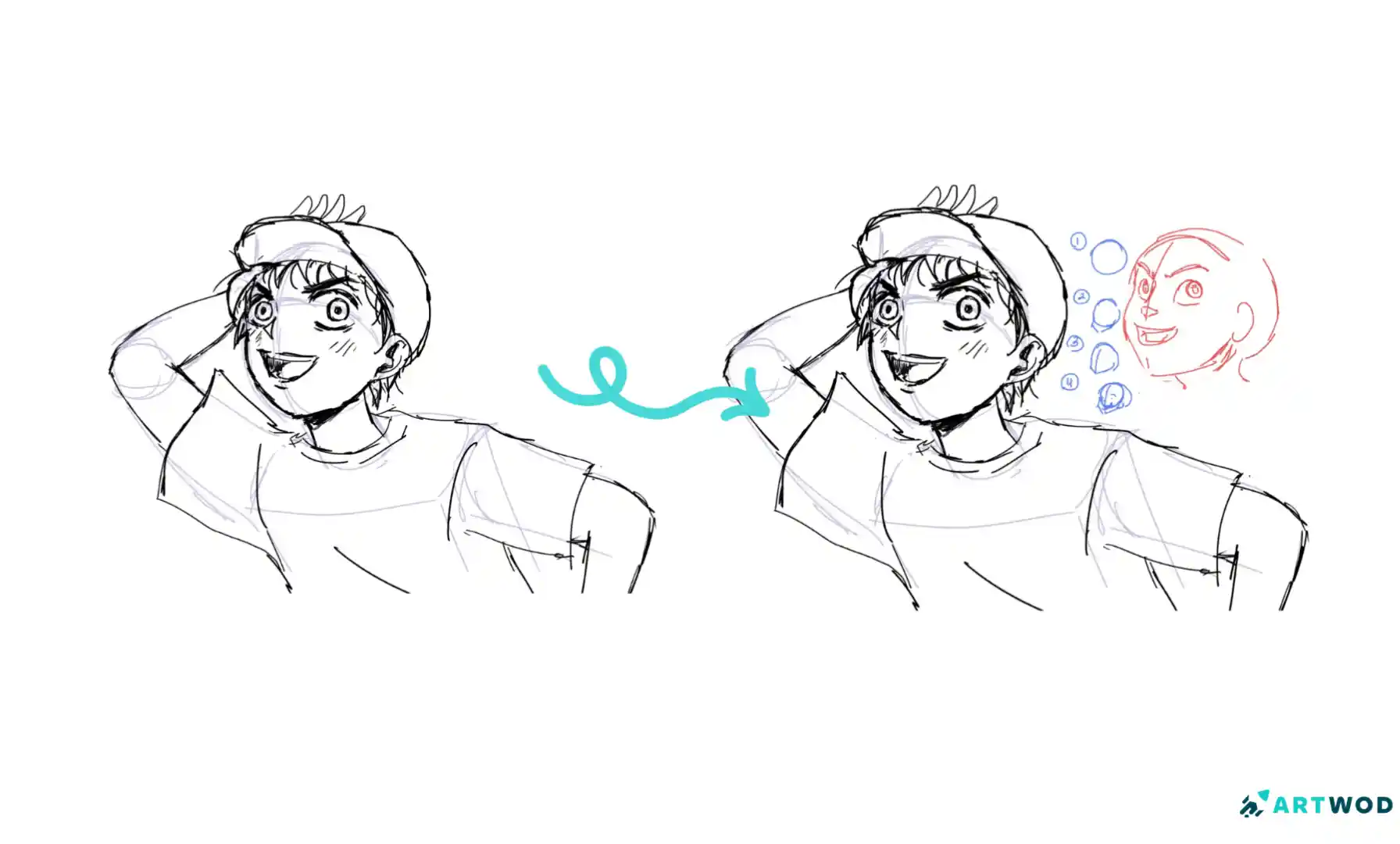
This submission does not contain a completed before-and-after drawing by the original artist. The second image is a paintover/visual correction, so it should not be presented as an artist transformation or an "after" version.
Instead, the paintover demonstrates an alternative construction approach. The red sketch simplifies the head and facial features, while the blue numbered diagrams show progressively built circular forms. Together, they shift attention away from the final eye details and toward the forms underneath them.
That is the transferable lesson: when an eye looks wrong, investigate the construction underneath it before endlessly adjusting the pupil.
What Other Artists Can Learn
Pupil placement depends on more than simply centering the pupil inside the iris.
A dynamic bottom-up viewpoint makes facial construction especially important.
Both eyes need to follow the same three-dimensional orientation of the head.
Simplified construction drawings can reveal problems that are difficult to see in finished linework.
Solving the structure before adding details makes eye corrections much easier.
Community Feedback and Peer Learning
A structural drawing problem can be surprisingly difficult to diagnose when you are looking at your own work. Sharing the sketch while you are still unsure about the construction gives another artist an opportunity to point out the relationship you may be missing.
Artwod’s Art Community is built around artists sharing work, explaining what they are struggling with, and getting feedback from other artists. The platform specifically positions feedback as a way to learn from mistakes and improve drawing skills.
That makes a question like this particularly useful for peer learning: instead of asking only whether the finished drawing looks good, the artist can identify the exact structural problem they are trying to solve.
FAQs
Start with the head's three-dimensional construction and facial axis before drawing the finished eyes. The eye forms, irises, and pupils should all follow that underlying orientation.
Why do my anime pupils look like they point in different directions?The problem may not be the pupils themselves. Differences in eye angle, iris placement, facial construction, or head orientation can make correctly centered pupils appear misaligned.
Should the pupil always be in the center of the iris?The pupil needs to be positioned according to the intended gaze and the orientation of the eye. Simply placing it geometrically in the center is not enough when the character is looking in a particular direction.
How can I improve anime eye anatomy?Practice constructing the eyes as rounded forms within a simplified head rather than drawing them only as flat anime symbols. Then add the iris, pupil, eyelids, and other details.
How do I draw a dynamic anime boy pose?Begin with the head orientation, gesture, and major forms before refining facial details. A strong viewpoint depends on the underlying construction being consistent.
Can feedback help with anime eye drawing?Yes. Another artist can identify construction or perspective relationships that are difficult to notice when you are focused on individual details. Explaining the exact problem you are struggling with can make the feedback more useful.
The main lesson from this anime boy eye drawing is that pupil placement is a construction problem as much as an eye-detail problem. When a character is viewed from below, the eyes need to follow the three-dimensional orientation of the head and work together as a pair.
The paintover does not show a completed transformation, but it provides a useful alternative way to think about the drawing: simplify the forms, establish the head and eye construction, then add the pupils and other details.
If the pupils still look off, the artist can go back in and check if the directions they’re sitting are correct. Are they following the trajectory of the head? Are they pointing towards the same direction from the angle? These are qualities you want to keep in mind evaluating your own work.
If you're struggling with a similar drawing problem, share your artwork with the Artwod’s Art community, explain exactly what feels wrong, and ask fellow artists for feedback on the specific issue. Another perspective can help you identify what to investigate before you spend more time refining the details. If you want some critique pertaining to your anime artstyle, you can post under the anime category.