Animal Drawing Mistakes Artists Make and How to Fix Them
Common Animal Drawing Mistakes Artists Should Fix
You spent six hours rendering every single hair on a wolf’s coat. The fur texture looks incredible, the lighting is dramatic, but when you step back to look at the final piece, something feels entirely wrong. It like a poorly stuffed taxidermy project.
If this sounds familiar, you aren’t alone. Capturing the organic fluid nature of wildlife is one of the hardest milestones for an artist.
The good news? You don't lack talent; you are likely just falling into a few common traps that sabotage your construction before you ever pick up a rendering brush. Let’s break down the most common animal drawing mistakes and look at exactly how to fix them.
Pro-Tip before we start:
Spotting your own anatomical errors is notoriously difficult. If you want professional eyes on your sketches to point out exactly where your perspective is warping, check out Artwod's centralized art feedback platform. It is the fastest way to bridge the gap between what you see in your head and what lands on the page.Why Animal Drawings Feel Unnatural
The primary reason animal drawings often feel unnatural is that artists try to draw what they think
they see, rather than what is actually there. Beginners frequently treat an animal as a collection of flat, 2D outlines.When you focus purely on the outer contours, you lose the 3D volume. Animals are organic machines built from interlocking three-dimensional masses. If you don't understand the underlying forms, your drawing will collapse the moment you try to pose the creature in a dynamic perspective.
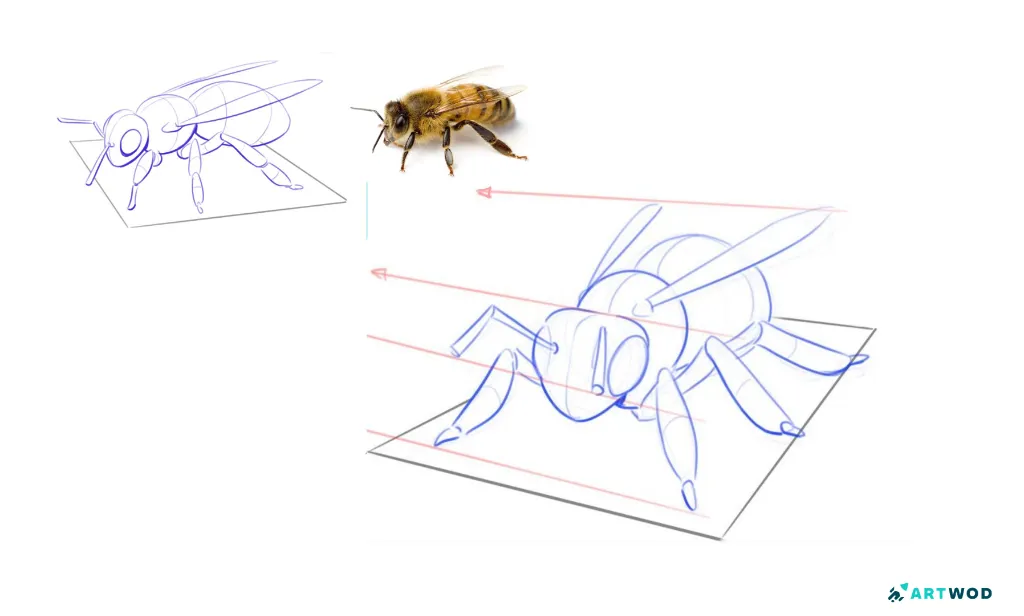
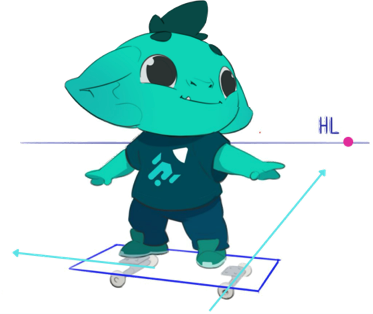
A bee drawn in 2 different perspectives with planes at the bottom for clarity. Instructional drawing. Reference attached
Missing the Skeletal Foundation
One of the most frequent animal anatomy errors beginners make is ignoring the skeletal framework. You don’t need to memorize every single bone, but you absolutely must understand animal skeletal structure to anchor your proportions. When you look at a quadruped (four-legged animal), think of it as two major boxes: the ribcage
and the pelvis, connected by the bridge of the spine. Common proportion mistakes in animal art happen when artists make the torso too long, the ribcage too shallow, or fail to tilt the pelvis correctly. If the distance between the hips and the shoulder blades is off, the entire drawing loses its structural integrity.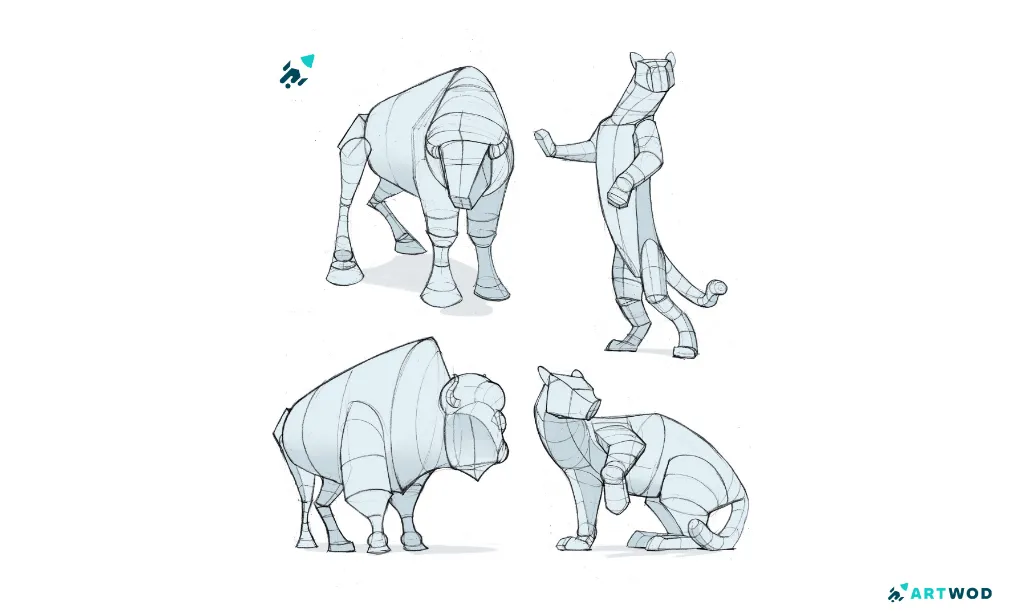
Sketches of animals, 2 bulls and 2 cats, broken down into simple form. Digital 2d drawing
Why Copied References Look Flat
We love Pinterest for inspiration, but relying blindly on photos introduces a major problem: why copied references still look wrong.
A camera flattens a 3D creature into a 2D plane, often distorting depth with a specific lens. If you copy a photo line-for-line without understanding the volumetric mass of the muscle groups beneath the surface, your drawing will look completely flat. You must learn to translate a photograph into forms you can rotate in your mind.
Fur Rendering Mistakes
Nothing ruins great anatomy faster than bad fur. The classic mistake is trying to draw individual hairs over the entire body. This results in the "pillow effect"—where the animal looks like a smooth sack with thousands of tiny, chaotic scratches on top.
Fur has weight, direction, and volume. It wraps around the muscles. To render fur correctly:
Group the hair into large, structural shapes.
Only render individual strands where the form turns sharply into the light or along the outer silhouette.
Let the underlying anatomy dictate how the fur folds and splits.
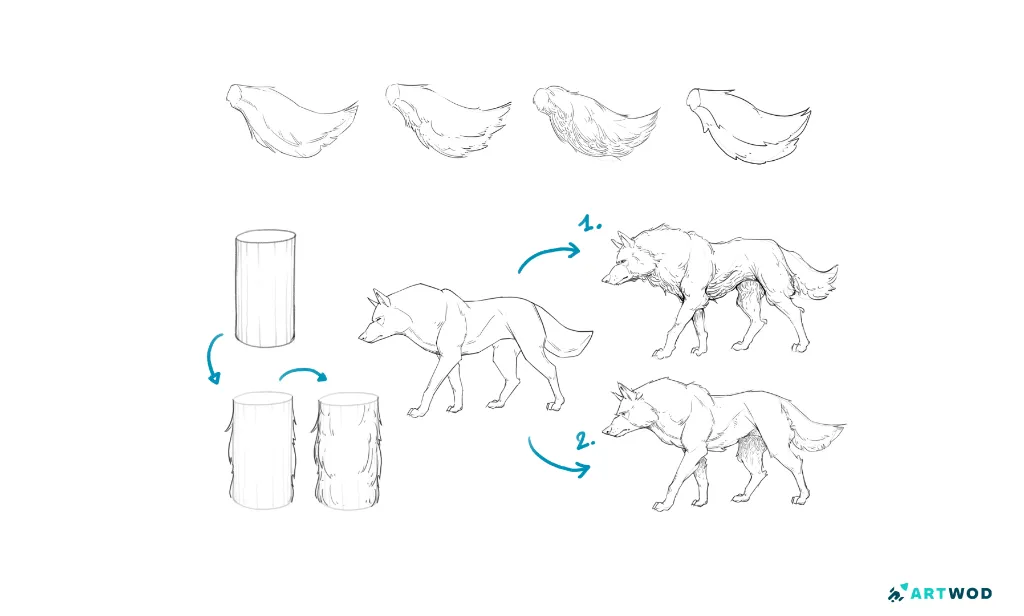
Wolf drawings by Arne Billen, explaining how to draw fur. Fur first is shown on a cylinder and then on wolf drawings. Digital 2d drawing.
The Ultimate Shortcut to Mastery
You can read every anatomy book on the shelf, but improving animal drawings through critique is the fastest way to break your bad habits. It is incredibly hard to spot your own perspective tilts or proportion errors because your brain automatically rationalizes your own work.
If you are tired of guessing why your sketches look off, get professional, tailored animal drawing feedback from the instructors at Artwod and other artists. Having an expert draw directly over your work to correct your underlying construction will save you months of frustrating trial-and-error.
Keep your sketches structural, master the skeleton first, and leave the fur for the very end!
Related Posts