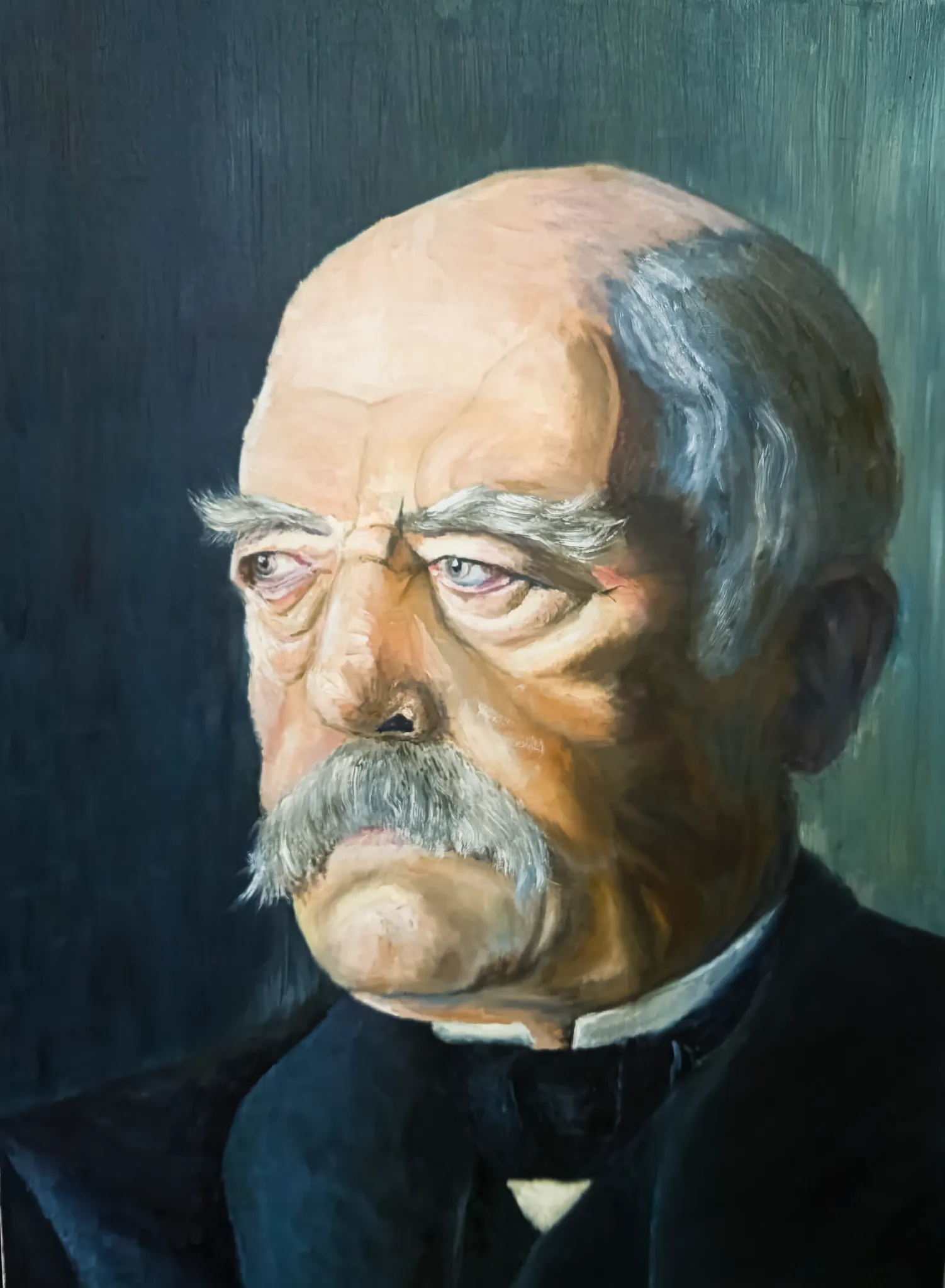
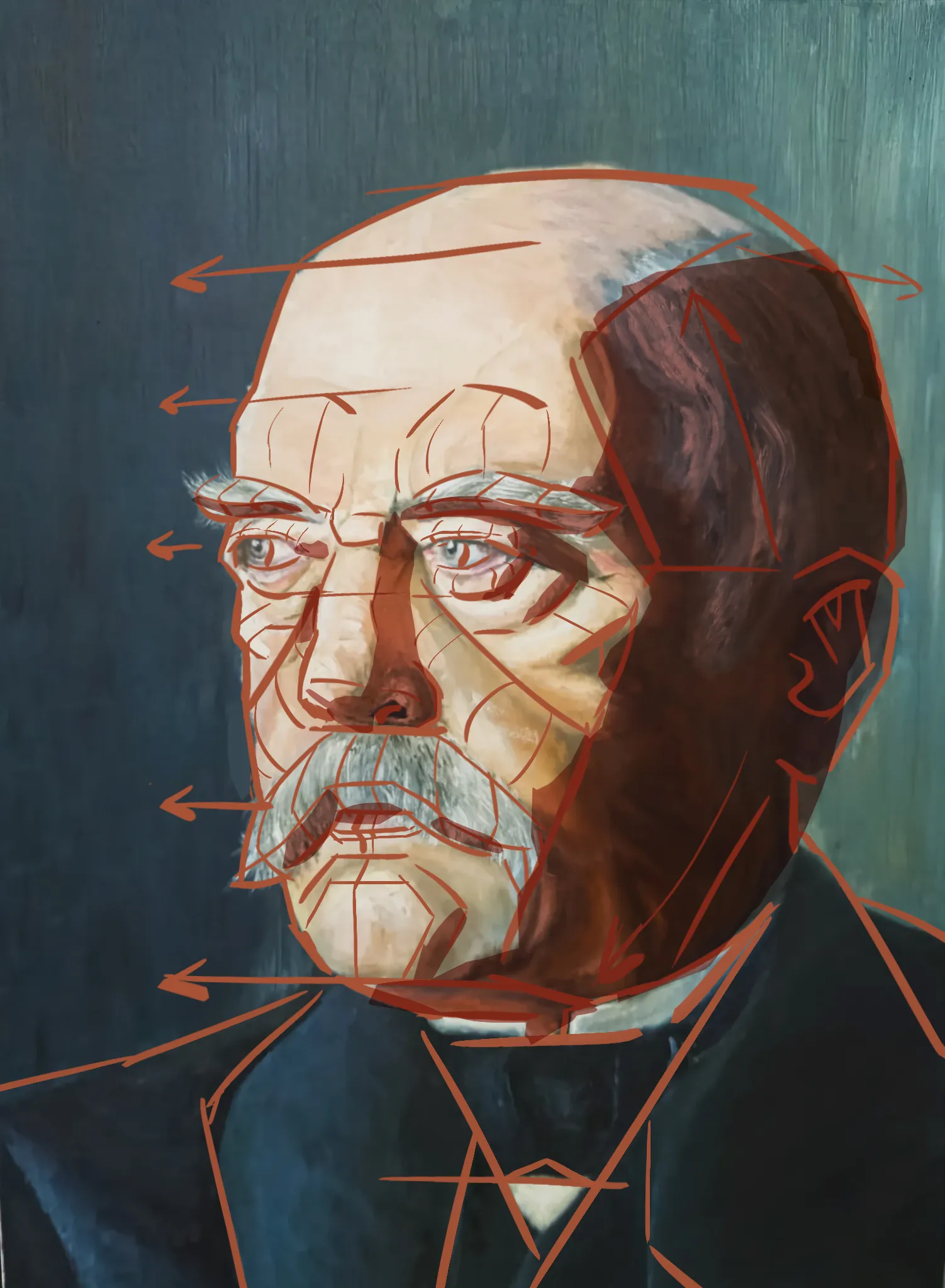

First of all, you've done a fantastic job capturing the subject's character and the intensity of his expression. There is a lot of life in the eyes, and the texture you are building in the facial hair—especially the mustache and eyebrows—gives the piece some really nice visual interest. You have a very strong foundation here. To help push the three-dimensionality of the painting even further, I put together a quick draw-over for you. Here are the main concepts I wanted to highlight: Building with Planes: Instead of looking at the face as a collection of 2D shapes, try breaking it down into distinct structural planes. The red lines map out how the surface of the face changes direction (like the sharp turn of the cheekbones or the bridge of the nose). Keeping this underlying structural logic in mind will make the head feel much more solid. Grouping the Shadows: To make the form really "turn" in 3D space, it helps to clearly separate your light family from your shadow family. In the redline, I blocked in a large, unified shadow shape on the right side of the head and jaw. Grouping these darks together instantly gives the head more volume and establishes a more convincing light source. Wrapping the Features: I added some directional arrows and cross-contours to show how the features need to wrap around the cylindrical form of the head. Paying close attention to how the center line and horizontal axis wrap in perspective will ensure the eyes, nose, and mouth all feel anchored to the same skull. You are making great progress with this piece. Keep up the great work, and I hope this visual breakdown helps you take it to the next level!
Thank's a lot for the feedback! I clearly see the shadows issue you are talking about. Regarding the wrapping the features you mean more blending to make the surface less flat?
Hey! Great question, but it's actually not about blending—in fact, too much blending can flatten your forms. By "wrapping," I mean treating the head as a 3D volume rather than a flat canvas. Imagine wrapping a drawing of a face around a coffee mug or a simple cube, the features have to physically bend and curve along with that surface. In your painting, the eyes, mouth, and brow, try to curving around the cylindrical form of the skull. The red grid lines in my draw-over represent that 3D surface curvature, and I marked all his side of the face and the planes facing way from the light source with darker red, so u can feel the form turning. For a great visual reference, look up the artist Krenz Cushart. He has amazing tutorials showing exactly how to map facial features onto curved 3D grids so they stay anchored in perspective.
Ohh, I think I understand now. Thank you!