
You can use markers as visual guides
Pinturas (0)
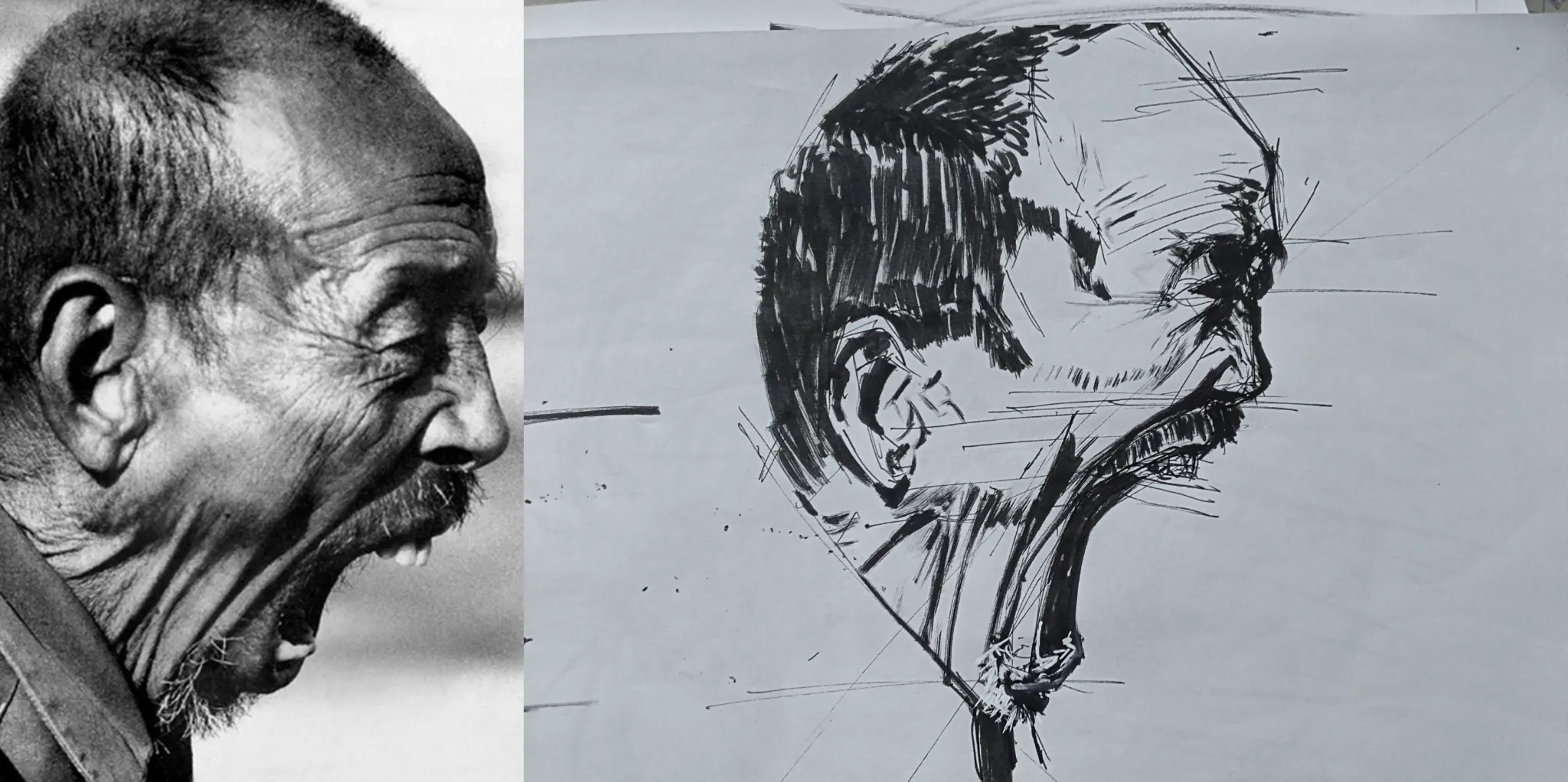
Observational study
Notas de autor:
I'm struggling with the proportions
Comenta 5
Definitely not perfect the feedback didn't go as planned because i totally failed to capture the expression. however what i wanted to hint was the proportions of the face
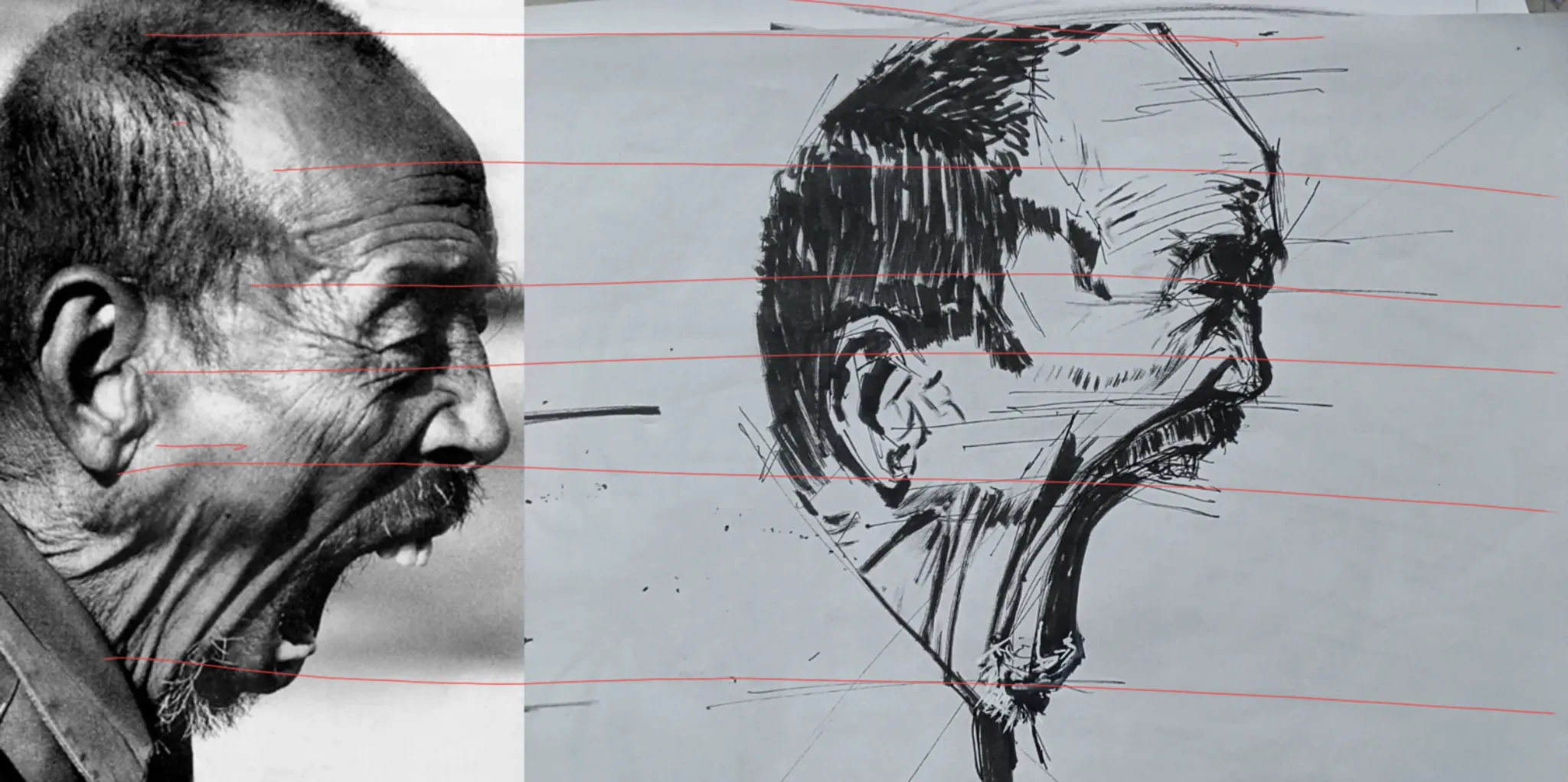
Hi, first of all really nice attempt. I really like your pen work and I think you did a really good job capturing the energy of the expression. The main issue I’m seeing here is in your observation of the reference. The problem is that you have treated the reference as a collection of details rather than as a unified whole. So the reason the proportions have gotten away from you is because you’ve placed each feature without referencing other parts of the face. In the top image I’ve placed some lines to show just a few relationships between the features. So you can see, for example, that the top of the ear lines up with the brow line. The purple line shows how the open mouth creates an angle that is shallower than what you’ve drawn. Observing your subject is all about noticing these relationships. Estimating or measuring the angle and the distance of invisible lines that connect the different landmarks of your subject. When it comes to drawing the head, especially when you have a difficult expression like this, remember that the skull doesn’t move. So in the middle image I’ve loosely drawn in his skull. Studying the human skull will help you a lot with drawing human heads because it provides you with landmarks like the eye sockets, the nasal bridge etc. In terms of how to go about the drawing, there are a lot of methods you can use. One user suggested the grid method. I personally wouldn’t recommend the grid. The grid is a legitimate are tool and has been used by traditional painters to accurately lay in their initial sketch onto the canvas before they start painting. The main benefit of the grid is that it’s the easiest way to adjust the size of your subject. So if your subject is smaller or larger than your canvas, the grid is the easiest way to get the proportions down if you’re not copying in a 1 to 1 ratio. The downside of the grid is it takes time to set up and the only thing you can do with it is copy your reference. In terms of a learning aid, this will not help you. It won’t help you to observe your subject and that’s why I don’t recommend it. In the bottom image I’ve started laying in a rough sketch using the Loomis method. The benefit of the Loomis method is you can take that reference and adjust it to your liking. You can even change the angle or apply the expression to a different head. Whatever method you use, try to slow down and spend more time placing the features. Start with the biggest shapes first. I first drew in a circle to represent the cranial mass. I made sure the circle was the correct size based on the reference. Then I placed a horizontal line to represent the brow line. This allowed me to place the ear. Observing the reference I can see roughly how big the ear is and how it relates to the brow line and the bottom of the nose. I used the angle of the mouth and distance from the bottom of the nose to the bottom of the chin to plot out where the jaw should be. At each step, I’m looking at what I’ve just drawn and I’m checking it with the reference. I’m looking for relationships to what I’ve already drawn to check the placement and if something looks off I make sure to see where it should be and then change it. To help train my eye, once I’ve finished with the initial sketch I then check it again against the reference. This is easier to do digitally because I can just place the sketch over the reference to see how close it lines up. If there are mistakes I make a note of what I did wrong (did I tend to make the distances between features too big or too small? Same with the angles). Once I’m happy with the proportions, then I go in and refine the details. There’s a lot there sorry. Hopefully that makes sense. Like I said you did a really good job with your drawing. There’s some really good shapes that you’ve gotten from the reference and with just a few tweaks on how you do your initial sketches I think you’ll do really well.
its pretty cool only need a previus sketch before if you want to be accurate
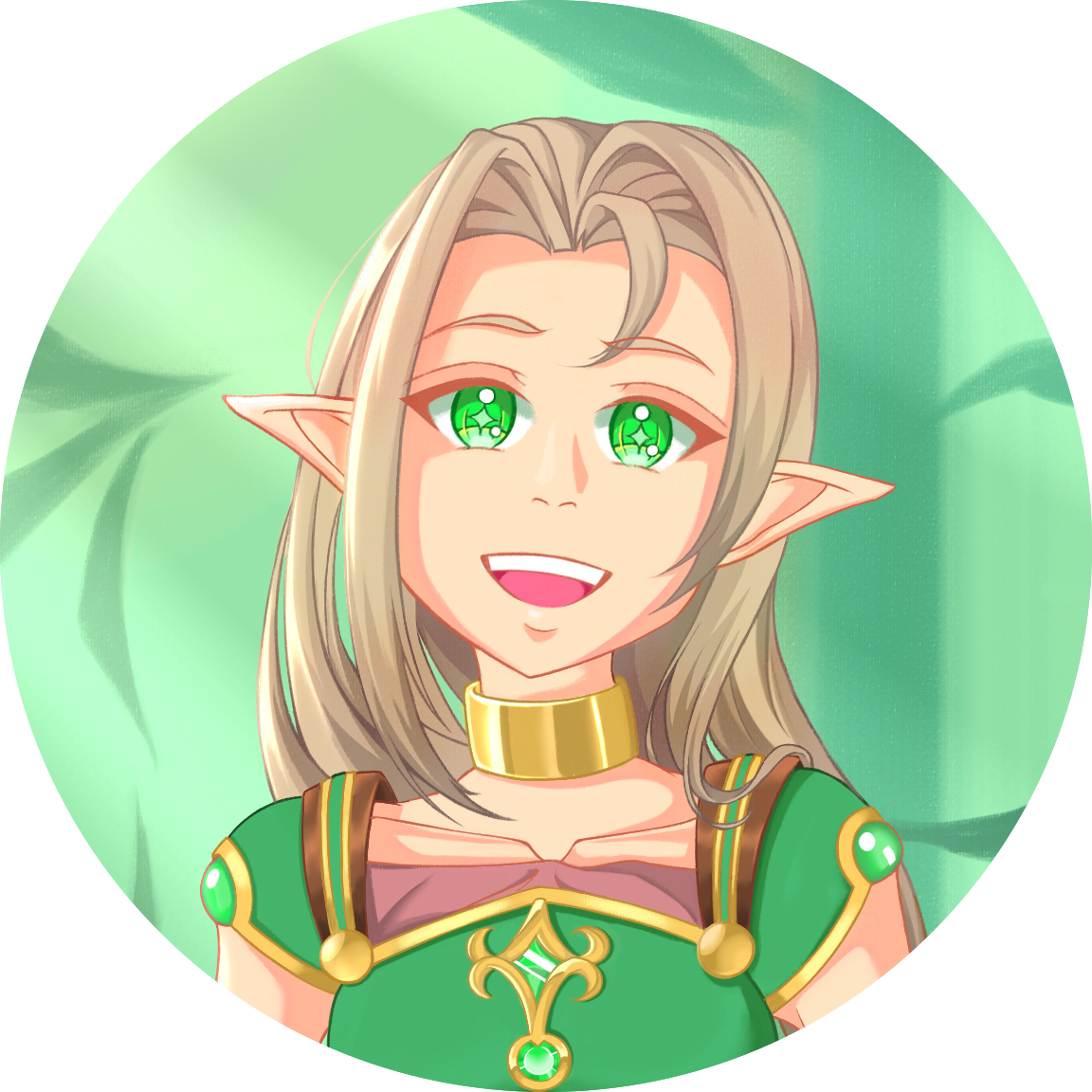
well, you’re doing a really good job of getting the posture and expression on this study so far. something that i would recommend if you’re working digitally is that you turn on the grid feature in your program. this will help you measure the proportions relative to each other so that you can see where certain forms should begin and end. in the draw-over, i’ve included an example of this type of grid so that it’s easier to visualize how well your proportions line up with the image that you’re studying. using a trick like this, you can practice trying to copy what you see without tracing so that you can hone the particularity of the lineart while crafting the silhouette. (also, if you’re doing this work traditionally instead of digitally, you might consider using rulers or other straight-edged items as guidelines as you continue this study). great job on what you’ve already drawn, and i wish you well as you move forward! ♡