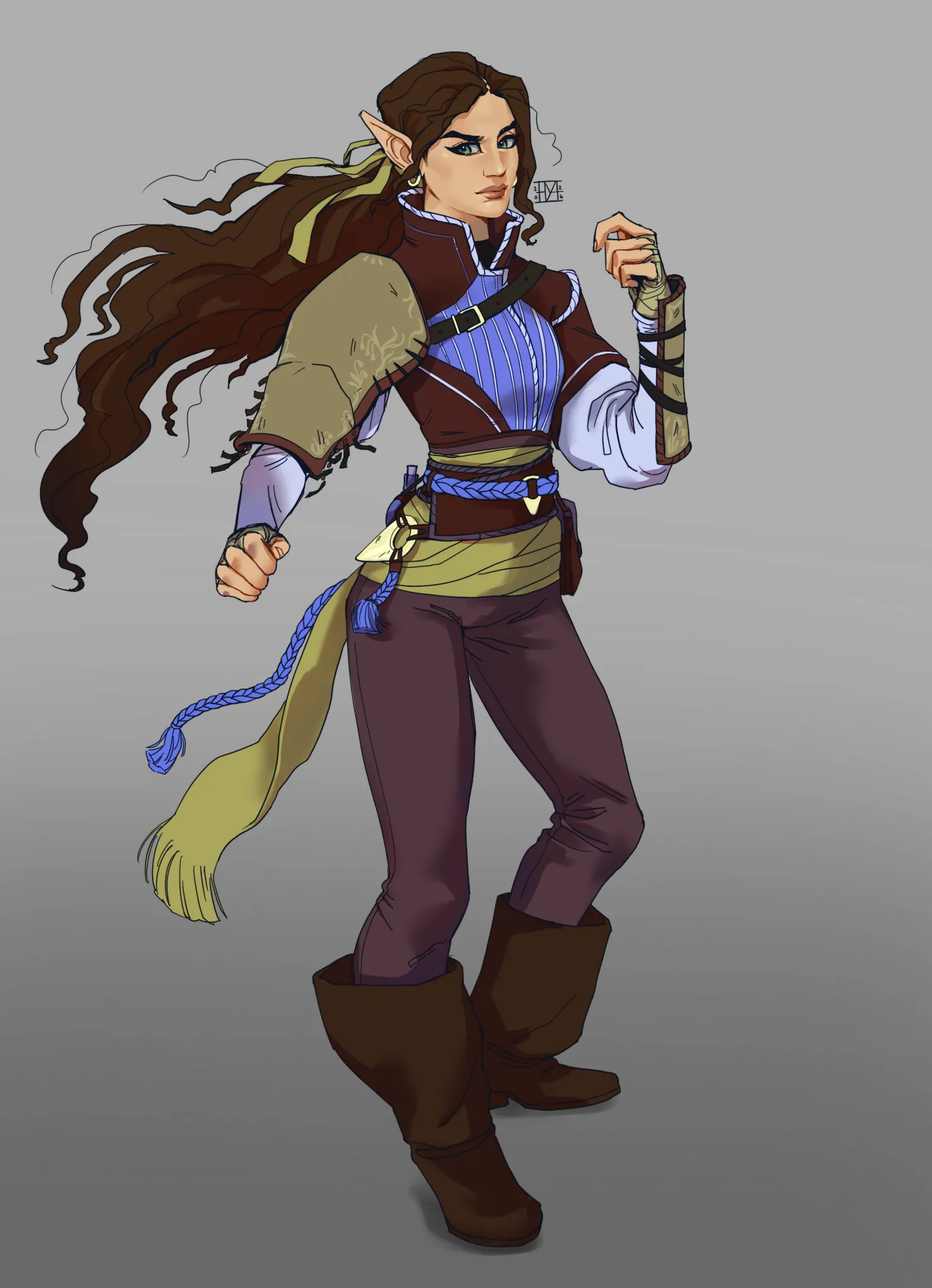
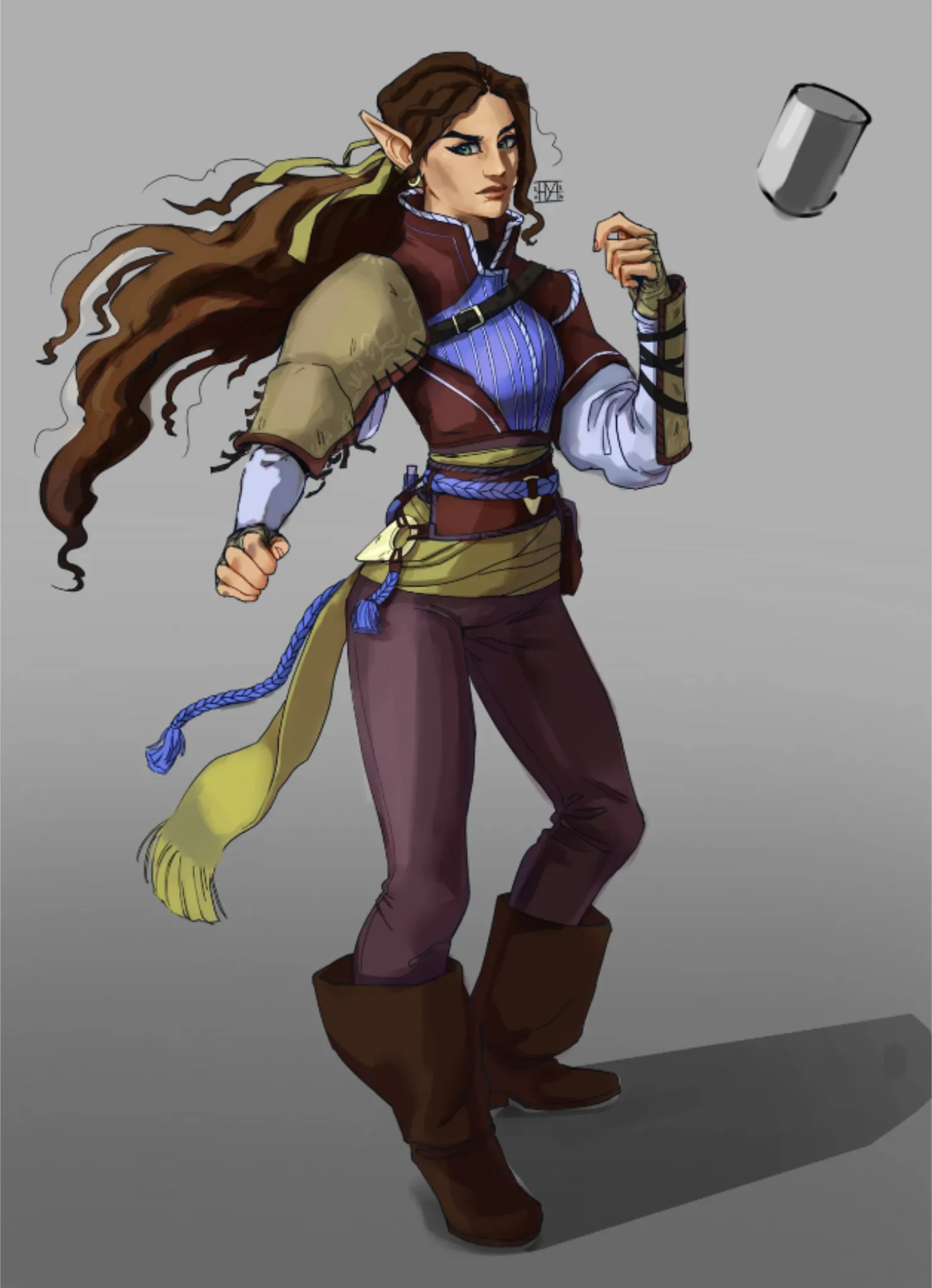


I see you’ve already received some really great feedback! I’d still like to add my two cents :D You chose a really nice color palette! You can use the color wheel when selecting your palettes (thinking about basic color theory: complementary colors, analogous colors, triads, etc.). From there, you can organize your colors using the BMS hierarchy (visual hierarchy). Not all colors should carry the same visual weight. Big (dominant color) The main color that occupies most of the character. This could be the cape, main armor, robe, etc. Medium (secondary color) A color that supports the dominant one but with less presence. For example: pants, gloves, shoulder pads, belts, etc. Small (accent color) A small color used to draw attention or create contrast. For example: jewelry, stitching, patterns, armor details, etc. Accent colors are often placed near the focal point of the character (usually the face or weapon) to help guide the viewer’s eye. Also think about your values when choosing your colors. Usually, it’s helpful to have a layer where you can toggle the values on and off. It’s something I commonly do to make sure the values are working properly. When painting, always keep the light source in mind (and whether there’s any secondary light you could use as a rim light to help highlight the silhouette). A simple way to think about it is by imagining cylinders. This helps keep the lighting consistent, but at the same time, as the artist, you get to decide where to focus the viewer’s attention. A common approach is to mainly light and render the upper part of the character (since we always look at faces as the main focal point), while keeping the lower part in darker values. Hope this helps!
Paintovers (0)
Regal Monk
Artist's notes:
I really struggle with color palletes and values that suit the character as well as making an art piece look finished!
Comments 4

Hello ! I love the character, she is very cool ! I think the colors you picked for her are very nice(mainly earthy tones with a blue accent works well), but what you could improve is shifting the temperature this way : Warm light ? Cooler shadows Cool light ? Warmer shadows That will bring some nice colors in there. Otherwise, to make it look finished, i would make sure to identify where the light comes from and really take my time putting the shadows where they need to be, and you can add a third value to give more dimensionality to the form. Finally, identifying the difference between the materials (maybe the cloth around her waist is a bit silky, a bit shiny, same for the brown leather on her chest. Dont overdo it, pick just a few of them that would make sense !) The contrast between these different materials, how shiny they are, how reflective, how dull, or rough, will push your work to a better finish !

sorry for the double feedback but i just noticed it isnt visible in the other comment ç_ç ( i dunno if you can download the feedback image as it is and not as i see it on the site)
Hi! So, i tried to give you some help on the values, and i think i've spotted the issue ( just because i did this a million times myself ç_ç) you design and then you try to bend the values after you decided a palette. On the contrary, what you should do is called compositional values, in which you design the piece to guide the eye where you want it to be, so you keep you higher contrasts on the part you want the viewer to look, and you mute the other less interesting parts, so the focus point is even more highlighted. Sorry for the butchering, but it was just to get the message accross. Then, when you have all your values figured out, you can put whatever colors you choose, cause remember, if the values work, the colors will too! Hope it helped, and i know very well the struggle. Cristiana