Portrait Drawing: Creating Unique Style
Portrait Drawing: Creating Unique Style
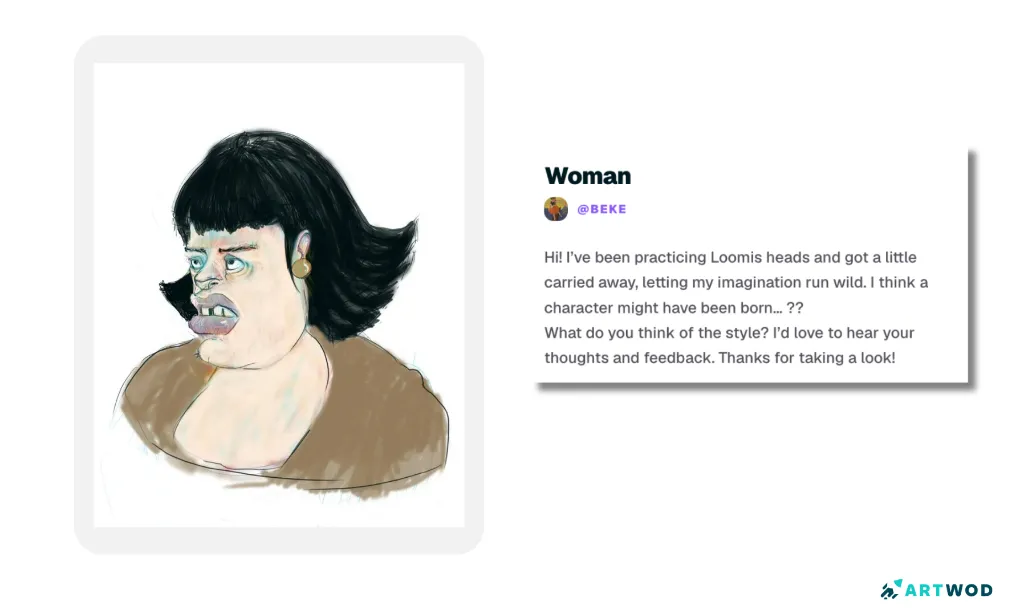
Woman portrait drawing created from Loomis head practice with an expressive character style
The Artwork and the Problem
The artwork was submitted by @beke in the Portraits category.
The artist explained that they had been practicing Loomis heads when they became carried away by their imagination and felt that a character might have emerged from the exercise. They were primarily looking for thoughts and feedback on the style.
That makes the submission interesting because it sits between structured portrait drawing practice and character creation. The challenge is knowing when experimentation is strengthening the character and when it starts to weaken the underlying structure. And it’s a challenge that many beginner artists are facing - getting out of the rigid structural boundaries like Loomis and Asaro and moving onto a more creative process.
Use the Loomis Head as a Foundation, Not a Constraint
The Loomis method is useful because it turns the head into a three-dimensional construction rather than a flat collection of facial features.
The basic idea is to establish the head's volume first and then place the facial features in relation to that volume.
If you’re having trouble with these first steps, you absolutely need to check out our Portrait road. Guided exercises for 10 minutes a day can make a significant change to your portraits.
For a portrait drawing like this, the construction can help you check:
The overall head shape
The direction the head is facing
The center line of the face
The brow and eye placement
The position of the nose and mouth
The relationship between the front and side planes
This doesn’t mean that the Loomis head has to have the same proportions in every portrait. You can change them according to your artistic choice, adjusting the features accordingly. Remember this:
Construction gives you control, stylization gives you personality.
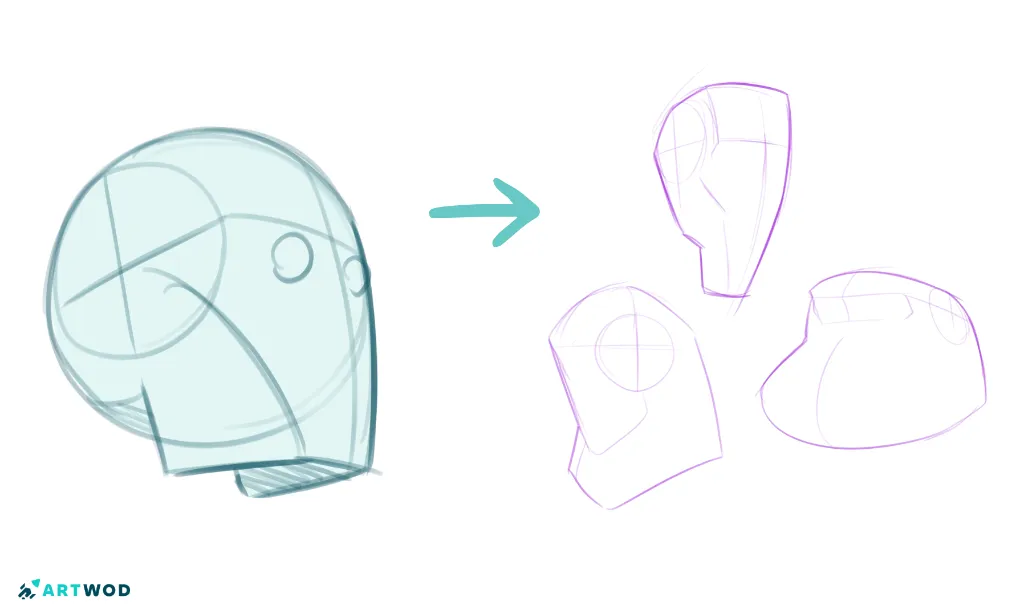
Loomis heads - basic Loomis to variants with changes proportions
How to Keep an Imaginative Portrait Drawing Structurally Convincing
When imagination takes over, it is easy to focus on individual features. You might change the eyes, jaw, nose, lips, hair, or proportions because each change looks interesting on its own. But over-obsessing with details can lead to losing the overall structure.
So, periodically step back and assess the whole head. You can even set a 20 minute timer to remind yourself of this check.
Ask:
Does the face still feel three-dimensional?
Do the features follow the head's orientation?
Are the eyes sitting on the same underlying plane?
Does the nose connect naturally to the face?
Does the mouth follow the curvature of the jaw?
These checks let you experiment without losing the construction that makes the portrait drawing feel solid.
Style Comes From Relationships
A recognizable character style is rarely created by changing one facial feature in isolation. Instead, it emerges from relationships between features.
For example, you might explore:
Larger or smaller eyes
A narrower or wider jaw
A longer or shorter nose
Stronger cheek shapes
Different eyebrow shapes
More angular or rounded facial forms
Exaggerated proportions
But changing several of these together creates a different result from changing just one.
The important question is not simply:
“Does this feature look good?”
Instead ask:
“Does this feature belong to the visual language of the rest of the character?”
That is where an imaginative portrait drawing can begin to feel intentional rather than accidental.
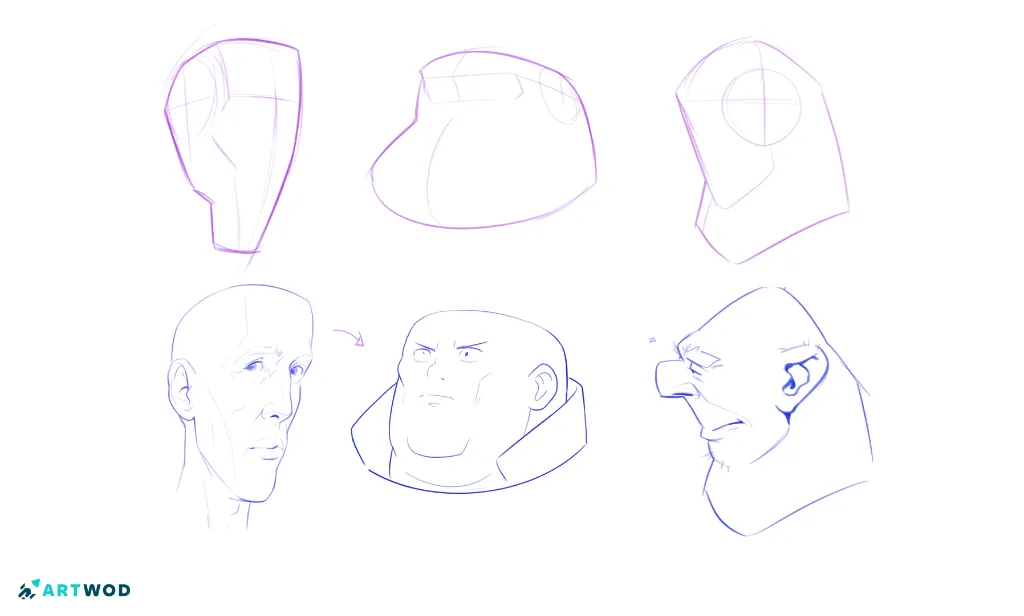
Modified loomis head to portrait transformation
A Simple Process for Developing a Character From a Portrait Drawing
Start with the basic Loomis construction and establish the head's orientation. You can first draw a standard Loomis and then practice other variations, trying out different proportions.
Step 2: Place the featuresUse the construction to position the eyes, nose, mouth, and other major features.
Step 3: Check the proportionsBefore stylizing, make sure the major facial relationships make sense.
Step 4: Experiment deliberatelyChange one or two characteristics at a time rather than altering everything simultaneously.
Step 5: Compare variationsCreate a few versions with different proportions, shapes, or expressions.
Step 6: Choose the strongest visual languageLook for the version where the features work together to create a distinct character.
This approach gives imagination room to work while keeping the exercise grounded in figure and portrait drawing fundamentals.
Don't Confuse Stylization With Incorrect Construction
A stylized portrait drawing does not need realistic proportions. You can exaggerate facial features considerably and still create a convincing character.
The important distinction is whether the exaggeration appears intentional and internally consistent.
For example, if the eyes are intentionally oversized, the surrounding features may need to adapt to that choice. If the jaw is made narrower, the placement of the mouth and chin should still make sense within the new structure.
Stylization changes the rules, but it does not eliminate relationships between forms.
Practice Exercise: Turn One Head Into Three Character Drawings
A useful exercise based on this submission is to take the same basic Loomis construction and develop three different character drawings.
Keep the head orientation similar.
First draw a Standard Loomis head.
Then do 3 versions with different proportions.
Draw facial features that fit the newly established proportions.
Compare the three versions.
The purpose is not to produce three finished portraits, but to discover how much personality can emerge from controlled changes to facial structure.
Remember to show off your versions in the Artwod Community!
Common Portrait Drawing Mistakes
Changing features independently: A stylized feature can feel disconnected when the rest of the face does not support it.
Skipping construction: Imagination becomes harder to control when the underlying head orientation is unclear.
Over-focusing on individual features: A feature can look good by itself while weakening the overall character.
Avoiding experimentation: Portrait drawing practice does not always have to remain purely observational; controlled invention can develop your understanding of facial structure.
Making every variation equally extreme: Subtle changes can sometimes create a stronger and more coherent character than exaggerating everything.
The most important lesson to remember is that structure does not have to limit creativity. It can give you enough control to experiment more confidently.
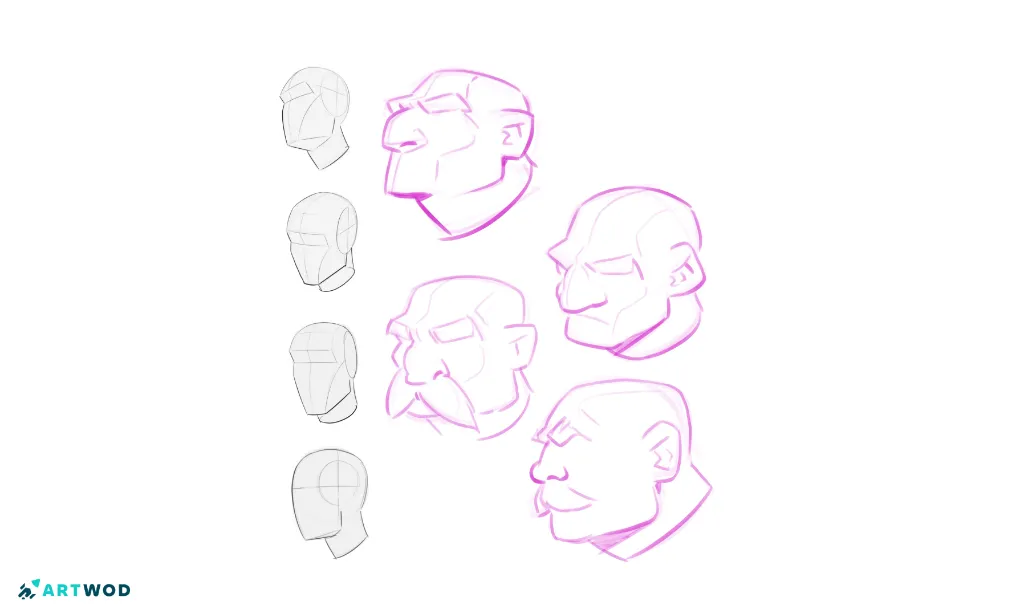
Another loomis to modified loomis to expressive portrait transformation
Getting Feedback on Portrait Drawing Style
Style can be particularly difficult to evaluate on your own because you are already familiar with the decisions behind the drawing. You may know what you intended the character to look like, while another artist only sees the finished result.
That makes focused feedback useful.
Instead of simply asking whether a portrait drawing looks good, you can ask whether the facial proportions feel intentional, whether the character's style reads clearly, or which feature is currently dominating the design.
The Artwod community gives artists a place to share their work, explain what they are exploring, and ask fellow artists for feedback on specific questions.
FAQ
Loomis construction helps you understand the head as a three-dimensional form and provides a framework for placing facial features. This makes it easier to experiment with proportions and style while maintaining structure. Check out our Intro to Portraits to get familiar with Loomis and other methods.
Can I use the Loomis method for stylized character drawings?Yes. Loomis construction can provide the underlying structure while you deliberately exaggerate or modify facial proportions to create a stylized character.
How do I develop my own portrait drawing style?Experiment with relationships between facial features, proportions, shapes, and expressions. Creating several variations of the same basic construction can help you identify visual decisions that consistently produce a character you like.
How can feedback help with character drawing?Another artist can tell you what visual impression the character actually creates rather than what you intended it to create. That can help identify whether proportions, shapes, or facial features are communicating the character you want.
Related Posts