Best Perspective Drawing Practice Routine for Artists
How to Practice Perspective Drawing Efficiently
Perspective is one of those subjects that makes artists feel stupid. You understand it intellectually - vanishing points, horizon lines, converging lines - but the moment you try to apply it to a real drawing... Well, you know how this goes. The building is falling and the character's environment doesn't match the character. It's frustrating in a way that most other drawing problems aren't, because perspective has rules, and you followed them, and it still looks wrong.
The problem is the order in which things get practiced. Here's how to build a step-by-step perspective drawing practice routine that actually builds spatial understanding instead of just teaching you to draw boxes.
Why perspective feels difficult for artists
Before you worry about buildings, streets, or environments, you need to understand how simple forms behave in perspective. They are the building blocks of everything else, and if you can't draw them convincingly in space, you can't draw anything else convincingly either.
The reason understanding forms before environments matters is that environments are just collections of forms: a building is a box with details and a tree is a cylinder with a sphere on top. And don't forget about human figures - they are series of boxes and cylinders arranged in space. Once the basic forms feel solid, the environment follows naturally.
So start here, before anything else. Draw simple forms from different angles. Draw them above the horizon line, below it, to the left of the vanishing point, to the right. Get them feeling right in space before you add complexity.
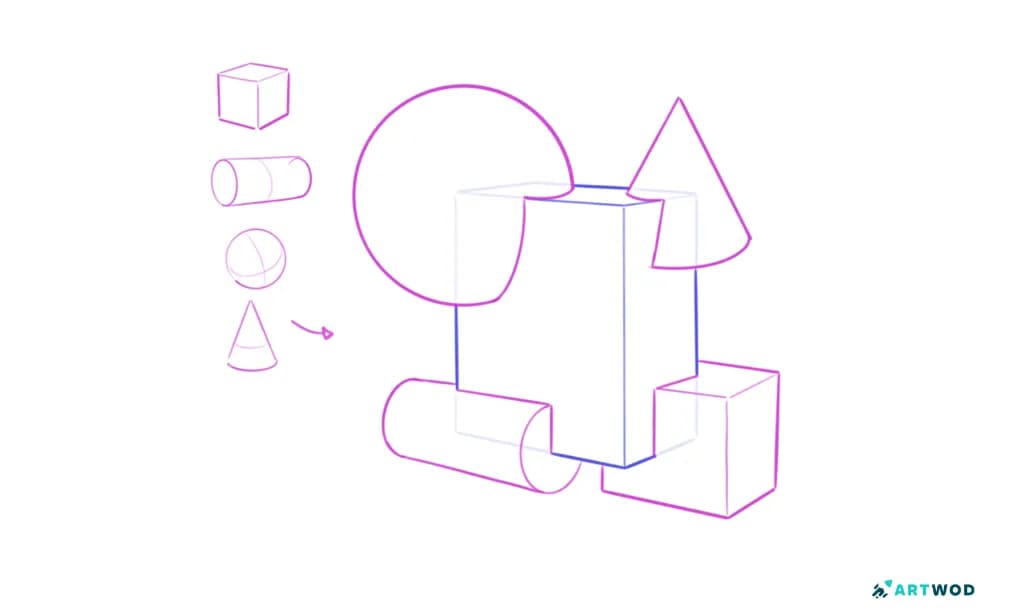
Simple forms arrangement in perspective, digital 2d.
One-point vs two-point perspective practice
One-point perspective is where most artists start, and rightfully so. Everything recedes to a single vanishing point on the horizon. It's the simplest version of the system and the best place to build intuition.
But two-point perspective is where spatial understanding really develops. Two vanishing points means forms can face in different directions relative to the viewer - which is how objects actually behave in real space. A box sitting at an angle to you has two sets of receding lines going to two different vanishing points, and learning to feel that intuitively is what makes perspective start to click.
Practice both, but don't move to two-point until one-point feels solid. The system builds on itself, and skipping ahead creates gaps that show up later as specific types of drawings that always feel wrong.
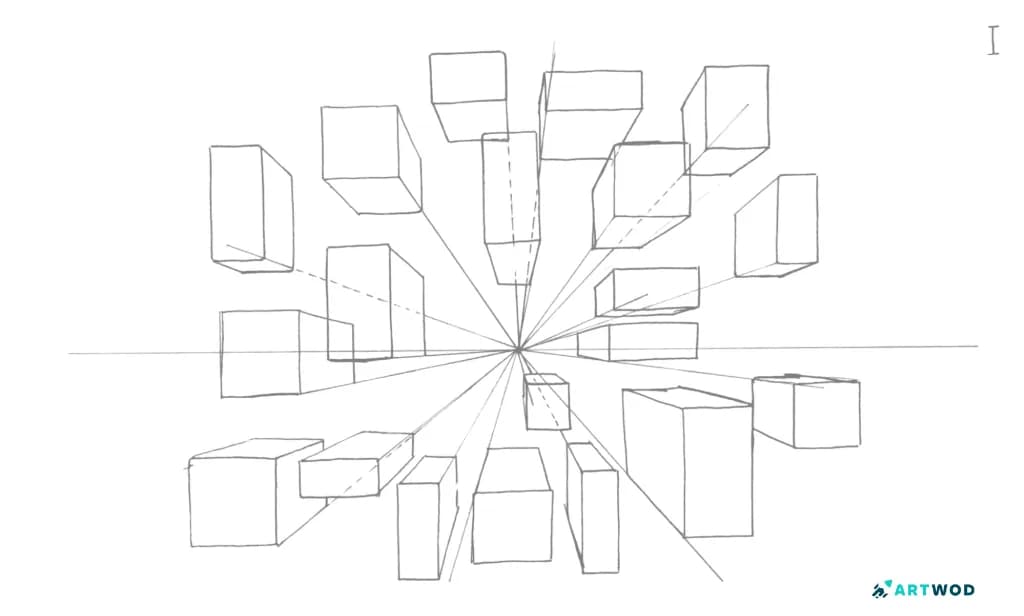
Student submission - boxes in 1 point perspective in digital 2d.
Drawing boxes and forms in space
Drawing boxes in space is the single most effective perspective drill available, and also the most underrated because it sounds boring. It's not boring. It's the fastest way to build spatial intuition because it isolates the perspective problem from everything else.
The practice: fill a page with boxes in different orientations, at different distances from the horizon, tilted at different angles. Draw through them - show all the edges, even the hidden ones. Make sure the lines converge correctly to the vanishing points. Vary the proportions.
Do this for 10-15 minutes before any drawing session and your spatial intuition will develop faster than almost any other exercise. Architects and industrial designers have been doing this for centuries. It works.
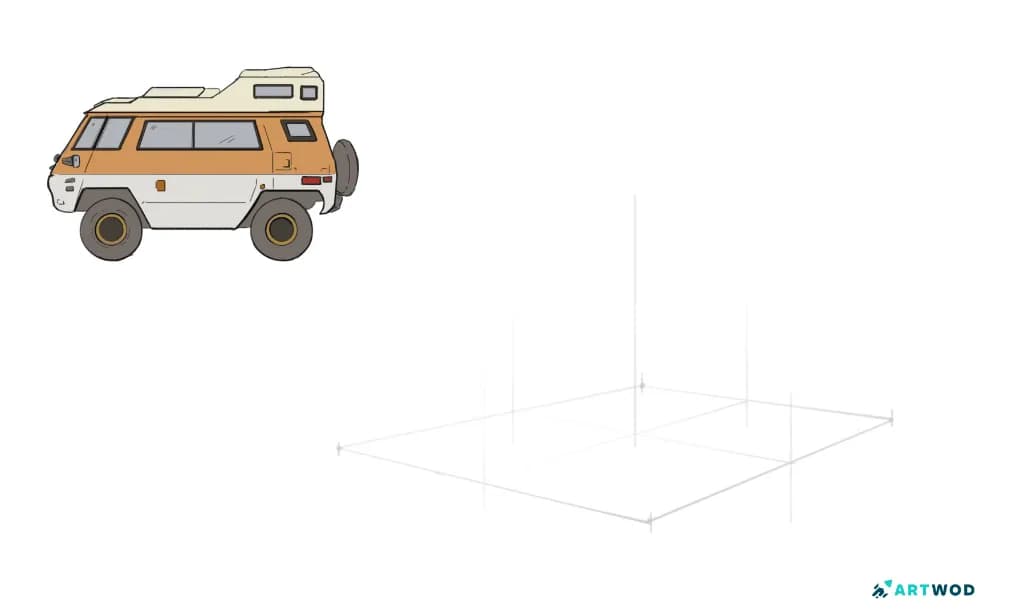
When you're done with boxes in perspective, try this art workout! Share results with community, if you need help
Perspective drills for beginners
The most effective perspective drills for beginners follow a simple progression. Start with horizon lines and single vanishing points. Place simple boxes on either side of the horizon, above and below it. Then add a second vanishing point and practice orienting the same boxes differently. Then start replacing the boxes with recognizable objects - a table, a chair, a simple building - while maintaining the perspective logic.
The key is keeping the drill short and specific. Ten minutes of focused perspective practice beats an hour of vague drawing. Know what you're trying to solve before you start, and stop when you've solved it.
Understanding depth and scale
Understanding depth and scale in perspective is about more than vanishing points. It's about how objects relate to each other in space - how the table in the foreground relates to the chair in the midground and the window in the background.
The rules are simple: objects get smaller as they recede. Horizontal lines converge toward vanishing points. Vertical lines stay vertical (in standard one and two-point perspective). The horizon line is always at eye level.
But understanding these rules and feeling them are different things. To develop the feeling, practice drawing the same scene with different eye levels. Put the horizon line high - you're looking down at the scene. Put it low - you're looking up. Put objects at different distances and make sure their relative sizes feel right. That practice builds the intuition that rules alone can't give you.
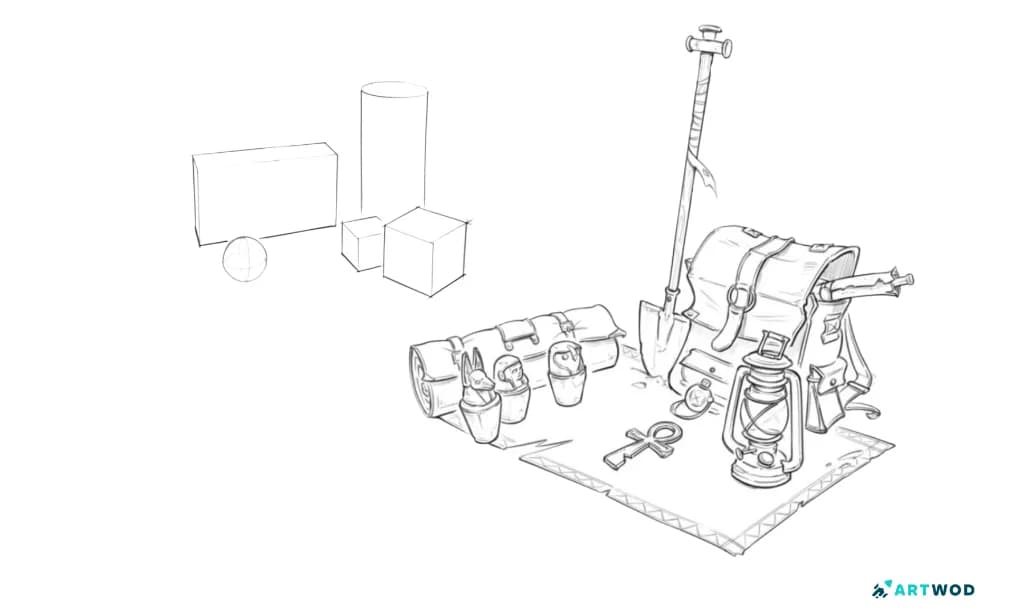
Prop arrangement below the horizon line, digital 2d art.
Common perspective practice mistakes
The most common perspective practice mistakes worth knowing before you make them:
Using rulers for everything - rulers teach you to draw technically correct perspective, but they don't build the hand-eye intuition that lets you feel perspective in a gestural drawing. Practice freehand, use rulers to check, not to draw.
Placing the vanishing point inside the picture - vanishing points often sit far outside the edges of your image. Placing them inside creates extreme distortion that reads as wrong. When in doubt, push the vanishing points further apart.
Ignoring the horizon line - the horizon is always at eye level, and everything in the scene relates to it. If you forget where your horizon is halfway through a drawing, the perspective will drift. Establish it first and commit to it.
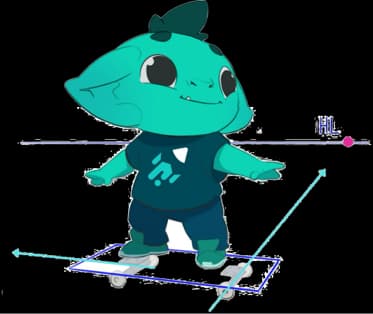
Applying perspective to environments but not figures - a figure standing in a perspective environment needs to obey the same rules as the environment. The figure's feet should align with the ground plane, their head should scale correctly with distance. Ignoring this breaks the illusion even when the environment is perfect.
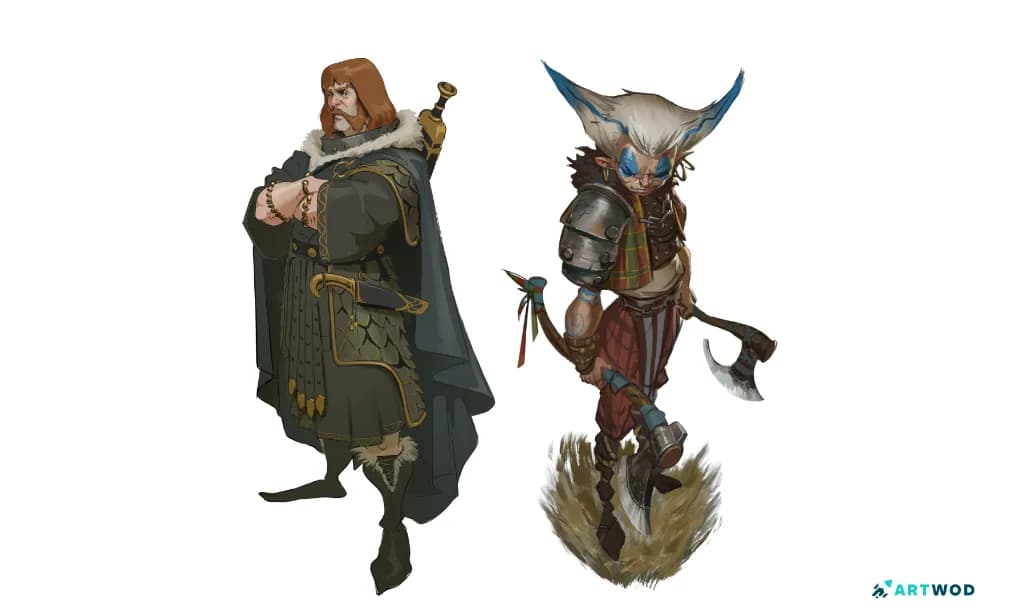
2 characters in perspective by Antonio Stappaerts, digital 2d art.
Applying perspective to characters and scenes
This is where applying perspective to characters and scenes gets interesting - and where most artists hit a wall. A technically correct box in perspective is one thing. A character standing in a room, at an angle, interacting with objects that all need to obey the same spatial rules, is another.
The bridge between boxes and figures is the mannequin. Before you draw a figure in a scene, block out a simple box figure in the correct perspective. Where are the feet on the ground plane? How tall is the figure relative to the environment? Once the box figure is in the right place and the right scale, the actual figure can be drawn over it.
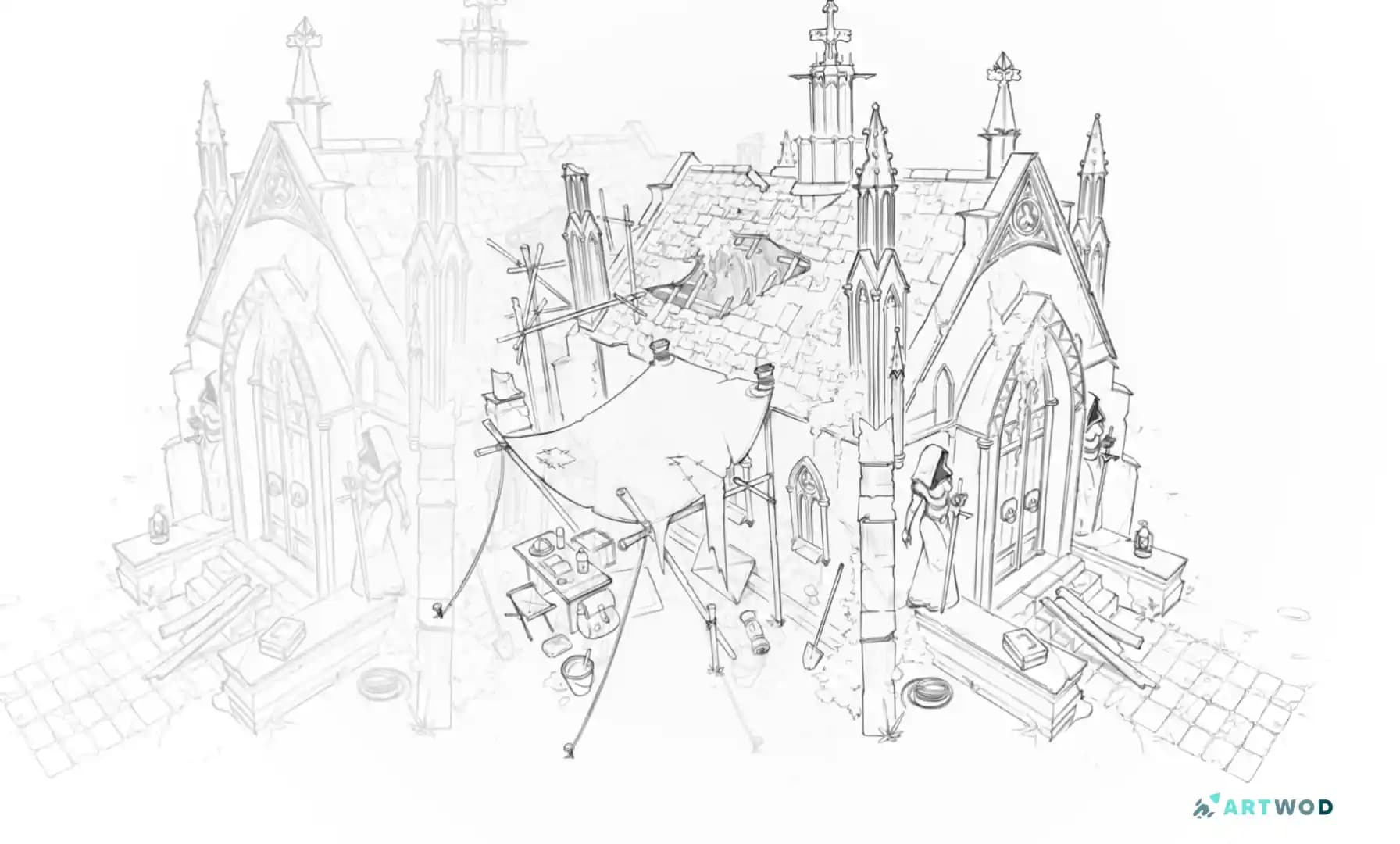
The same logic applies to objects. Before you draw a detailed chair, draw the box that contains the chair. Before you draw a complex building, block in the simple volumes first. Perspective happens at the construction stage, not the detail stage.
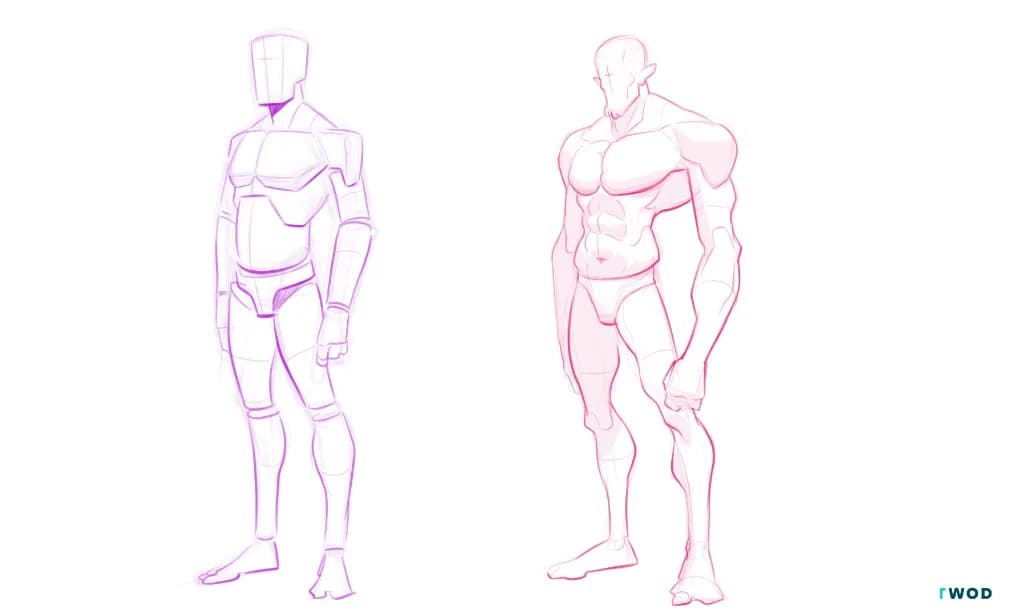
Mannequin to figure transformation, digital 2d art. 2 digital drawings side by side
Daily perspective exercises that work
The most effective daily perspective exercises are short, specific, and connected to real drawing rather than pure technical practice.
5 minutes of box drawing to warm up spatial intuition. Then 10 minutes applying perspective to a simple scene or environment. Then whatever your main drawing session is, with perspective applied deliberately rather than assumed.
That's 15 minutes of focused perspective practice before you start the actual work. Done consistently, it builds the kind of spatial understanding that starts to feel automatic - where you stop calculating and start feeling the space.
Improving spatial thinking through critique
One of the fastest ways to improve spatial thinking is to have your perspective work reviewed by someone who can identify where the spatial logic is breaking down. Perspective errors are often subtle - slightly wrong convergence, a figure that's scaled incorrectly for its position in the scene - and they're notoriously hard to see in your own work.
The Artwod perspective critique community is built for exactly this. Begginner or intermediate, submit your perspective studies or environment work and get specific, technical feedback from real artists on where the spatial logic is working and where it isn't. The art feedback and critique you get from someone with a trained eye changes how you see perspective problems in your own work - and that change is permanent.