Anime Bangs Drawing: Make Hair Look Natural and Fluffy
Anime Bangs Drawing: Refine Hair Flow and Volume
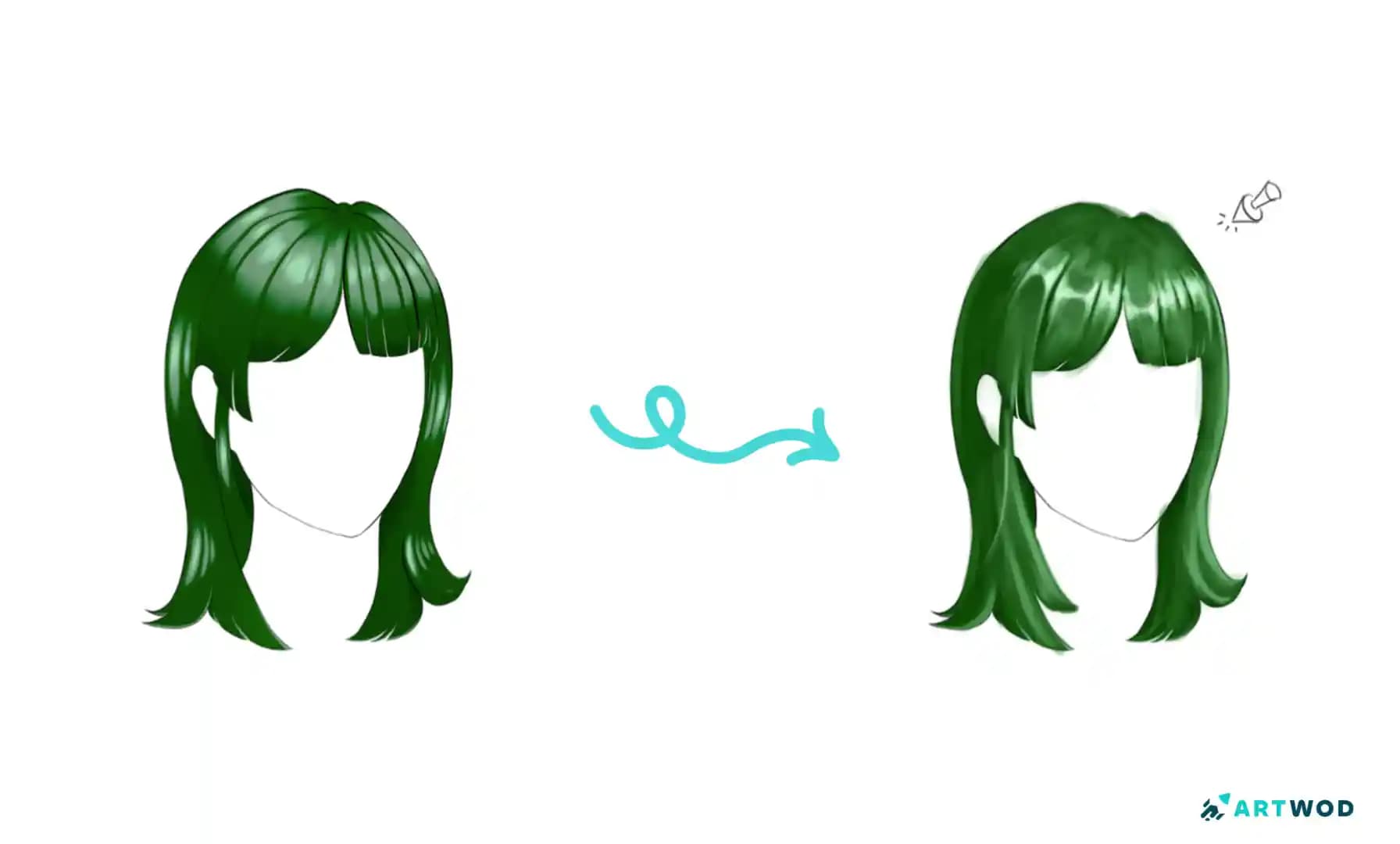
Artist @kyaw71178 shared a quick colored anime hair study asking for help with female anime bangs that looked "pasted on." The artist specifically wanted to make the bangs look more natural and fluffy. The feedback shows how hair grouping, flow, volume, and lighting can work together to make bangs feel more integrated with the hairstyle.
Insights shared in this blog post are by: @gabrielle34427. You can also request feedback on your artwork in Artwod’s Art Community.
The Feedback Request: Making Anime Bangs Look Natural
In the Artwod Feedback Tool submission, @kyaw71178 explained: "I'm trying to draw female anime hair bangs but they look pasted on instead." The artist asked how to make them look more natural and fluffy.
The artwork shows a stylized green hairstyle with large bangs across the forehead, longer sections framing both sides of the face, and bright highlights running through the hair.
The core issue is not simply a lack of detail. The bangs already contain multiple sections and highlights. The bigger question is how those sections relate to the overall hair mass.
When bangs look pasted onto the head, it can help to stop thinking about individual strands and instead ask:
Where is this section of hair coming from, and how does it flow into the larger hairstyle?
That change can make the hair feel much more connected.
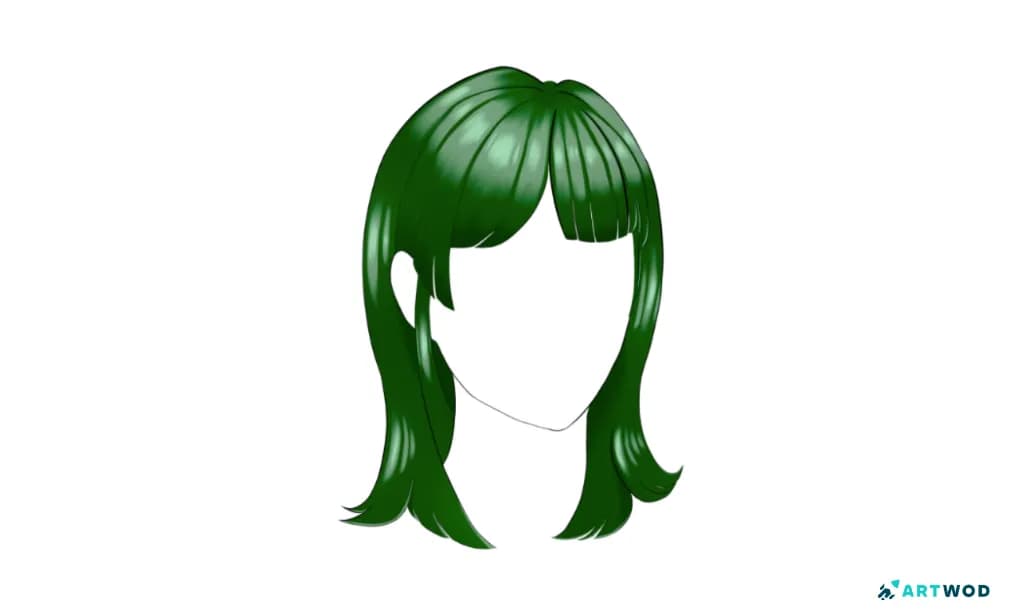
Colored green anime bangs drawing with long side sections, rounded hair masses, and bright highlights
Start With Large Hair Masses
A useful way to draw anime bangs is to establish the larger masses before worrying about individual strands.
The hairstyle in @kyaw71178's submission already has several major sections: the top hair, central bangs, side sections, and longer hair around the face. The next step is to make those sections feel connected rather than independently placed.
Try this sequence:
Establish the overall hair cap. Think of the hair as a volume sitting over the head.
Identify where the bangs originate. The front sections should emerge from the larger hair mass.
Divide the bangs into a few major locks. Avoid immediately breaking them into many thin strands.
Give each lock a clear direction. Let the shapes curve, overlap, or taper naturally.
Add smaller strand details last.
This makes the bangs feel like part of the hairstyle rather than an attachment placed over it.
Make Anime Bangs Feel Fluffy
"Fluffy" hair does not necessarily mean adding lots of individual lines.
Volume comes from the silhouette and the way the locks overlap. A fluffy bang can have a broad base, a curved outer contour, and a tapered end. Several such locks placed together can create the impression of softness without requiring dozens of strands. When I draw fluffy bangs, making strands not follow as uniformly can help, while still following the hair line having some strands stick up, curve or curl can make a difference.
Look at the negative spaces between the locks as well. Small gaps and overlaps can make the hair feel lighter and more dimensional.
If every bang has the same width, curvature, and spacing, the hairstyle can start to look mechanically assembled. Varying the size and direction of the major locks creates a more natural rhythm.
For the artist's specific concern about the bangs looking pasted on, this is especially important: the bangs need to feel like they belong to the same volume as the rest of the hair.
Another anime artwork submission, featuring a subject with her hair blowing in the wind has a nice example of fluffy bangs. Notice the curves and the additional strands.
Follow the Flow From the Hair's Origin
One of the most useful changes visible in the paintover is the organization of the hair's directional flow. The revised version makes the major sections read more clearly as connected forms rather than isolated pieces.
When drawing bangs, imagine the hair emerging from the scalp and flowing outward.
The strokes and contours should support that movement. For example, a lock can begin close to the top of the head, curve toward the forehead, and taper toward its tip.
This gives the viewer a reason for the shape.
The same principle applies to the longer side sections. Their curves should communicate how the hair travels downward and outward rather than simply filling the available space beside the face. A tip that could help is drawing a circle or line where several strands connect. This makes the hair feel less disjointed and more like it all flows from the same place. The strands don't all have to connect to the same place, but having a general direction of flow can be a big help.
I personally think this other piece from this user feels more cohesive, as this feedback submission has a clear direction, the hair is being pulled back. We can see the direction all flows from the same place. Following this principle in other pieces can help strengthen the look of the hair.
Use Highlights to Describe Hair Form
The original drawing already uses bright highlights across the green hair. The issue is not necessarily a lack of highlights; it is how those highlights relate to the underlying hair forms.
The paintover introduces a clearer lighting direction, shown by the light-source symbol, and reorganizes the highlights so they help describe the larger hair masses.
When rendering anime hair, think of highlights as form indicators.
Instead of placing a bright mark wherever it looks attractive, ask:
Which part of the hair faces the light?
Which major lock is turning toward or away from it?
Should the highlight follow the curvature of that lock?
Where should the brightest accents be concentrated?
This makes the coloring support the drawing rather than sit on top of it.
Lighting that lacks forms can make the hair look fake or plasticy, we can see in other feedback submissions by this user as well such as here in “Anime long hair isn't actually easy to draw at all”. The highlights here also don’t follow an exact trajectory, and have a lack of dimension due to the low amount of transition from hair to highlight.
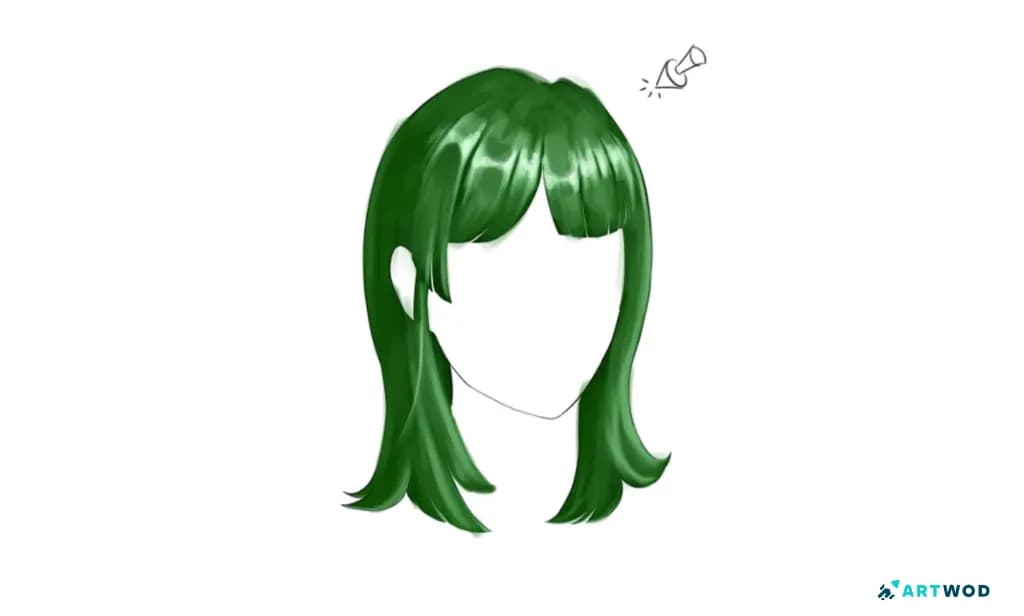
Anime bangs paintover showing clearer hair masses, smoother hair flow, and highlights organized around a defined light source
A Simple Anime Hair Practice Exercise
Try practicing bangs in three stages.
Stage 1: Silhouette
Draw only the outer hairstyle and major bangs. Use no strand details.
Stage 2: Hair masses
Divide the silhouette into a handful of large locks. Give each one a clear direction and taper.
Stage 3: Lighting
Choose one light source and add a limited number of highlights that follow the curvature of the locks.
Repeat the exercise with different bang shapes: straight, curved, side-swept, and uneven.
The goal is to make the hairstyle look convincing before adding detailed rendering.
Common Mistakes When Drawing Anime Bangs
A few habits can make bangs look pasted on:
Drawing each bang as an isolated object
Adding strand lines before establishing the major masses
Making every lock the same size and shape
Ignoring where the hair originates from the scalp
Using highlights without a consistent light direction
Adding more rendering when the underlying silhouette is still weak
If the hair feels artificial, adding additional detail is usually not the first solution. Reconsider the larger shapes and their relationships.
What Other Artists Can Learn From This Drawing
Hair is a connected structure. Individual locks should still belong to a larger mass.
Volume starts with silhouette. A convincing outer shape can communicate fullness before rendering begins.
Fluffy does not mean detailed. Large, well-shaped locks can create softness without excessive strands.
Highlights should follow form. Lighting becomes more useful when it reinforces the direction of the hair.
Fix structure before rendering. More color and shine cannot fully solve disconnected hair shapes.
These principles apply to many stylized hairstyles, not just anime bangs.
How Community Feedback Can Help With Hair Drawing
Hair is particularly easy to misjudge when you have been staring at the same drawing for a long time. Another artist can point out whether the problem comes from the silhouette, the direction of the locks, the connection between sections, or the rendering.
For a question like @kyaw71178's, the most useful feedback is specific to the stated problem: why do the bangs look pasted on, and what would make them feel more natural and fluffy?
When sharing an anime hair drawing for feedback, asking about hair flow, volume, or the relationship between the bangs and the larger hair mass gives fellow artists a concrete problem to respond to.
Focused peer feedback can help identify structural problems before spending additional time on rendering. The Artwod Community tool allows artists to get feedback from other artists just like @kyaw71178.
FAQs
Start with the overall hair mass, then divide it into a few connected locks that originate from the scalp. Give each lock a clear direction and taper instead of treating the bangs as separate pieces.
Why do my anime bangs look pasted on?The bangs may not visually connect to the larger hair mass. Check where they originate, how they overlap, and whether their shapes follow the same overall flow as the rest of the hairstyle.
How do you make anime hair look fluffy?Use broad, varied hair masses with curved silhouettes, tapered ends, and controlled negative spaces. Fluffiness comes from volume and shape rather than simply adding more strands.
Where should highlights go on anime hair?Place highlights according to a consistent light source and let them follow the curvature of the major hair locks. Concentrated highlights are generally more useful than random bright marks.
Should I draw individual strands before coloring anime hair?Usually, establish the large hair masses and major locks first. Smaller strands and rendering details can be added after the structure is working.
How can I make colored anime hair look more three-dimensional?Use value and highlight placement to describe the major hair forms. Decide where the light comes from and make the highlights reinforce the curvature and direction of the locks.
Natural-looking anime bangs begin with structure. Establish the hair volume, connect the bangs to the larger hairstyle, give each major lock a clear direction, and use highlights to reinforce those forms.
For @kyaw71178's specific problem, making the bangs look less pasted on does not require simply adding more strands or rendering. The more important step is making the bangs feel connected to the same underlying hair mass. Considering your light source is a critical step to making your piece look more believable. It’s also important to mention that hair does not have to be perfectly uniform, in my opinion it can look more realistic with a bit of variation in strands.
If you're practicing anime hair, sharing your sketch and asking specifically about hair flow, volume, or lighting can help you identify the structural issue that is hardest to see on your own. The anime category under the feedback tool is the perfect place to get advice on how to improve your anime artwork!