
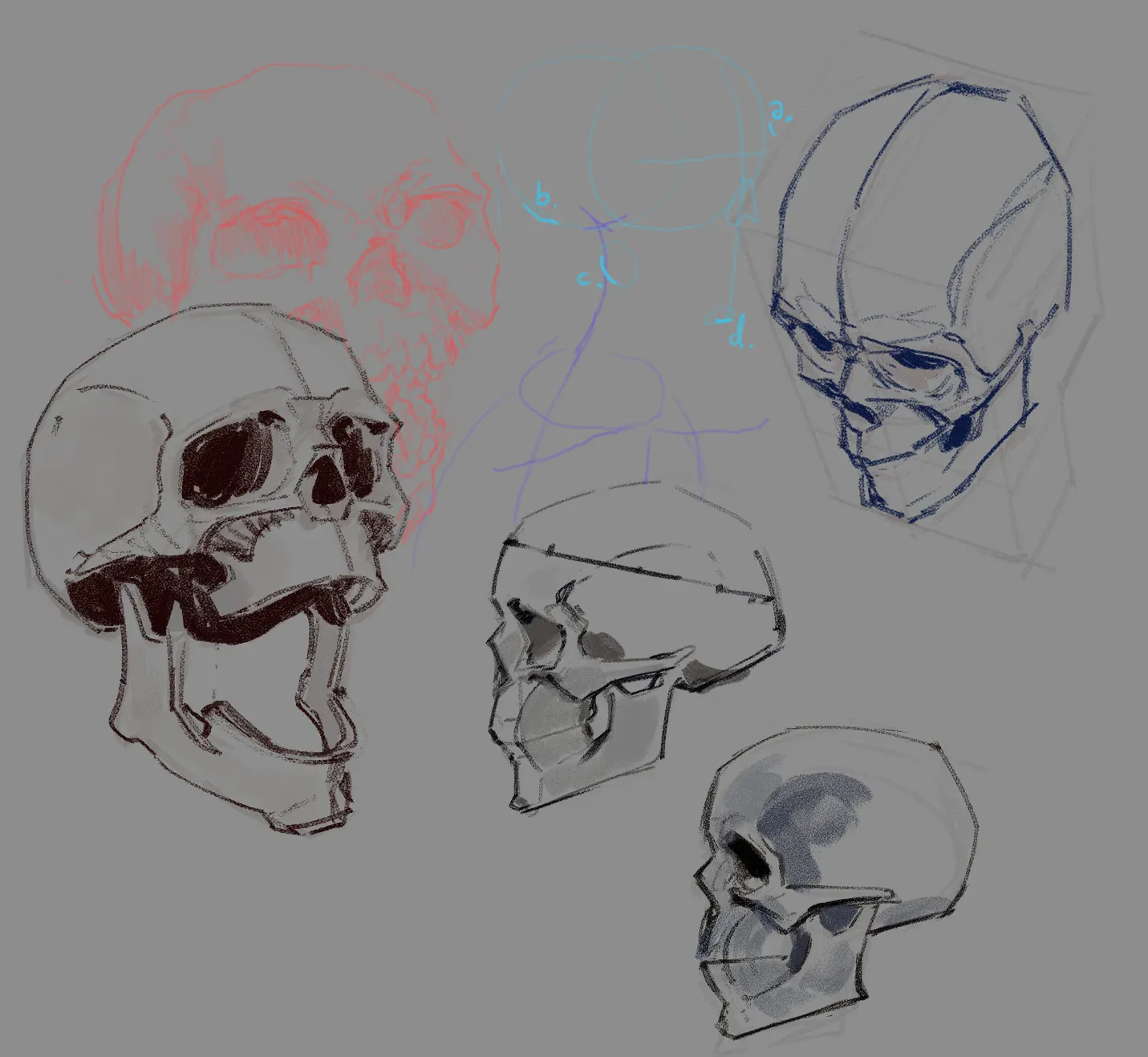
Sometimes there's not much else to add, a skull is a skull. It is worth to respect the subject matter for the greater context, too often I feel like skulls aren't seen as a part of our human head, but as a prop outside of it; not that that can't be pretty Open your teeth as wide as you can and you'll see they go apart not much taller than the height of an eye socket. A skull wide open is only possible outside of the head If you'd like to draw prop skulls, learn the 29 bones, refine their anatomical landmarks, and try showing some teeth. If you'd like to draw heads, move on down to the spine and back up through the whole neck and the skin around it, and show the person for who they are Also just in general skulls have a very great range! you can look up any word with "-cephaly" to see how the dome can have a great variety of shapes, consider muscles and how they add detail by pulling on the bone (the inion and ramus most specifically) and generally try to control the head so it's not just one generic idea of a skull To answer the question, the simplest is to parse through all the anatomical landmarks and see which ones are important and which ones aren't. You do it once, then what's necessary sticks around and ultimately you need just the transform of the skull to complete the head, extrapolating from landmarks You can also try rendering out a prop skull with an arbitrary material of choice, make one of the skulls you've got out of wood, gold, glass - if you'd like to practice rendering as well, skulls are a great subject Cheers, have fun
Paintovers (1)
Skull Practice
Artist's notes:
I'd love to get some feedback on my skull studies! Please point out any mistakes and areas to improve while practicing. Are there also any neat or simpler construction methods for drawing skulls?